Names in Morse Code
Names in morse code are the most personal thing people convert, and the least forgiving. A name is the one string where nobody will accept "close enough" — a dropped dot in an ordinary word is a typo, but in a child's name on a bracelet it is a different name. This page covers how to spell any name correctly, the specific places names go wrong more than other text, what to do about letters Morse has no symbol for, and the thirty-second check that catches every one of these before it becomes permanent.
👀 Preview
Press ▶ Play — this shows what you'll see and hear.
Customize your message
Your picture appears in Play and downloaded videos. Note: it can't be included in a shared link — links carry the message only.
Share as a secret message
The message is hidden inside the link and decodes with sound & light when your friend opens it.
How to spell a name, and why the tool beats the chart
The mechanics are simple: convert each letter, put a letter gap between them, and put a word gap between a first and last name. Case does not exist in Morse, so there is no capital letter to mark the start.
The reason to type it into the translator rather than assemble it from a chart is not laziness. It is that hand-assembly has a specific, repeatable failure: you look up a letter, write it, look up the next, and somewhere around the fifth letter you lose your place and either skip a mark or repeat one. It happens to everyone, it happens silently, and on a name it is expensive.
Worked example — SARAH is ... .- .-. .- ....
Five letters, thirteen marks. Notice the two As. They are identical patterns in different positions, and that repetition is precisely where a hand count goes astray.
The tool also gives you the reverse check for free. Paste the pattern back in and confirm it returns SARAH. That is the whole quality-control process, and it takes seconds.
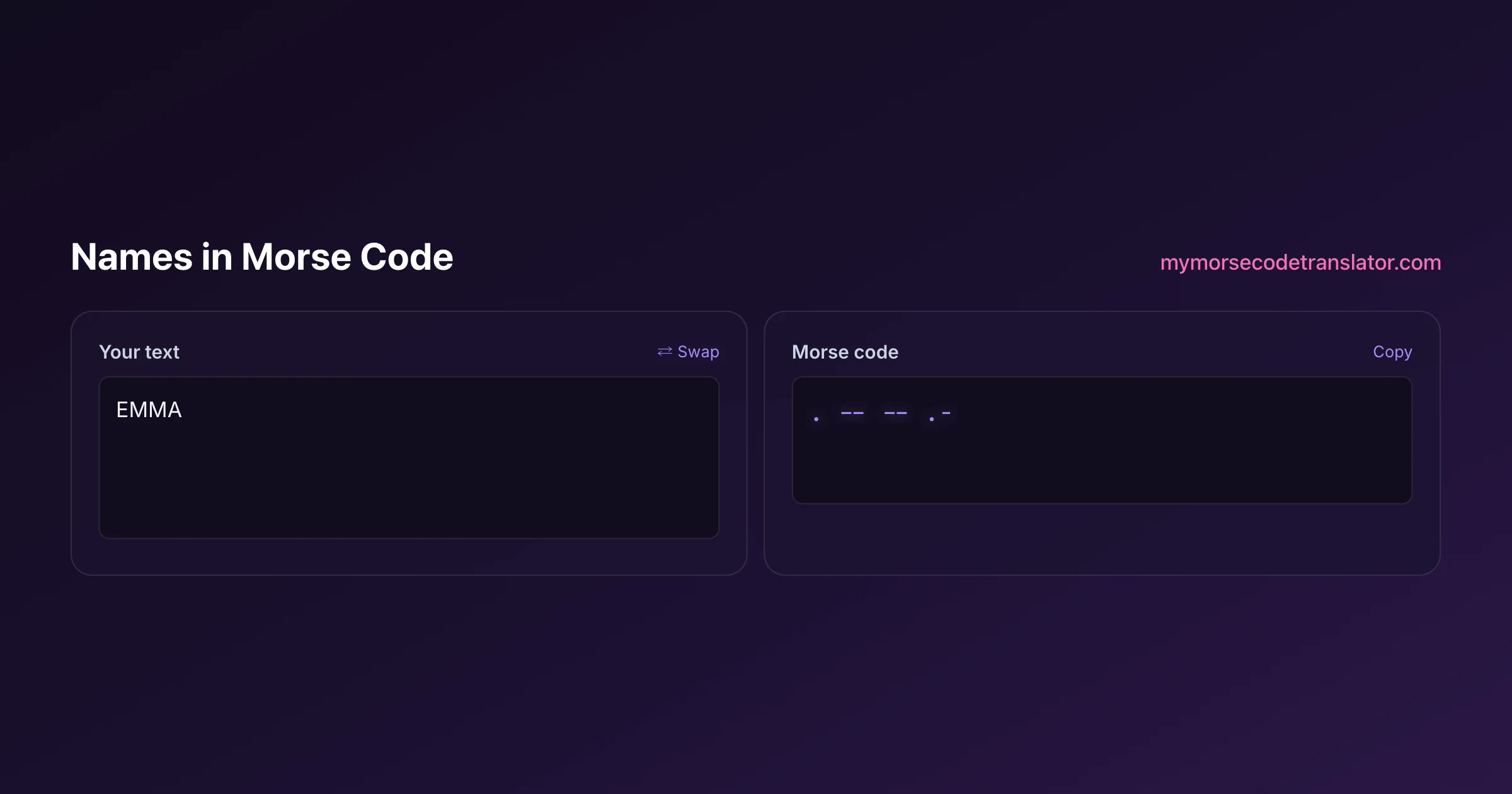
A second worked example, because the doubled-letter case is the one that matters. EMMA is . -- -- .- — E is a single dot, then M and M as two identical pairs of dashes, then A. Written out with the gaps made obvious it is: dot, gap, dash-dash, gap, dash-dash, gap, dot-dash. Four letters, seven marks, and the entire risk sits in the middle where the two Ms must stay visibly separate. Merge them and you get . -- .-, which decodes as EMA — a real name, plausible on a bracelet, and not the one you ordered.
That is the general shape of the problem. Morse errors on names rarely produce obvious gibberish; they produce a shorter name that looks fine. Gibberish would be easier, because somebody would notice.
The four ways names specifically go wrong
Names fail differently from ordinary text, and it is always one of these four.
Double letters vanish. EMMA has two Ms, HANNAH has two Ns and two As, MOLLY has two Ls, AARON has two As. Two identical patterns side by side, separated only by a letter gap, are the easiest thing in Morse to merge into one. This is by far the most common error on names.
Letter gaps collapse. On a bracelet or a tattoo, if the gap between letters is the same width as the gap between marks inside a letter, the letters run together — and the run is then genuinely ambiguous rather than merely hard to read.
Initials merge. J.M. sent as .--- -- reads correctly with a proper gap and becomes an unreadable five-mark run without one. Initials are short enough that people get careless with the spacing.
Accents get dropped silently. José, Zoë, Chloé, Björn — the accented character either has a non-standard Morse pattern or gets quietly replaced by its unaccented form. Decide deliberately which you want rather than letting a tool decide for you.
Accented and non-Latin names
This is where names differ most from ordinary English text, and it deserves a straight answer.
The twenty-six Latin letters are identical worldwide, fixed by the ITU in the international standard. Accented characters are a separate, later addition and they are conventions rather than universals — é is ..-.., ñ is --.--, ö and ø share ---., ü is ..--, å is .--.-.
Two practical consequences.
First, several accented letters share a pattern. ö, ø and ó are all ---., so the same marks mean different letters depending on which language you assume. A decoder cannot resolve that without being told.
Second, most people strip the accent, and that is a legitimate choice. JOSE and JOSÉ are the same name to a reader who knows it. The accented form is more correct; the stripped form is more likely to be read by a stranger. Pick one on purpose.
Names in Cyrillic, Greek, Hebrew, Arabic or Japanese are a bigger question — those scripts have their own Morse mappings that reuse Latin patterns for entirely different characters. The usual approach is to transliterate into Latin letters first. Morse code in other languages covers how those systems work.
Length: the constraint nobody mentions first
Morse is long, and names get long fast.
Rough counts, marks only, before you add the spacers: AVA is 8, EMMA is 12, SARAH is 13, JENNIFER is 25, CHRISTOPHER is 33.
On a beaded bracelet every mark is a bead and every letter gap needs a spacer, so an eight-letter name is already most of an adult wrist. An eleven-letter name is a necklace.
This is why the pieces that actually get worn are short: a single short name, a pair of initials, sometimes one letter. The long version looks fine in a mockup and fails on an actual arm, because the only way to fit it is to squeeze the gaps — and squeezed gaps are exactly what makes a piece unreadable.
If the name is long, change medium rather than spacing. An engraving inside a band, ink where you control the scale, or two lines on a card all hold a long name comfortably. Keep the wearable version short and legible.
There is a full walkthrough of bead counts and spacer placement on morse code bracelet maker.
One more consideration if the name is going on something you will keep for decades: think about how it ages. Beads shift on a cord and the spacing drifts. Ink spreads. Engraving on a ring wears at the contact points first. In each case the thing that degrades is the gap, which is the part carrying the letter boundaries — so a piece that was marginal on day one becomes unreadable rather than merely worn.
The practical hedge is generosity at the design stage. Make the letter gaps larger than the minimum, make the dashes clearly longer than three times the dots rather than exactly three, and resist the temptation to fit one more letter. A short name with generous spacing outlasts a long name squeezed to fit, both physically and in terms of whether anyone can still read it.
The check, and why it is not optional
Everything above reduces to one habit.
Take the exact dots and dashes from your final layout, paste them into the decoder, and confirm the name that comes back is the name you meant.
Not read forwards against a chart — forwards you see what you expect. Backwards you see what is actually there.
Run it specifically when the pattern came from a seller, when you assembled it by hand, when someone else laid it out, or when it is about to become permanent. Those four cases account for essentially every error I have seen.
And if you are buying rather than making: ask the seller for the exact pattern rather than trusting the photograph, and decode it yourself before ordering. Listings on Etsy and similar marketplaces are photographed at angles that flatter the spacing, and a seller who cannot produce the dots and dashes usually did not work from them. Thirty seconds beforehand, or a remake afterwards.
Every name I have been asked to check that turned out wrong was wrong in the same place: a doubled letter. Two Ms in EMMA, two Ns in HANNAH. The maker counted the beads correctly and merged the pair, which produces a shorter name that still looks plausible — which is exactly why nobody catches it by reading forwards.
Frequently Asked Questions
Q. How do I write a name in morse code?
Convert each letter, put a letter gap between them, and a longer word gap between first and last names. Type it into the translator rather than assembling from a chart — hand-assembly loses count around the fifth letter, silently.
Q. What is the most common mistake with names?
Double letters. EMMA, HANNAH, MOLLY and AARON all contain two identical patterns side by side, and merging them into one is the single most frequent error. The result is a real but different name, which is why it slips through.
Q. How do I handle an accented letter in a name?
Either use the accented pattern — é is ..-.., ñ is --.--, ö is ---. — or strip the accent and use the plain letter. Stripping is common and legitimate; just decide deliberately rather than letting a tool choose silently.
Q. Is there a capital letter in morse code?
No. Case does not exist in the code, so there is nothing to mark the start of a name. A name and the same letters in lower case produce an identical pattern.
Q. How long is a name in morse code?
Longer than people expect. AVA is 8 marks, EMMA 12, SARAH 13, JENNIFER 25, CHRISTOPHER 33 — before the spacers. An eight-letter name already fills most of an adult wrist once letter gaps are added.
Q. How do I write initials?
As two letters with a clear gap between them. J.M. is .--- --, and without a visible gap it collapses into one unreadable five-mark run. Initials are short enough that spacing gets neglected.
Q. Can I put a name in a non-Latin script into morse code?
Not directly. Cyrillic, Greek, Hebrew, Arabic and Japanese have their own Morse mappings that reuse Latin patterns for different characters, so a Latin decoder reads them as gibberish. Transliterate into Latin letters first.
Q. What if two names produce the same pattern?
They will not, provided the letter gaps are correct. Ambiguity comes from missing gaps, not from the letters — which is precisely why the spacing matters as much as the marks on anything physical.
Q. How do I check a bracelet spells the right name?
Photograph it flat, straight on, on a contrasting background, and read it with the picture translator — or transcribe the beads by eye and paste the marks into the decoder. Either way you are verifying backwards rather than forwards.
Q. Should a name include a space between first and last?
Yes, and make it clearly longer than the letter gaps — seven units against three. On a physical piece that means a visibly larger spacer, otherwise the two names read as one long run.
Q. Can I put a name on a tattoo?
Yes, with the usual precautions: hand the artist the pattern rather than the word, specify the spacing visually at final size, and ask for a dash that is generously long relative to the dot, because ink spreads over the years.
Q. What about a pet's name or a nickname?
Identical process — Morse has no concept of what a word means. Short pet names are among the best candidates for jewellery precisely because they fit comfortably and stay readable.
Related guides
← Back to the My Morse Code Translator home page.

By Sukie
Sukie is the creator of My Morse Code Translator — a puzzle nerd and gadget tinkerer who fell down the Morse code rabbit hole and decided to build the most fun Morse translator on the web. When she's not adding new sound packs or reveal animations, she's decoding hidden messages in songs or designing Morse code bracelets for friends.
Last updated: 2026-10-21