Roblox Morse Code: Signal Past the Chat Filter and Crack In-Game Puzzles
Roblox morse code has quietly become one of the game's cleverest player tricks: because the chat filter blocks so much, players started sending messages with their bodies instead — a jump for a dot, a sidestep for a dash — spelling words in movement that no filter can catch. On top of that, a huge number of Roblox horror and puzzle games hide Morse clues in flickering lights and beeping radios. This guide covers both sides: signalling in Morse yourself, and decoding the Morse a game throws at you. Paste anything into the translator and you're ready.
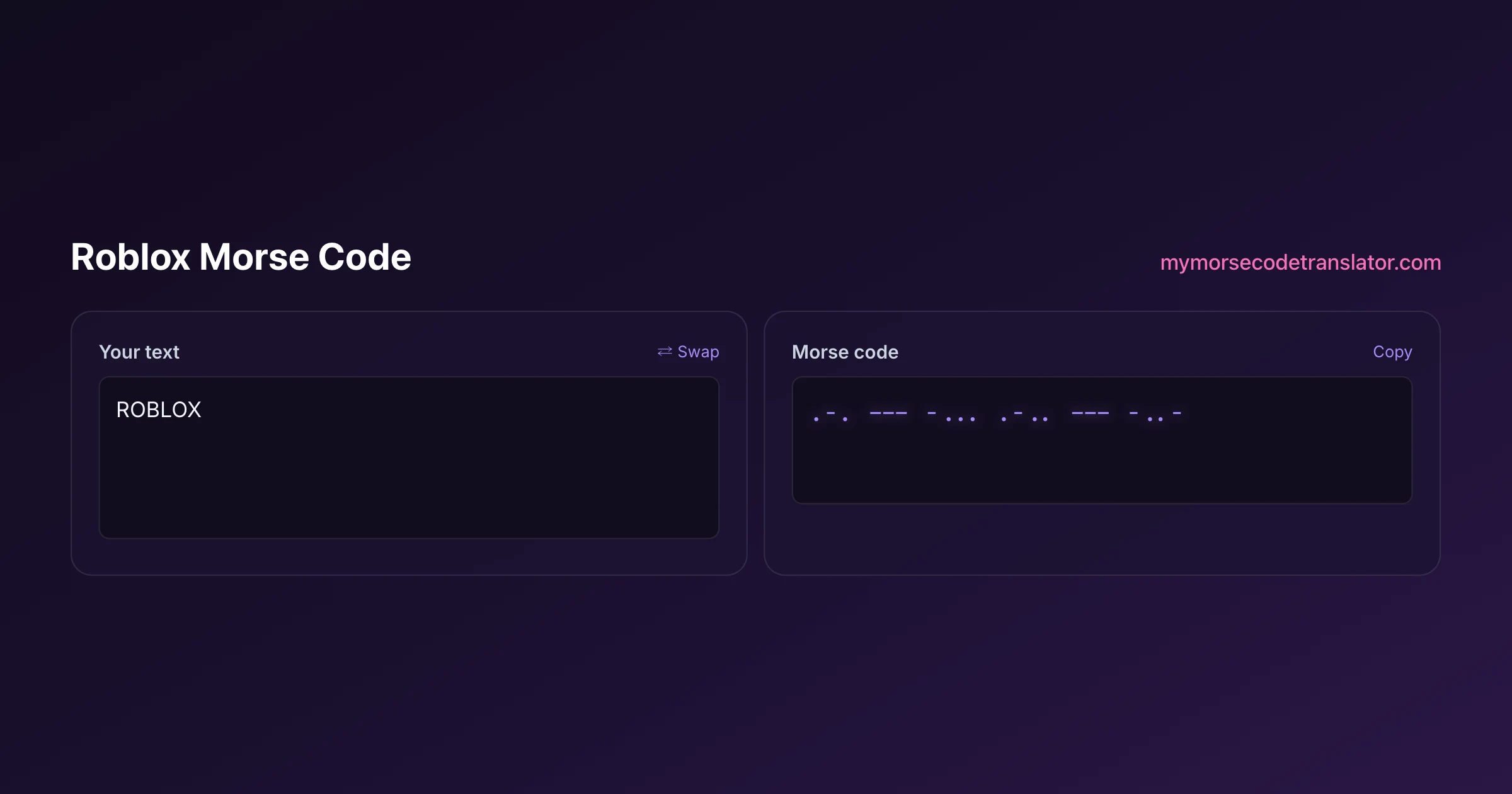
👀 Preview
Press ▶ Play — this shows what you'll see and hear.
Customize your message
Your picture appears in Play and downloaded videos. Note: it can't be included in a shared link — links carry the message only.
Share as a secret message
The message is hidden inside the link and decodes with sound & light when your friend opens it.
Why players turned to Morse in the first place
Roblox has a strict chat filter, especially on accounts set to under-13, where a lot of ordinary words and nearly all numbers get hashtagged out. That's there for good reasons — child safety is the priority — but it also means players sometimes can't say simple, harmless things to a friend across the map.
Morse is the community's workaround. It's a language of movement and light, not text, so the filter has nothing to grab. A player who wants to send "RUN" doesn't type it; they act it out. It's the same instinct that made real prisoners tap code on pipes and soldiers blink it with signal lamps — when your normal channel is blocked, you fall back to rhythm. Watching a Roblox lobby where two players are clearly signalling each other in little hops is genuinely charming, and it's a small piece of proof that a 180-year-old code still solves modern problems.
The jump-and-move signalling method
The most common player convention maps Morse onto your avatar's movement. The exact mapping is a community agreement, not an official feature, but the widespread version is:
- Jump = dot (a quick, short action)
- Sidestep or a longer move = dash (a longer action)
- Pause standing still = the gap between letters
- A longer pause = the gap between words
So to send the letter A (dot-dash), you'd jump once, then step to the side. For SOS — three dots, three dashes, three dots — you'd jump three times, make three sidesteps, then three more jumps. Both players have to agree on the mapping beforehand, because there's no universal standard for "which movement is a dot." Some groups use crouch for dot and jump for dash; others use emotes. Agree on your code first, then signal — otherwise you're both just hopping at each other confused.
A gentler, safer signalling variant
Movement Morse is slow and easy to misread, so many players use light or sound instead when a game gives them the tools.
If a game has a flashlight, a lantern, or any toggleable light, you can flash Morse the classic way — short flash for a dot, long flash for a dash. Games with musical instruments or a horn let you beep it. Some builders even wire up blinking lights in their own Roblox creations specifically so visitors can leave Morse messages. Whatever channel you use, the underlying code is identical to real-world Morse: the letters, numbers, and timing all follow the same international standard, so the translator on this page produces exactly the dots and dashes you'll signal. Learn the code once and it works whether you're hopping, flashing a lantern, or tapping a Roblox piano.
Decoding Morse that games throw at you
The other half of Roblox Morse is puzzle-solving, and this is where the translator really earns its keep.
Horror and mystery games love Morse clues because they're atmospheric and genuinely challenging. A radio crackles a rhythm; a light in a distant window blinks; a phone buzzes a pattern. These almost always spell a code word, a door PIN, or a hint. The trick to solving them is patient transcription: watch or listen carefully and write down each element as a dot or dash, mark the gaps as letter breaks, then feed the whole string into our morse code to English translator or decoder. Games rarely invent their own Morse — they use the real standard — so a correct transcription decodes to a real answer. If your decode comes out as gibberish, you almost certainly missed a gap or mistimed a dash, so re-watch and try again.
Common games and where Morse shows up
You'll run into Roblox Morse most often in a few genres:
- Horror and escape games: flickering lights and static-filled radios spelling the combination to escape.
- Mystery and detective games: a hidden Morse clue pointing to the culprit or a secret room.
- Puzzle and ARG-style experiences: layered ciphers where Morse is one step among many.
- Military and roleplay servers: players signalling tactically without tipping off the enemy team in chat.
- Community meetups: friends chatting in movement-Morse just for the novelty of it.
Because the format is always standard Morse, the same decoding workflow solves all of them: transcribe carefully, mind the gaps, and run it through the translator. Keep a second tab open with the decoder while you play and you'll crack clues that stump players hammering random numbers into the keypad.
Reading numbers, PINs, and codes
A lot of Roblox Morse puzzles spell out a number — a keypad PIN, a locker combination, a door code — so it pays to recognize the number patterns.
Every Morse digit is exactly five elements long, which actually makes numbers easier to spot in a puzzle: if you see clean groups of five, you're probably reading digits, not letters. The digit 1 is one dot then four dashes; 5 is five dots; 0 is five dashes; and the rest follow a mirrored pattern in between. So a blinking light that flashes five even groups is very likely a five-digit code. When you suspect a puzzle is numeric, our number translator decodes the digits directly. And remember the chat-filter angle here too: because Roblox filters numbers hard, movement-Morse is often how players share a code they found without the filter blanking it out.
Tips for signalling that your friend can actually read
Movement Morse fails more often from sloppy sending than from bad decoding, so a few habits help enormously.
Go slow. A clear, slow dot-dash beats a fast blur every time; your friend can't rewind you. Exaggerate the difference between your dot action and your dash action — if a jump and a sidestep look too similar at a distance, pick more distinct moves. Pause deliberately between letters, and pause longer between words; those gaps are the grammar, and skipping them turns "SO" into an unreadable run. Start with short, real words so your friend gets an early success and stays patient. And agree on your dot/dash mapping and a "start" and "repeat" signal before you begin — a quick spin to mean "I'm about to send" and another to mean "say that again" saves a lot of confused hopping.
Is signalling in Morse against the rules?
Worth addressing directly, because kids and parents ask: using Morse to communicate in Roblox isn't a hack or an exploit. You're not modifying the game or breaking anything — you're jumping and moving, which every avatar can do.
That said, the chat filter exists to keep younger players safe, and Roblox's community standards still apply to whatever you spell out. Signalling "let's team up" or a puzzle answer to a friend is harmless fun and a neat skill. Using Morse to sneak past the filter to say something that would break the rules if typed plainly is still breaking the rules — the code doesn't launder the content. So have fun with it as the clever, wholesome puzzle-language it is, and keep whatever you signal within the same standards you'd follow in chat. Used that way, Roblox Morse is exactly the kind of creative problem-solving that makes the community great.
Using the translator alongside your game
The fastest workflow is to play with this page open in a second tab or on your phone.
When you want to send something, type it into the English-to-Morse translator, and it spells out the dots and dashes for you to signal — jump for the dots, step for the dashes. When a game blinks or beeps a clue at you, transcribe it, paste the dots and dashes into the decoder, and read the answer. You don't need to memorize the whole alphabet to start; the translator is your reference sheet, and the more you use it, the more letters you'll just know. Plenty of players tell me they came for a single puzzle answer and stayed because signalling in movement-Morse turned out to be more fun than the game they were stuck on.
If you want to get faster, learn the handful of highest-value letters first: E (one dot), T (one dash), and the SOS pattern cover a surprising number of quick signals. A few common code words in horror games — "RUN," "HELP," "KEY," "DOOR" — are worth memorizing outright so you can both send and recognize them without breaking stride. Keep the translator open for everything else, and treat each puzzle as a free Morse lesson: the code you decode to escape a game is the same code that turns out to be useful the next time a friend is stranded across the map with a filtered chat box.
The code itself follows the international standard published by the ITU (ITU-R M.1677), so the dots and dashes you tap out in Roblox are the genuine article.
I got genuinely stuck on a flashing-light puzzle in a Roblox horror game for twenty minutes because I kept reading one long flash as two dashes. Once I slowed down and transcribed a single long flash as one dash, the string decoded to a four-letter door code on the first try. Patience with the gaps is the whole skill.
Frequently Asked Questions
Q. How do players send Morse code in Roblox?
The common method maps Morse onto movement: a jump is a dot, a sidestep or longer move is a dash, a short pause separates letters, and a longer pause separates words. Both players agree on the mapping first, then one signals by hopping and stepping out the code. Games with lights or instruments let you flash or beep it instead.
Q. Why do people use Morse instead of just typing?
Roblox's chat filter blocks many words and nearly all numbers, especially on younger accounts. Morse is a language of movement and light rather than text, so the filter has nothing to catch. It's the same instinct that made prisoners tap code on pipes — when the normal channel is blocked, players fall back to rhythm.
Q. How do I decode a Morse puzzle in a Roblox horror game?
Transcribe it patiently: watch or listen and write each element as a dot or dash, mark the gaps as letter breaks, then paste the whole string into our decoder. Games use real standard Morse, so a correct transcription decodes to a real answer. Gibberish means you missed a gap — re-watch and try again.
Q. Is using Morse code against Roblox rules?
No — jumping and moving your avatar isn't a hack or exploit, so signalling in Morse is allowed. But the community standards still apply to what you spell. Using Morse to sneak rule-breaking content past the filter is still against the rules; the code doesn't make banned content okay.
Q. How do I signal a number if the chat blocks numbers?
Movement Morse is exactly how players share numbers the filter would block. Each Morse digit is five elements long — 1 is one dot and four dashes, 5 is five dots, 0 is five dashes — so signal the pattern out. Our number translator gives you the exact dots and dashes for any code or PIN.
Q. What's the best way to make my movement-Morse readable?
Go slow, exaggerate the difference between your dot action and dash action, and pause clearly between letters and longer between words — those gaps are the grammar. Start with short real words, and agree on a 'start' and 'repeat' signal with your friend before you begin.
Related guides
← Back to the My Morse Code Translator home page.

By Sukie
Sukie is the creator of My Morse Code Translator — a puzzle nerd and gadget tinkerer who fell down the Morse code rabbit hole and decided to build the most fun Morse translator on the web. When she's not adding new sound packs or reveal animations, she's decoding hidden messages in songs or designing Morse code bracelets for friends.
Last updated: 2026-07-08