Morse Code Tattoo Generator: Design and Verify Before You Ink
Morse code tattoo generator tools exist for one reason above all: to stop the horror stories. There's a photograph that circulates in tattoo forums of someone whose Morse tattoo, translated, spells absolute gibberish — one dot in the wrong place and "HOPE" became nonsense forever. This tool turns your word into dots and dashes, and just as importantly, it decodes the result back into plain English so you can confirm the meaning is exactly right before a needle ever touches skin. Type your word below and check it twice.
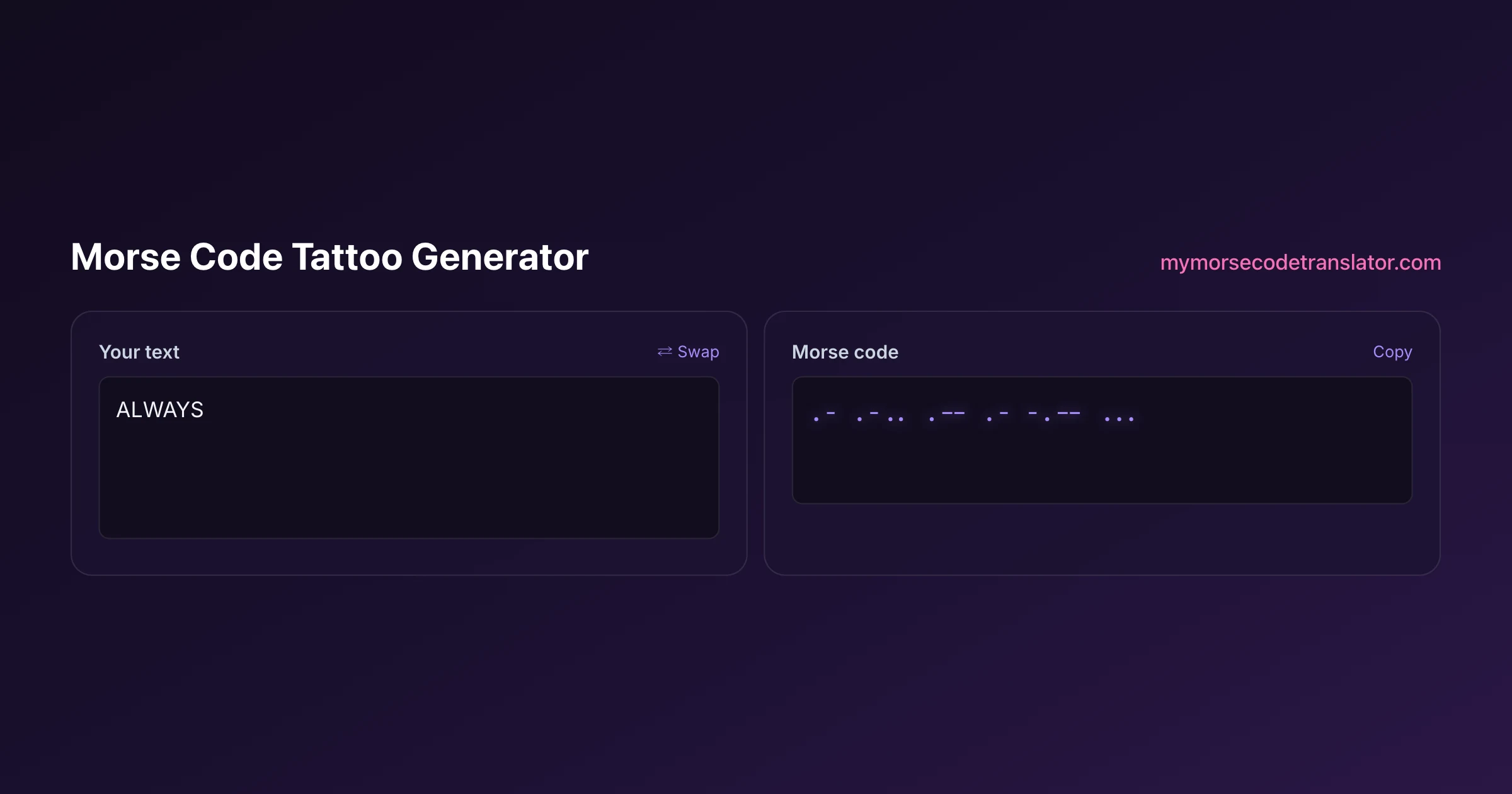
👀 Preview
Press ▶ Play — this shows what you'll see and hear.
Customize your message
Your picture appears in Play and downloaded videos. Note: it can't be included in a shared link — links carry the message only.
Share as a secret message
The message is hidden inside the link and decodes with sound & light when your friend opens it.
Why one misplaced dot is a permanent problem
Morse is unforgiving in a way most tattoo scripts aren't. If a calligrapher makes a letter slightly wonky, it's still readable. If a Morse tattoo has one extra dot, one missing dash, or a gap in the wrong spot, it doesn't just look off — it spells a different word, or nothing at all.
Consider how close some letters are. The letter E is a single dot. The letter I is two dots. S is three dots. H is four dots. So a run of dots with the spacing even slightly wrong can turn "HI" into "SE" or "EEEE." The letter A is dot-dash; N is dash-dot — the same two elements in the opposite order, meaning completely different letters. On skin, forever, that reversal is a disaster you can't Ctrl-Z. This is exactly why verification, not just generation, is the feature that matters.
The decode-back check that saves you
The single most useful thing this tool does is close the loop.
Most "generators" only go one direction: word in, dots and dashes out. But you have no way to know the output is right unless you can read Morse yourself. So this tool runs the round trip. It encodes your word, then immediately decodes that Morse back into English and shows you the result. If you type "STRENGTH" and the decode-back reads "STRENGTH," you're safe. If it reads anything else, you caught the problem on a screen instead of on your forearm. Before you take a design to an artist, I'd run the exact final string through the decoder one more time — our morse code to English translator does the same check independently, and two confirmations beats one.
Design choices: dots, dashes, and how they look on skin
Once your code is verified, there's a real aesthetic decision about how to render it.
The most common Morse tattoo style is a row of filled circles and lines — a small dot for each dot, a longer bar or dash for each dash — often running along a forearm, a collarbone, or a finger. Some people space the whole word evenly and rely on the reader knowing the letter breaks; purists insist on visibly wider gaps between letters so the code is genuinely readable. Others get creative: dots as tiny hearts, dashes as small bars, or the code arranged in a circle. Whatever the style, keep the length difference between dots and dashes obvious. If a dot and a dash look nearly identical, your beautiful, correct code becomes unreadable — accurate but illegible.
What people choose to permanently wear
Morse tattoos are popular precisely because they hide meaning in something that looks like minimalist line art. Common choices:
- A single word: "breathe," "brave," "hope," "family," a name.
- A meaningful date rendered in Morse numbers — a birth, a loss, a milestone.
- Coordinates or initials tying two people together, matching tattoos that only they can read.
- A short phrase from someone who has passed, in their memory.
- A private motto the wearer doesn't want the whole world to read at a glance.
The appeal is the secret. A Morse tattoo says something specific to the wearer while reading as abstract dots and dashes to everyone else — which is also exactly why getting it right matters so much. A memorial tattoo that accidentally spells the wrong thing is heartbreaking in a way a trendy design never could be.
There's also a practical honesty to consider: because Morse is a real, decodable standard, a Morse tattoo is not truly private. Anyone who knows the code, or who photographs your arm and runs it through a translator, can read it. That's usually fine — most people choose words they'd happily explain — but if you're encoding something you'd never want decoded, understand that "nobody can read this" is a comforting myth. The code hides your message from a casual glance, not from a curious stranger with a phone. Pick a word you're at peace with being readable, and the secret-in-plain-sight charm works entirely in your favor.
Take these to your tattoo artist, not just the word
Your artist is an expert with a needle, not necessarily with Morse — so don't hand them a word and hope.
Bring the finished dots-and-dashes string, clearly drawn, with the letter gaps marked. Tell them explicitly which marks are dots and which are dashes, and how much space goes between letters versus between words, because that spacing is meaning, not styling. It helps to print the verified code at the size you want it and mark the breaks in a second color. A good artist will appreciate the precision; the horror stories almost always come from an artist guessing at spacing, or freehand-adding a dot to "balance" the composition. Confirm the stencil against your decoded string one final time before they start.
A quick note on numbers and standards
If you're inking a date, know that Morse numbers each run exactly five elements long, following the same international standard (ITU-R M.1677) that governs the letters.
The digit 1 is one dot and four dashes; 5 is five dots; 0 is five dashes; and the digits in between follow a tidy mirrored pattern. Because every digit is the same length, a date tattoo has a pleasing, even rhythm — but it also means a single missing dash silently turns one number into another. Run any date through our number translator, then decode it back, and you've verified it with the same round-trip safety as a word. Numbers feel simpler than words, but they're just as unforgiving, and "2019" one dot short is a different year on your skin forever.
The couple-tattoo trap nobody warns you about
Matching Morse tattoos are romantic and popular — two people wearing the same coded word, or halves of a phrase. But they hide a subtle danger that ruins more of them than any spacing error.
If two artists ink the "same" code on two different arms on two different days, tiny differences in dot size, dash length, and gap spacing creep in — and now your matching tattoos don't quite match. Worse, if one artist reads the design slightly differently, one of you can end up with a correctly spelled word and the other with a subtly wrong one. The fix is to finalize one single verified design, print it at the exact size, and have both people bring the identical printout so both stencils come from the same source. Decode-back-check the string once, together, before either appointment. Two people, one verified design, is the rule that keeps couple tattoos from becoming a cautionary tale.
The same logic applies to a tattoo you want to match an existing piece of Morse jewelry — bring the bracelet or necklace to the shop and confirm the code matches the metal before anyone inks.
Placement, size, and how the code ages
Once the meaning is locked, the practical question is where it goes and how big — and Morse has a specific quirk here that ordinary text tattoos don't.
Because the whole message is dots and dashes, shrinking it too small is dangerous: skin blurs ink over the years, and if your dots are tiny and close, a decade of healing can merge two dots into what looks like a dash. A word tattoo just gets a little soft; a Morse tattoo can literally change letters as it ages. So err larger than you think you need, keep generous gaps, and talk to your artist about how the specific ink and placement will spread over time. Areas with less friction and stretch — the forearm, the ribs, the collarbone — hold fine detail better than fingers or feet, where Morse dots are most likely to blur together.
If you love the idea of a finger or wrist micro-tattoo, consider spelling a very short word — even a single letter or two — so each element has room to stay distinct. A crisp three-element "E-T" ages far better than a cramped eight-letter word squeezed onto a knuckle.
Questions to ask before the needle touches you
Run through this list once, out loud, with the design in front of you. Every item on it comes from a mistake somebody actually made.
Have you decoded it backwards? Not read it forwards against the chart — pasted the exact dots and dashes from the final artwork into a decoder and confirmed the text that came back. Reading forwards means you see what you expect to see.
Does the artist have the pattern, or just the word? If you hand over a word and let them lay it out, you have delegated the spacing decisions to someone who may not know that letter gaps must be visibly wider than the gaps inside a letter. Give them the marks.
Is the spacing convention written down? "Three units between letters, seven between words" means nothing on skin. Specify it visually: this much space between letters, this much between words, and show it at actual size.
Have you seen it at final size? A pattern that reads cleanly at 20cm on a screen can close up at 6cm on a wrist. Print it at the real dimensions and look at it on the actual body part.
Does it still read if the marks blur slightly? Tattoos spread over years. If a dot and a dash are only just distinguishable on day one, they will not be at year ten. Ask for the dash to be generously long relative to the dot.
Is anyone else's name in it? Not a technical question, but the one most likely to be regretted. Morse does not make a name any less permanent — it just delays the moment somebody asks what it says.
A friend asked me to check her planned forearm tattoo before her appointment. She'd hand-copied the Morse for "FEARLESS" from a random image and dropped a dot — decoded back, it read "FEARLDSS." We caught it the night before. That near-miss is the entire reason I made decode-back the headline feature here.
Frequently Asked Questions
Q. How does the decode-back verification work?
The tool encodes your word into Morse, then immediately decodes that Morse back into English and shows you the result. If the decoded text matches what you typed, your code is correct. If it doesn't, you've caught the mistake on a screen instead of on your skin.
Q. Why is accuracy so critical for a Morse tattoo?
Morse is unforgiving. One extra dot, a missing dash, or wrong spacing spells a different letter or word entirely — and a tattoo is permanent. A is dot-dash while N is dash-dot, so even a reversed pair changes the meaning. Always verify before you ink.
Q. Should letter gaps be visible in the tattoo?
Ideally, yes. Visibly wider gaps between letters make the code genuinely readable and prevent runs of dots from blurring together. In Morse, spacing is meaning, not decoration, so mark the letter and word breaks clearly on your design.
Q. Can I tattoo a date in Morse?
Yes. Each digit is exactly five elements long, giving a date a clean, even rhythm. Use our number translator to get the pattern, then decode it back to confirm the year is exactly right — a single missing dash turns one number into another.
Q. What should I bring to my tattoo artist?
Bring the finished, verified dots-and-dashes string clearly drawn, with letter gaps marked, and tell them which marks are dots and which are dashes. Don't just hand over the word — your artist knows needles, not necessarily Morse, so give them the exact code and spacing.
Q. How do I make dots and dashes look different enough?
Keep the length difference obvious — a small filled circle for a dot, a clearly longer bar for a dash. If they look nearly identical, the code becomes unreadable even though it's technically correct. Legibility comes from contrast in size.
Q. Is it worth double-checking with a second tool?
Yes. Before finalizing, run your exact code string through our morse code to English translator as an independent second check. Two confirmations from two directions is cheap insurance against a permanent mistake.
Q. What are the most common Morse tattoo messages?
Single meaningful words like "breathe," "brave," or a name; significant dates; coordinates or initials for matching couple tattoos; and memorial phrases. The appeal is a private meaning hidden inside what looks like minimalist dot-and-line art.
Related guides
← Back to the My Morse Code Translator home page.

By Sukie
Sukie is the creator of My Morse Code Translator — a puzzle nerd and gadget tinkerer who fell down the Morse code rabbit hole and decided to build the most fun Morse translator on the web. When she's not adding new sound packs or reveal animations, she's decoding hidden messages in songs or designing Morse code bracelets for friends.
Last updated: 2026-07-08