Morse Code Numbers 0–9 and the Pattern Behind Them
Morse code numbers have a secret that the letters don't: every single digit from 0 to 9 is built from exactly five elements — five dots and dashes, no more, no less. That one fact makes the digits far easier to learn than the alphabet, because once you spot the underlying pattern you can reconstruct any number without memorizing ten separate codes. This page lays out the full chart, then walks through the genuinely elegant logic that ties all ten together and shows you where the numbers actually get used.
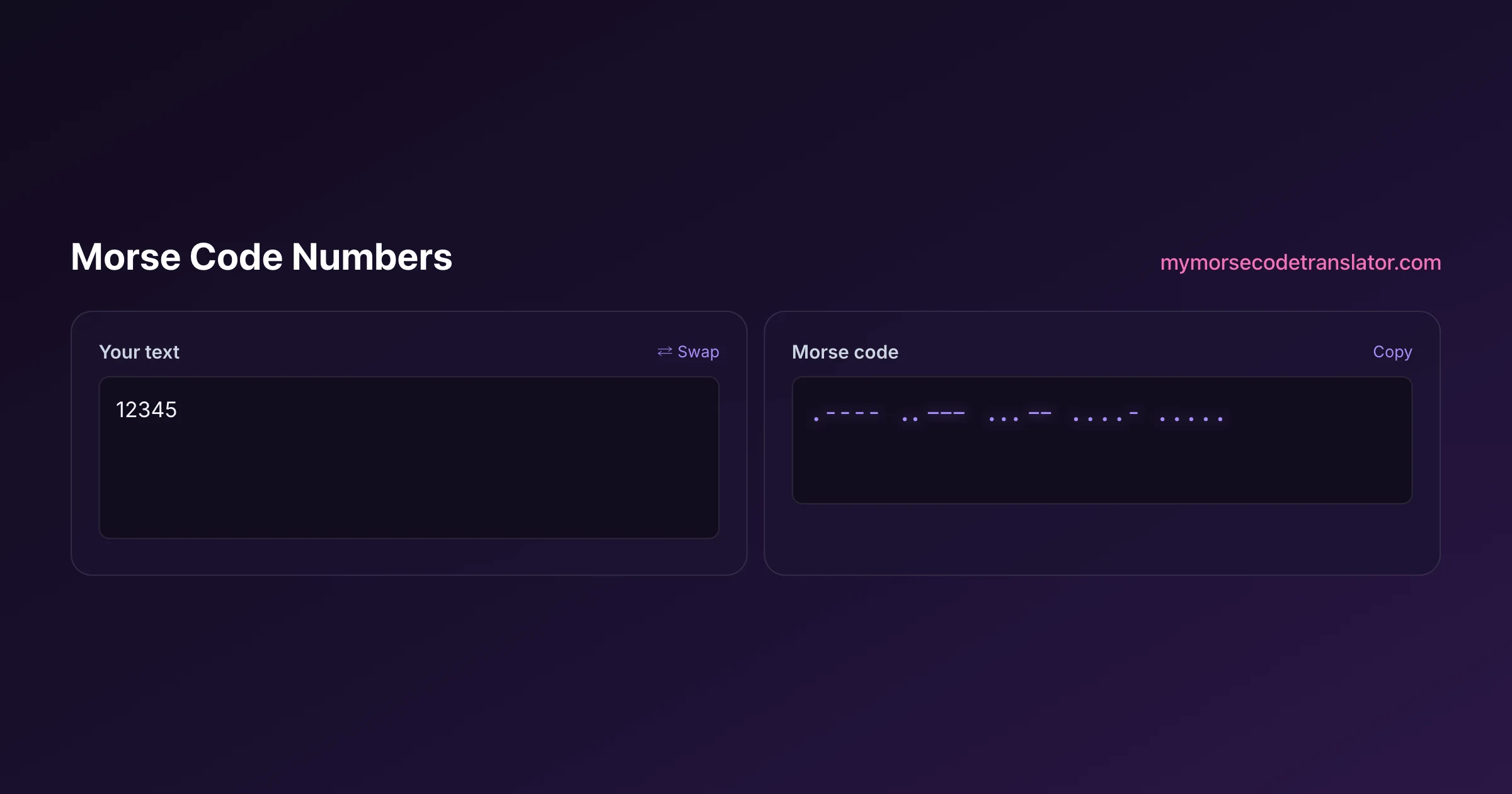
The 0–9 chart
Here are all ten digits. Read each line as "number: pattern," where a dot (·) is short and a dash (–) is long.
- 1: .----
- 2: ..---
- 3: ...--
- 4: ....-
- 5: .....
- 6: -....
- 7: --...
- 8: ---..
- 9: ----.
- 0: -----
Stack them like that and the shape jumps straight off the page: the dots march from left to right as the numbers climb from 1 to 5, then the dashes take over and grow from 6 up to 0. Nobody has to brute-force ten unrelated codes — the whole set is one continuous idea.
It helps to picture the ten digits as a single sliding scale. Start at 1, which is almost all dashes with a single dot leading the way. As you count upward, one dash at a time turns into a dot, until you reach 5 in the middle, which is pure dots. Keep going and the process reverses: dots turn back into dashes one at a time, sweeping through 6, 7, 8, and 9 until you land on 0, which is pure dashes again. Seen that way, the digits aren't ten things to memorize at all — they're a single wave rolling from one extreme to the other and back.
The mirror pattern that unlocks all ten
The design is genuinely clever, and it's worth slowing down to appreciate. For the digits 1 through 5, the count of leading dots equals the digit, and dashes simply fill the rest of the five slots:
- 1 = one dot, four dashes (.----)
- 2 = two dots, three dashes (..---)
- 3 = three dots, two dashes (...--)
- 4 = four dots, one dash (....-)
- 5 = five dots, zero dashes (.....)
Then the second half mirrors it perfectly, with dashes leading instead of dots. For 6 through 0, the pattern flips: 6 starts with one dash then four dots, and each higher number swaps one more dot for a leading dash until you reach 0, which is five dashes.
- 6 = one dash, four dots (-....)
- 7 = two dashes, three dots (--...)
- 8 = three dashes, two dots (---..)
- 9 = four dashes, one dot (----.)
- 0 = five dashes (-----)
So you never memorize ten codes. You memorize one rule: five slots, dots leading for 1–5, dashes leading for 6–0, and the count of leading symbols (or that count minus five, for the second half) tells you the digit. Five and zero are the two anchors — all dots and all dashes — and everything in between shifts one symbol at a time.
Why five elements, and why it's slower than letters
The letters use variable lengths so common letters send faster — E is one dot, T is one dash. The digits deliberately go the opposite way: every number is a full five elements, no shortcuts. The reason is clarity. When a telegraph operator or a ham radio station is sending a callsign, a frequency, a grid reference, or a signal report, a misread digit can be genuinely costly. Making every number a uniform five-element block means the digits stand out sharply from the shorter, ragged letters around them, so they're much harder to confuse.
The tradeoff is speed: a number takes longer to key than any single letter, and a long string of numbers feels slow to send. That's exactly why some operators use informal "cut numbers" in casual traffic — for example sending T for zero or N for nine — to shave off time. But those are unofficial shortcuts born of practicality, not part of the standard, and you'd never use them where accuracy truly matters.
The official standard behind the digits
These ten patterns are part of ITU International Morse Code, the globally standardized version defined in the International Telecommunication Union's ITU-R M.1677 recommendation. The same digit codes appear in every serious reference, from the ARRL's amateur radio study material to Wikipedia's Morse code article, so what you see above is not a regional quirk — it's the worldwide standard.
Because of that universality, the pattern for 7 (--...) is identical whether it's punched into a radio contest log in Ohio, flashed by a signal lamp between two ships, or beaded onto a bracelet in Melbourne. That consistency is the entire point of a standard: a number you encode here can be read correctly by anyone who knows Morse, anywhere in the world, with no ambiguity.
Where you'll actually use the numbers
You reach for the digits more often than you'd expect once you're using Morse for anything real. A few of the most common places:
- Ham radio callsigns and signal reports almost always contain numbers, so anyone getting on the air needs them cold.
- Meaningful dates on jewelry and tattoos — an anniversary, a birth year, a wedding date — are pure digits, and they're one of the most popular reasons people encode numbers at all.
- Coordinates, grid squares, and radio frequencies are all numeric.
- Puzzle hunts, escape rooms, and geocaching clues frequently hide a combination or coordinate in Morse numbers.
Because the digits are so regular, most people find them easier to send accurately than letters, even fairly early on. If you're encoding a date for a keepsake, remember that each digit is five elements and needs a clear three-unit gap from the next digit — the number translator on this site spaces those five-element groups correctly so the recipient can decode the date cleanly instead of running the digits together.
Sending and hearing numbers cleanly
Numbers reward you for slowing down. Because each digit is five elements long, a string of numbers is a marathon compared with the sprint of a short letter, and it's easy for a sender to get sloppy and for a listener to lose count halfway through.
When you send numbers by hand or with a key, keep the internal rhythm even — the temptation is to rush the middle of a five-element digit, which smears a 3 (...--) into something that sounds like a 4 (....-). When you copy numbers by ear, lean on the pattern rather than counting every dot: if a digit opens with dots it's somewhere in 1 to 5, and if it opens with dashes it's in 6 to 0, so you already know half the answer before the digit even finishes. Then it's just a matter of how many of the leading symbol you heard. Skilled operators use exactly this shortcut, which is why numbers feel awkward for about a week and then suddenly become the easiest thing you copy.
One more practical tip: when a message mixes letters and numbers, the uniform five-element length of the digits actually helps you. A sudden run of long, regular five-element groups is your ear's cue that you've left the words behind and hit a callsign, a frequency, or a date.
A little history behind the digits
The number patterns weren't an afterthought bolted on later — they were part of shaping International Morse Code into a clean, teachable system in the 19th century, as the original American Morse gave way to the Continental version that the world now uses. Where the letter assignments were driven by frequency (common letters got short codes), the designers took the opposite approach with the digits and chose regularity over speed.
That decision reflected how numbers actually get used on the wire. Money, times, coordinates, quantities, and callsigns are exactly the sort of information where a single misheard character causes real trouble, so a predictable, self-checking pattern was worth the extra keying time. The result has proven remarkably durable: the same ten patterns codified in the International Telecommunication Union's standards are still what every ham radio operator, every navigation beacon, and every Morse learner uses today, unchanged. It's a small piece of design that has quietly outlived the telegraph, the spark-gap transmitter, and just about every technology that ever carried it.
There's a nice symmetry to the whole scheme when you step back from it. The letters were optimized for the sender's speed, shaving milliseconds off the most common characters. The numbers were optimized for the receiver's certainty, spending a few extra elements to make every digit unmistakable. Two opposite design philosophies, living side by side in the same code, each suited to the kind of information it carries. That thoughtfulness is a big part of why Morse still feels elegant rather than merely old — it wasn't thrown together, it was engineered, digit by digit, for the realities of sending words and numbers down a wire.
I encoded my daughter's birth year onto a beaded bracelet and got the spacing wrong on my first attempt — I ran the five-element groups together and it decoded as a completely different number. Once I left a clear three-bead gap between each digit, a friend who knew Morse read it back perfectly on the first try. The lesson stuck: with numbers, the gaps between the five-element blocks matter every bit as much as the dots and dashes themselves.
Frequently Asked Questions
Q. Do all Morse code numbers have the same length?
Yes. Every digit from 0 to 9 is made of exactly five elements — five dots and dashes combined. This uniform length is what makes the numbers so predictable and easy to learn compared with the variable-length letters of the alphabet.
Q. What is 0 in Morse code?
Zero is five dashes in a row: -----. It sits at the far end of the pattern where the digits are entirely dashes, making it the exact mirror image of 5, which is five dots (.....).
Q. How do I remember the number pattern quickly?
Remember one rule instead of ten codes: for 1 through 5, the number of leading dots equals the digit; for 6 through 0, the number of leading dashes equals the digit minus five. The dots and dashes always fill exactly five total slots.
Q. What are cut numbers in Morse code?
Cut numbers are informal shorthand where operators substitute a shorter letter for a full digit to save time — for instance T for 0 or N for 9. They're common in fast ham radio exchanges but are not part of the official ITU standard and aren't used where accuracy is critical.
Q. Are numbers harder to learn than letters?
Usually easier, in fact. Letters have irregular lengths you must memorize individually, while the numbers follow one clean mirror pattern. Most learners can reconstruct all ten digits from the rule alone within a few minutes of understanding it.
Q. How do I write a date in Morse code?
Encode each digit separately using its five-element pattern, leaving a three-unit gap between digits. For example 2025 becomes ..--- ----- ..--- ..... Our number translator handles the spacing automatically so the date decodes correctly instead of blurring together.
Q. Is 5 really just five dots?
Yes — 5 is ..... , five dots in a row, and 0 is ----- , five dashes. They're the two anchor points of the entire number system, and every digit between them shifts one dot to one dash at a time as you count up.
Related guides
← Back to the My Morse Code Translator home page.

By Sukie
Sukie is the creator of My Morse Code Translator — a puzzle nerd and gadget tinkerer who fell down the Morse code rabbit hole and decided to build the most fun Morse translator on the web. When she's not adding new sound packs or reveal animations, she's decoding hidden messages in songs or designing Morse code bracelets for friends.
Last updated: 2026-07-08