International Morse Code Translator
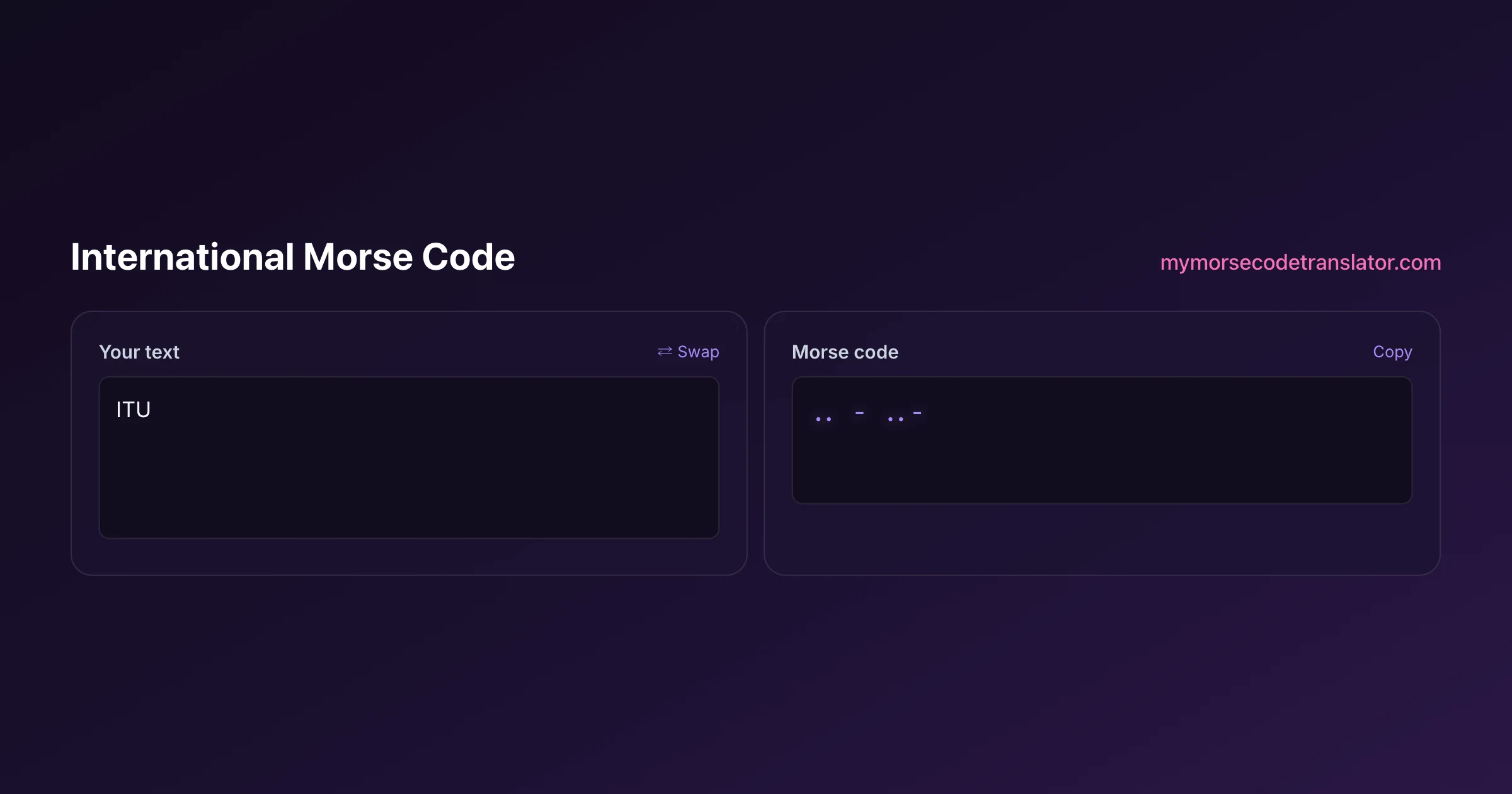
An international morse code translator encodes and decodes using the one Morse standard the whole world actually agrees on: International Morse Code, formally defined in ITU-R Recommendation M.1677. That distinction sounds pedantic until you meet a genuine 19th-century American telegram and discover its letters do not match. This page uses the international standard for everything, and it explains precisely which characters differ from the older American and railroad Morse, so you always know which code you are looking at.
👀 Preview
Press ▶ Play — this shows what you'll see and hear.
Customize your message
Your picture appears in Play and downloaded videos. Note: it can't be included in a shared link — links carry the message only.
Share as a secret message
The message is hidden inside the link and decodes with sound & light when your friend opens it.
Why there is more than one Morse code
Most people assume Morse is a single universal alphabet. It is not, and the history is worth knowing. The original code that Samuel Morse and Alfred Vail devised in the 1840s for American telegraph lines is now called American Morse, or landline Morse, or railroad Morse. It worked, but it had quirks: some letters contained internal spaces, and a few used dashes of different lengths, which made it fiddly to send cleanly over long, noisy circuits.
When telegraphy went international, especially across Europe and over undersea cables, those quirks caused problems. So in 1865 a refined version, then called Continental Morse and later International Morse, was standardised to be simpler and more robust. That international version is what survived into radio, aviation, and amateur use, and it is what the ITU maintains today. American Morse lingered on some US railroads and landlines for decades, which is why old American artifacts can still confuse a modern reader.
The ITU-R M.1677 standard in plain terms
International Morse Code is not folklore; it is a formally published telecommunications standard. ITU-R Recommendation M.1677, maintained by the International Telecommunication Union, lays out every dot and dash, the exact timing ratios, and the punctuation and procedural signals. It is the reference amateur radio operators, maritime services, and this translator all draw from, which is exactly why a message you encode here is understood identically by an operator in Berlin, Nairobi, or Buenos Aires.
The standard fixes the fundamentals everyone relies on: a dash is three times the length of a dot, the gap between symbols in a letter is one dot-length, the gap between letters is three, and the gap between words is seven. Wikipedia's Morse code article reproduces the same tables in a more casual form if you want to browse them, but M.1677 is the authoritative source. Building on a published standard is what lets a hobby translator interoperate with a professional station.
Which letters actually differ from American Morse
This is the part people search for and rarely find laid out clearly. Compared with the old American Morse, international Morse changed the patterns for a whole cluster of letters. The letters that differ include:
- C, F, J, L, O, P, Q, R, X, Y, and Z all have different patterns between the two systems
- Several of these, notably C, O, R, Y, and Z, used internal spaces within the letter in American Morse, a feature international Morse abolished entirely
- L in American Morse was an extra-long dash, longer than a normal dash, a length distinction international Morse dropped
- Many numerals differ too, and American Morse used a long dash for zero rather than the five-dash international 0
The letters that stayed the same across both systems, like E, T, A, I, M, N, and S, are the short, common ones, which is a small mercy. But it means a word like "CLOCK" or "ZERO" sent in American Morse will simply not decode correctly on an international translator, and vice versa.
How to tell which code you are looking at
If you have an old signal and are not sure which Morse it is, a few tells help. Internal spaces inside a single letter, where a character looks like it has a gap partway through, strongly suggest American Morse, because international Morse never puts a space inside a letter. Unusually long dashes that seem longer than the standard three-unit dash also point to American Morse's variable dash lengths.
Context is the bigger clue. Anything from amateur radio, aviation, maritime use, the military, or after roughly 1900 is international Morse with near certainty. Anything from a US railroad office, a landline telegraph, or a pre-1900 American telegram may well be American Morse. If a message decodes to gibberish on this international translator but clearly should be English, and it is genuinely old and American, that mismatch is your answer: you have American Morse, and you need a specialist table for it.
What the international standard covers beyond letters
M.1677 is broader than the alphabet. It defines the digits 0 through 9 as their familiar five-symbol patterns, the punctuation set including the full stop, comma, question mark, and colon, and the procedural signals operators use to run a contact. It even accommodated the @ sign in 2004, encoded as .--.-. by running A and C together, so that email addresses could be sent, the first new character added to Morse in decades.
The standard also formalises accented and non-Latin extensions used in various countries, letters like the German umlauted vowels and the Spanish Ñ, so that Morse serves languages beyond English. This translator focuses on the core Latin set most people need, but the point stands: international Morse is a living, maintained standard with room for growth, not a frozen relic. That is a large part of why it, and not American Morse, became the version the world kept.
How international Morse spread across the world
The reason international Morse feels universal is that it rode every new communication technology as it appeared, and each one locked the standard in a little more firmly. When wireless telegraphy arrived at the turn of the twentieth century, it adopted international Morse wholesale, because the code was already the common language of the cable networks. Ships at sea used it, which is why the 1912 Titanic disaster was signalled in international Morse and helped drive international agreements on distress calling. Aviation used it to identify navigation beacons, a practice that lingered into the jet age. Militaries the world over trained operators on it.
That shared adoption is precisely why a single standard mattered so much. A German ship and a British ship could only help each other in an emergency if their operators read the same code, and international Morse was the agreement that made that possible. The ITU, the same body that publishes M.1677 today, grew out of exactly this need to make telecommunications interoperate across borders. When you encode a message on an international translator, you are plugging into more than a century of that accumulated agreement, which is why it works the same everywhere.
American Morse, by contrast, never made that leap. It stayed tied to the US landline and railroad systems where it was born, and as those systems were replaced, the code faded with them. Today it survives mainly among historians, telegraph-key collectors, and living-history demonstrators, a fascinating relic rather than a working standard.
There is a small irony worth savouring here. The version of Morse that most of the world uses, and that this translator is built on, is not quite the one Samuel Morse originally created; it is the refined Continental descendant that a committee tidied up for cross-border work. Morse's own American code, the true original, is the one that all but vanished. So when people say they are learning "Morse code" today, they are almost always learning the international revision rather than the inventor's first draft. It is a good reminder that a standard survives not because it came first, but because it was the one everybody agreed to share, which is exactly the promise the word 'international' in this translator's name is meant to keep.
Using this translator with confidence
Because everything here is built on ITU-R M.1677, you can trust that what you encode is genuinely international and portable. Send a message to a ham operator and their equipment reads the same letters. Hand a decoded signal to a scout troop working from a standard chart and it matches. Check a maritime museum's Morse display and, assuming it is modern international Morse, it lines up.
The only time you will hit a wall is with genuine historical American Morse, and now you know how to recognise that case rather than being baffled by it. For every other purpose, learning, radio, puzzles, crafts, teaching, international Morse is the code, and this is your translator for it. Encode, decode, play the audio, and know that the standard underneath is the same one professionals rely on worldwide.
Why the international standard survived and the alternatives did not
It is easy to assume the international version won because a committee said so. The real reason is engineering, and it explains why the code looks the way it does.
The original American code had two features that were perfectly sensible on a telegraph wire: spaces inside certain characters, and dashes of more than one length. On a landline the signal is clean, the operator is listening to a mechanical sounder in a quiet room, and both distinctions are easy to hear.
Put that same code on a radio path and it falls apart. Signals fade in and out. Static crashes obliterate short intervals. Another station drifts across your frequency. Under those conditions, distinguishing a gap inside a letter from a gap between letters is guesswork, and telling a long dash from an ordinary one is worse.
The international revision removed both. One dash length, no internal spaces, every character a continuous run of marks. That rigidity is not tidiness for its own sake — it is what makes the code survivable when half of it arrives damaged. A listener who misses a mark can often still recover the message from context; a listener who cannot tell where one letter ends cannot recover anything.
This is also why the code outlived the technology it was built for. A system designed to be robust against noise turns out to be exactly what you want for signalling with a torch, a car horn, a tapped pipe, or a phone screen — none of which the designers had in mind.
I once tried to decode a photo of an 1870s railroad telegram a museum posted online, using a standard translator, and got confident-looking nonsense. The word that gave it away was a name with an O in it — American Morse's O has an internal space, so my international decoder chopped it into two wrong letters. That single mismatched O is what sent me down the rabbit hole of learning the two codes apart.
Frequently Asked Questions
Q. Why did international morse code replace the original version?
Because the original American code used spaces inside characters and more than one dash length, both of which are readable on a clean telegraph wire but unreliable over radio, where fading and static destroy short intervals. The international revision removed both, making it robust against noise.
Q. What makes an international morse code translator different from a regular one?
In practice, most modern Morse tools already use International Morse Code, so 'international' is really a promise about which standard is under the hood: ITU-R M.1677, the worldwide version, rather than the older American Morse. It matters because the two systems assign different patterns to a whole set of letters and numbers.
Q. What is ITU-R M.1677?
It is the formal International Telecommunication Union recommendation that defines International Morse Code: every dot and dash, the timing ratios, punctuation, and procedural signals. It is the authoritative standard that amateur radio, maritime services, and this translator all follow, which is why the code is genuinely universal.
Q. Which letters differ between international and American Morse?
C, F, J, L, O, P, Q, R, X, Y, and Z have different patterns, and several of them, like C, O, R, Y, and Z, used internal spaces in American Morse that international Morse removed. L was a long dash in American Morse, and several numbers differ too, including zero.
Q. How can I tell if an old message is American Morse?
Look for internal spaces inside a single letter or unusually long dashes, both hallmarks of American Morse that international Morse never uses. Context helps too: railroad offices and pre-1900 US landline telegrams often used American Morse, while anything from radio, aviation, or the military is international.
Q. Why did international Morse win out?
It was simpler and more robust: no internal spaces inside letters and consistent dash lengths, which made it easier to send cleanly over noisy long-distance and undersea circuits. When telegraphy went global in the 1860s, that reliability mattered, and radio later cemented the international version as the standard.
Q. Does international Morse cover letters beyond English?
Yes. The standard includes accented and extended letters used in other languages, such as German umlauted vowels and the Spanish Ñ, so Morse can serve many alphabets. This translator focuses on the core Latin set most users need, but the wider standard exists.
Q. Is the @ sign really part of Morse?
Yes, since 2004. The ITU added it as .--.-., formed by running the letters A and C together, specifically so email addresses could be sent in Morse. It was the first new character added to the code in decades and is part of the international standard.
Q. Will this translator decode a genuine 19th-century American telegram?
No. Because it follows the international standard, a real American Morse message will misdecode wherever the two systems differ, which is many letters and numbers. If you know you have historical American Morse, you need a specialist American Morse table instead.
Related guides
← Back to the My Morse Code Translator home page.

By Sukie
Sukie is the creator of My Morse Code Translator — a puzzle nerd and gadget tinkerer who fell down the Morse code rabbit hole and decided to build the most fun Morse translator on the web. When she's not adding new sound packs or reveal animations, she's decoding hidden messages in songs or designing Morse code bracelets for friends.
Last updated: 2026-07-08