Hearing Morse Code: What That Beeping Actually Is
Hearing morse code — or something that sounds unmistakably like it — is a surprisingly common experience, and people usually arrive here at two in the morning trying to work out whether the beeping is real. The short answer is that it is nearly always one of a handful of ordinary things: radio signals bleeding into audio equipment, a device announcing a fault, a genuine Morse transmission from an automated beacon, or a sound originating inside your own ear rather than in the room. This page walks through how to tell those apart, and what to do about each.
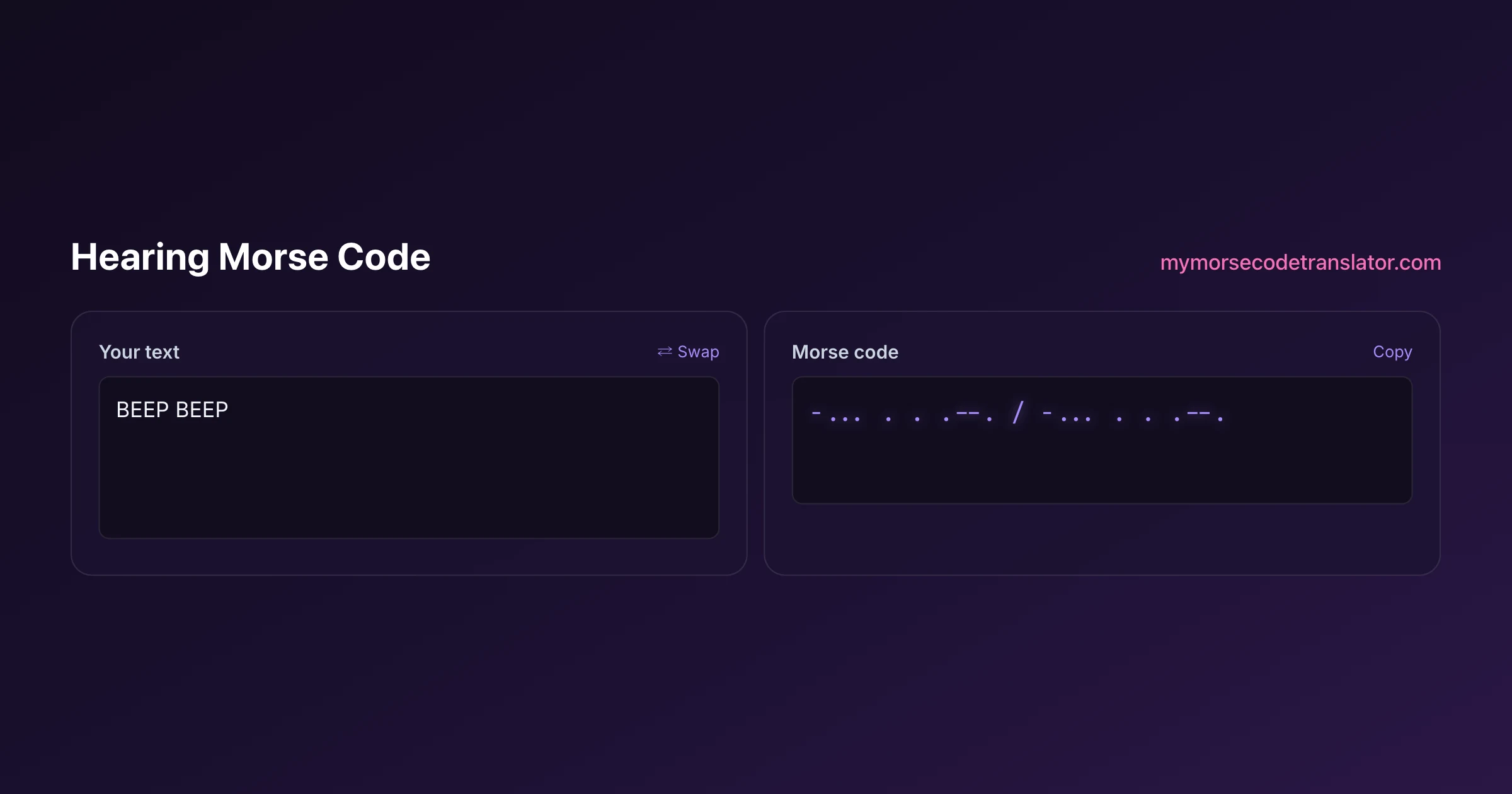
👀 Preview
Press ▶ Play — this shows what you'll see and hear.
Customize your message
Your picture appears in Play and downloaded videos. Note: it can't be included in a shared link — links carry the message only.
Share as a secret message
The message is hidden inside the link and decodes with sound & light when your friend opens it.
First: is the sound in the room or in your head?
Everything else follows from this, and there is a simple test.
Ask somebody else whether they can hear it. If they can, it is in the room and you are looking for a physical source. If they cannot, and the sound follows you from room to room and is present in a quiet house at night, it is very likely originating in your auditory system rather than the environment.
A second test, if you are alone: record it. Put your phone on the table with a voice memo running for a minute or two, then play it back with headphones. A real acoustic sound will be on the recording. Something generated internally will not.
This matters because the two categories have completely different answers. A beeping smoke alarm is a job for a stepladder. A rhythmic tone only you can hear is a question for an audiologist, and worth taking seriously rather than searching about at 2am — the NHS and other health services have straightforward guidance on tinnitus, and a persistent new sound in one ear in particular is a reason to book an appointment rather than self-diagnose. I am not a clinician and this page is not medical advice; the rest of it deals with the sounds that turn out to be real.
The most common real cause: a device telling you something
If the sound is genuinely in the room, start with the boring explanations, because they account for the overwhelming majority of cases.
Smoke and carbon monoxide alarms chirp when the battery is low, and they are engineered to be maddeningly hard to locate — usually a single short chirp every 30 to 60 seconds, often worse at night because falling temperature drops battery voltage. This is the single most common answer to "beeping at night" of any kind.
UPS units, alarm panels, boilers and appliances frequently signal faults with patterned beeps, and manufacturers genuinely do use counted sequences — three short, pause, three short — that sound very much like a code because they are a code, just not Morse.
Computers on some older motherboards use POST beep codes at startup, again patterned in a way that sounds deliberate.
The giveaway for all of these is repetition without variation. A device fault repeats the identical pattern indefinitely. Actual Morse carrying a message changes as the message progresses. If you have listened to twenty repetitions and the rhythm has never once differed, you are listening to a machine complaining, not a transmission.
Radio interference bleeding into your audio
This is the cause people rarely guess and it is genuinely common, particularly if you live near an amateur radio operator, a commercial transmitter, or an airport.
Strong nearby radio signals can be rectified by unshielded audio equipment — powered speakers, cheap amplifiers, guitar pickups, landline phones, hearing aids, even long unshielded cable runs — and end up audible as tones through the speaker. When the transmission is amateur CW, that arrives as real Morse code, at real Morse speeds, changing as the operator sends. This is a well-documented phenomenon known as RFI, radio frequency interference, and the ARRL publishes extensive material on diagnosing and curing it.
How to recognise it: it comes through a specific piece of equipment rather than the whole room, it often stops if you unplug or move that equipment, it may correlate with certain times of day, and — crucially — the pattern varies rather than repeating. It may also be accompanied by voices or a buzzing carrier at other times.
The fixes are usually mechanical rather than dramatic: ferrite chokes on the offending cables, shorter cable runs, better-shielded equipment, or a polite conversation with a neighbouring operator who will very likely have dealt with this before and may help you fix it.
Genuine Morse still on the air
It is worth knowing that Morse has not gone away, and if you own a radio receiver you can hear real transmissions any night of the week.
Amateur radio operators use it heavily. CW remains popular because it gets through when voice cannot — a weak Morse signal is readable at signal levels where speech is unintelligible — and there are active contests and daily conversations across the shortwave bands.
Navigational beacons transmit continuously. Non-directional beacons used in aviation identify themselves by repeatedly sending a two or three letter identifier in Morse, endlessly, at a slow speed. If you hear the same short group of letters over and over from a radio, that is almost certainly what you have found, and you can look the identifier up.
Automated station identification appears in various services where a licence requires periodic identification.
So if the sound is coming out of a radio rather than a household device, it may simply be Morse doing its job. In that case you can decode it — and if you can capture it, the tools on this site will translate it back to text for you.
How to decode something you are actually hearing
If you have established the sound is real, repeating, and looks like it might carry information, you can try to read it.
The practical approach is to write down what you hear as dots and dashes rather than trying to identify letters live. Use a short mark for the quick sounds and a long mark for the sustained ones, leave a gap when you hear a pause, and a bigger gap for a longer pause. Do not try to work out letters while you are listening — you will fall behind and lose the thread. Transcribe first, decode after.
Then paste that string of dots and dashes into the decoder on this page and it will convert it to text. If the result is gibberish, the usual culprit is the gaps rather than the marks: if you have not separated the characters clearly, four dots is ambiguous between H, two Is and four Es. Try regrouping.
An honest expectation: a beacon identifier or a slow deliberate signal is very decodable this way. An amateur operator sending at 25 words a minute is not, not by ear, not on a first attempt. If it is fast, record it instead and slow the recording down.
Why the brain finds Morse in things that are not Morse
There is a perceptual dimension to this that is worth naming, because it explains a share of the cases where nothing is ever found.
Human hearing is aggressively pattern-seeking, particularly in quiet conditions and particularly at night when there is little else to attend to. Intermittent noises with no obvious source — a pipe ticking as it cools, a fridge compressor cycling, distant machinery, a bird — get assembled by the auditory system into something that feels structured and intentional. Morse is the pattern people reach for because it is the culturally familiar example of beeping that means something.
This is not a suggestion that anyone is imagining things. The sound is usually real; it is the structure that gets supplied. A useful check is the one from earlier: record it and look at the recording. Genuine Morse has visibly consistent short and long elements with structured gaps. A cooling pipe does not, however deliberate it sounded at 3am.
If a recording shows nothing at all, and the sound persists, that circles back to the first section — it is worth speaking to a doctor rather than continuing to hunt the house.
Locating a beeping device without losing your mind
If you have concluded it is a device, actually finding it is its own problem, because intermittent high-pitched beeps are close to the hardest sound for humans to localise. This is not a personal failing — it is acoustics. We locate sounds using the tiny differences in arrival time and volume between our two ears, and that mechanism works poorly for short, high-frequency bursts, especially when they reflect off hard walls.
What actually helps:
- Wait for several repetitions and move between them, rather than trying to pinpoint direction from one chirp. Note whether it is louder or quieter after each move.
- Cup one ear closed. Turning your head slowly with one ear blocked gives you a crude directional filter that is surprisingly effective.
- Check every smoke and CO alarm in the building first, including ones in cupboards, hallways, lofts and garages, and including any you have forgotten exist. Interconnected alarms can chirp from a unit other than the one with the flat battery.
- Check anything with a backup battery: UPS units, burglar alarm panels, thermostats, doorbell chimes, old cordless phone bases, carbon monoxide detectors in boiler cupboards.
- Try at a different time of day. Battery-voltage chirps often worsen as temperature drops overnight, so a device that is silent at noon may be obvious at 3am.
And if the chirp stops the moment you go looking and resumes when you sit down, that is not a haunting — it is a long interval and confirmation bias. Time the gaps with a stopwatch; a regular interval is the signature of a machine.
A short checklist
Working through these in order will identify the cause in most cases:
- Can somebody else hear it? If no, and it persists, see a clinician.
- Does a phone recording capture it? If no, same answer.
- Does it repeat identically forever? Almost certainly a device fault — check smoke alarms first, then anything with a battery backup.
- Does it come from one piece of audio equipment and stop when that is unplugged? Radio interference.
- Is it coming from a radio receiver, and is it a short group of letters repeating? A navigational beacon.
- Does the pattern vary continuously like language? A real transmission — transcribe and decode it.
Most people who arrive here at night find their answer in the first three lines. The alarm in the hallway is a cliché for a reason.
I spent most of a night convinced there was a transmitter in my building. A phone recording showed a single chirp every 41 seconds, dead regular, no variation — a smoke alarm two floors up with a dying battery. The recording test took ninety seconds and I should have started with it.
Frequently Asked Questions
Q. Why do I hear morse code beeping at night?
The most common cause by far is a smoke or carbon monoxide alarm with a low battery — these chirp on a fixed interval and get worse at night as temperatures drop and battery voltage falls. Other frequent causes are UPS units, alarm panels and appliances signalling a fault with patterned beeps.
Q. Can radio signals really come through my speakers as morse code?
Yes. Strong nearby transmissions can be rectified by unshielded audio equipment and become audible as tones — a well-known effect called radio frequency interference. If the source is an amateur operator sending CW, what you hear is genuine Morse. Ferrite chokes and better-shielded cabling usually cure it.
Q. How can I tell a device fault from a real morse message?
Watch for variation. A device fault repeats an identical pattern indefinitely. A real message changes as it progresses. If you have heard twenty repetitions with no difference at all, it is a machine, not a transmission.
Q. What if nobody else can hear it?
If others cannot hear it and a phone recording does not capture it, the sound is likely originating in your auditory system rather than the room. That is common and often benign, but a persistent new sound — especially in one ear — is worth raising with a doctor or audiologist rather than researching online.
Q. I recorded it — how do I find out what it says?
Transcribe it as dots and dashes first, without trying to identify letters live, marking the pauses as you go. Then paste that into the decoder on this page. If the output is gibberish the gaps are usually the problem, since the spacing is what separates one letter from another.
Related guides
← Back to the My Morse Code Translator home page.

By Sukie
Sukie is the creator of My Morse Code Translator — a puzzle nerd and gadget tinkerer who fell down the Morse code rabbit hole and decided to build the most fun Morse translator on the web. When she's not adding new sound packs or reveal animations, she's decoding hidden messages in songs or designing Morse code bracelets for friends.
Last updated: 2026-09-13