Morse Code Timing
Morse code timing is the part of the system that beginners skip and experienced operators obsess over, and the reason is simple: the silences carry as much information as the sounds. A dot and a dash are only distinguishable by how long they last. A letter break and a word break are only distinguishable by how long the quiet lasts. Get the marks right and the timing wrong, and you have produced something that is technically Morse and practically unreadable. This page covers the whole timing system — the unit rules, how speed is actually measured, and the deliberate distortion called Farnsworth that makes learning far easier.
👀 Preview
Press ▶ Play — this shows what you'll see and hear.
Customize your message
Your picture appears in Play and downloaded videos. Note: it can't be included in a shared link — links carry the message only.
Share as a secret message
The message is hidden inside the link and decodes with sound & light when your friend opens it.
Everything is measured against one unit
Morse has no absolute durations. There is no rule that says a dot lasts 60 milliseconds. Instead there is a single basic unit — the length of one dot — and every other duration in the system is defined as a multiple of it.
- Dot (dit): 1 unit of signal
- Dash (dah): 3 units of signal
- Gap between marks within a character: 1 unit of silence
- Gap between characters: 3 units of silence
- Gap between words: 7 units of silence
That is the entire timing specification. People often shorthand it as the 1-3-3-7 rule, though it is really 1-3 for the marks and 1-3-7 for the silences.
Because everything is relative, Morse is scale-free. Speed it up or slow it down and it remains correct as long as the ratios hold. A message sent at a crawl by a torch on a hillside and the same message sent at forty words a minute over the air are the same code; only the unit length differs. This is also why a listener can adapt to a new operator within a few characters — they are not learning new patterns, just recalibrating the unit.
Working out the actual unit length
To turn units into milliseconds you need a speed, and the standard formula is built around a reference word.
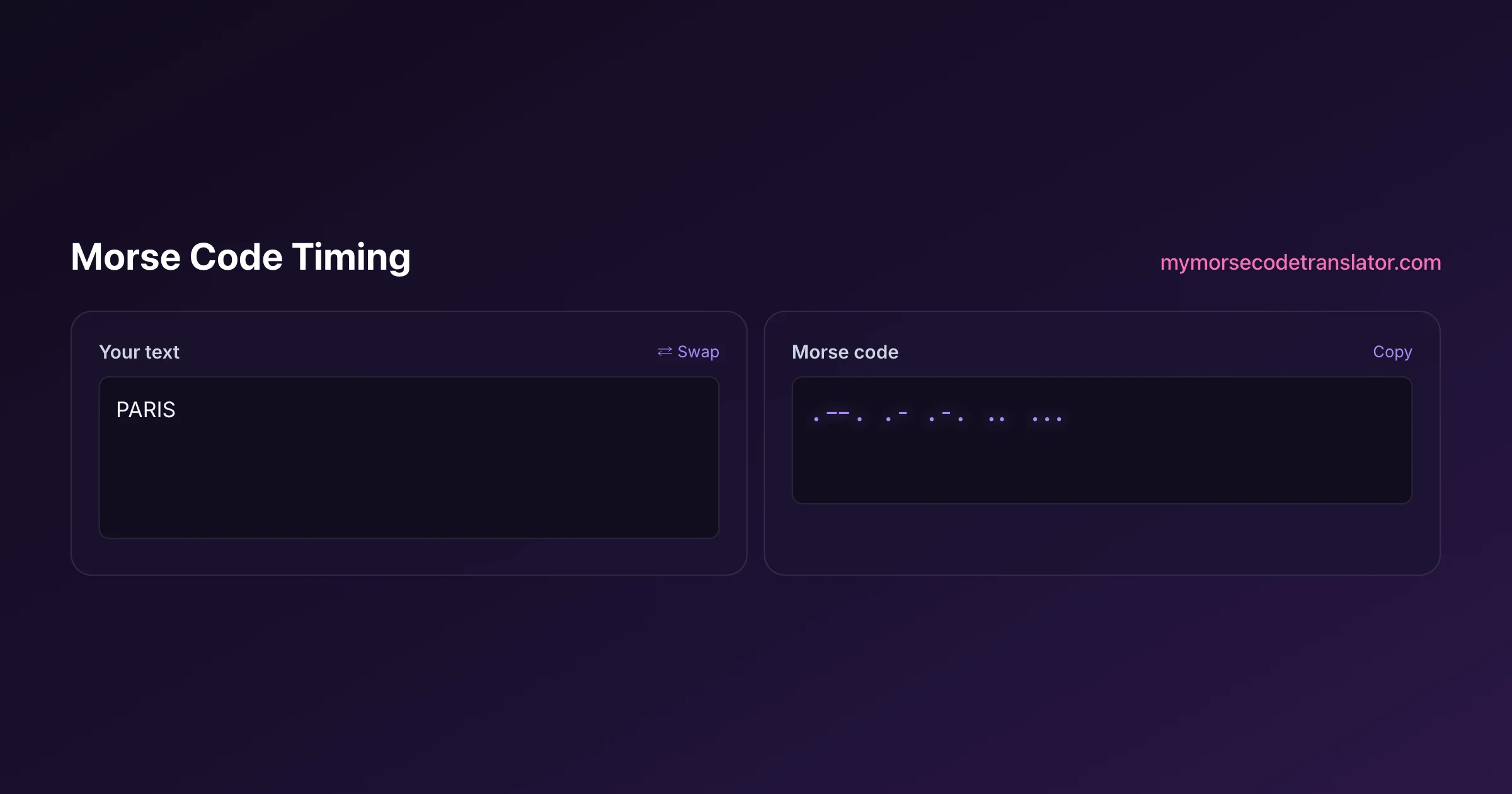
The convention is to use the word PARIS, because when you write it out with all its internal and trailing spacing it comes to exactly 50 units. That makes it a convenient yardstick: sending PARIS once per minute is 1 word per minute, so at W words per minute you are sending 50 × W units per minute.
From that, the dot length works out as:
dot duration (milliseconds) = 1200 ÷ WPM
So at 20 words per minute a dot is 60 ms, a dash is 180 ms, the gap inside a character is 60 ms, the gap between characters is 180 ms, and the gap between words is 420 ms. At 5 words per minute a dot is 240 ms and everything else scales with it.
That 1200 is not magic — it is simply 60,000 milliseconds in a minute divided by the 50 units in PARIS. Every Morse tool that offers a WPM control, including the one on this page, is running that calculation behind the slider.
Why PARIS and not some other word
The choice of a reference word matters because English words vary enormously in Morse length. A word made of E, T, I and A is quick; a word full of Q, Y, J and Z is not. If speed were measured against actual message content, two operators sending at the same nominal WPM could be sending wildly different amounts of signal.
PARIS was picked because it lands close to the average for ordinary English text and, conveniently, totals a round 50 units. There is a competing reference, CODEX, which comes to 60 units and is used in some contexts because it is a slightly more conservative benchmark. If you ever see two tools disagree about what a given WPM sounds like, a different reference word is one plausible reason.
For practical purposes PARIS is the near-universal default, and when somebody says "I copy at 25 words a minute", PARIS is what they mean.
The gaps are not optional
This is the point worth labouring, because it is where most self-taught Morse falls apart.
Consider four dots sent in a row with even spacing. Depending on the gaps, that is:
- H — four dots with 1-unit gaps between them
- I I — two dots, a 3-unit gap, two dots
- E E E E — four dots each separated by 3-unit gaps
- I E E — and so on
The marks are identical in every case. Only the silences distinguish them. This is why Morse cannot be written correctly from a character chart alone, and why software that renders Morse with sloppy spacing produces output that a human operator will read wrongly.
The same problem appears in physical Morse. On a bracelet or an engraved bar, the "gaps" are physical distances, and if the space between letters is not visibly about three times the space between beads within a letter, the piece is ambiguous. Anybody decoding it later is guessing.
Farnsworth timing: the deliberate distortion
There is a well-known problem in learning Morse. If you practise at a slow speed, you learn to count marks — dot, dot, dot, that is three, that is S. Counting works fine at 5 words per minute and collapses completely at 15, because there is no longer time to count. Learners who train slowly frequently hit a hard wall and have to unlearn the counting habit from scratch.
Farnsworth timing solves this by splitting the speed into two. Each individual character is sent at a fast speed — fast enough that counting is impossible and you are forced to recognise the character as a single rhythm — while the gaps between characters and words are stretched out to give you thinking time.
So you might send characters at 18 words per minute but with spacing that brings the overall rate down to 8. The rhythms you are learning are the rhythms you will hear at full speed; only the breathing room is artificial. As you improve, you close the gaps rather than speeding up the characters, and the characters themselves never have to be relearned.
This is the standard recommendation from the ARRL and from the instructors at the Long Island CW Club, and it is the single most effective change most learners can make. The translator on this page has a Farnsworth option for exactly this reason: switch it on and the character speed stays where you set it while the gaps stretch.
Weighting, and why two operators sound different
The 1-3 ratio between dots and dashes is the specification, but human operators deviate from it, and machines can be told to.
Weighting refers to deliberately lengthening or shortening the marks relative to the gaps. Slightly heavy weighting — dashes a touch longer than three units, or marks generally a little longer relative to the spaces — often sounds smoother and is easier to copy, and many operators send this way without consciously deciding to. Light weighting sounds crisper and more clipped.
This is a large part of what people mean by an operator's "fist" — the recognisable personal character of their sending. Before automated keyers, experienced listeners could identify a specific operator by rhythm alone, the way you might recognise a friend's handwriting. It is a genuinely human quality in what looks like a mechanical system.
For anything you are generating with software, the standard ratios are the right default. Deviating is a stylistic choice that makes sense for a person practising by hand, not for a message you want a stranger to decode.
Timing for light and vibration, not just sound
The same rules govern Morse sent as light or as physical pulses, but two practical issues change.
First, perception is slower for light than for sound. The ear resolves short gaps far better than the eye does. Flashing Morse at 20 words a minute is technically valid and almost impossible for a person to read visually. For light signalling, dropping to something in the range of 5 to 10 words per minute makes the difference between a signal and a flicker.
Second, flash rate is a safety issue. Rapid flashing can trigger seizures in people with photosensitive epilepsy, and the accessibility guidance in WCAG sets a threshold of three flashes per second for general web content. At higher Morse speeds a string of dots can exceed that. This is why the flashing feature on this site asks you to opt in before it starts and why lowering the WPM lowers the flash rate — slower Morse is both more readable and safer.
For vibration, on a phone, the constraint is different again: very short pulses are often not perceptible at all, so the practical floor on unit length is higher than either light or sound.
Checking your timing is actually right
If you are producing Morse and want to know whether the timing holds up, there are three checks that catch nearly everything.
Decode it back. The most reliable test. Take what you produced, run it through a decoder, and see whether it returns the text you intended. Timing errors show up immediately as wrong or unknown characters.
Listen for the word gaps. Play it and see whether you can hear where the words end without knowing the message. If the word breaks are not obvious to you — and you already know what it says — they will not be obvious to anyone else.
Compare the durations. A dash should be unmistakably three times a dot, not slightly longer. If you have to concentrate to tell them apart, the ratio has drifted. This is the most common flaw in hand-sent code and in hand-laid bead patterns.
On this site the timing is generated from the WPM value directly using the 1200 ÷ WPM rule, so the ratios are exact by construction. The failure mode with software is not usually bad ratios; it is a speed that is too fast for the medium you are using.
Picking a speed for what you are actually doing
There is no single correct speed, only a speed that suits the situation.
- Learning by ear: characters at 15–20 WPM with Farnsworth spacing pulling the effective rate down to 5–10. Fast characters, slow gaps.
- Sending to a person who does not know Morse: 5–8 WPM. They are going to be looking things up, and every extra unit of gap helps.
- Flashing as light: 5–10 WPM, lower if the viewer is at a distance or the light is dim.
- Casual radio contact: 15–20 WPM is comfortable for most operators.
- Experienced operators: 25–40 WPM and occasionally well beyond.
The common mistake is choosing a speed that flatters the sender rather than serving the receiver. If somebody is going to decode your message by hand, a slow message they can read beats a fast one they cannot.
I rendered the same message at 15 WPM as sound and as screen flashes and asked four people to read each. Every one of them copied the audio and not one managed the light. Dropping the light version to 7 WPM made it readable for three of the four — the eye needs roughly double the gap the ear does.
Frequently Asked Questions
Q. What is the timing rule in morse code?
A dot is 1 unit, a dash is 3 units, the gap between marks within a character is 1 unit, the gap between characters is 3 units, and the gap between words is 7 units. Every duration is relative to the dot, so the code works at any speed as long as the ratios hold.
Q. How is words per minute calculated in morse code?
Against the reference word PARIS, which totals exactly 50 units including its spacing. That gives the standard formula: dot length in milliseconds equals 1200 divided by the words per minute. At 20 WPM a dot is 60 ms; at 10 WPM it is 120 ms.
Q. What is Farnsworth timing and should I use it?
It sends each character at a fast speed while stretching the gaps between characters and words. This stops you learning to count marks, which is the habit that limits speed later. If you are learning to copy by ear, yes — it is the standard recommendation and it is available in the translator on this page.
Q. Why does my morse code decode incorrectly even though the letters are right?
Almost always the gaps. If the space between characters is not clearly about three times the space between marks inside a character, letters run together — four dots becomes H, or two Is, or four Es depending purely on the silences. Lengthen the character and word gaps and re-test.
Related guides
← Back to the My Morse Code Translator home page.

By Sukie
Sukie is the creator of My Morse Code Translator — a puzzle nerd and gadget tinkerer who fell down the Morse code rabbit hole and decided to build the most fun Morse translator on the web. When she's not adding new sound packs or reveal animations, she's decoding hidden messages in songs or designing Morse code bracelets for friends.
Last updated: 2026-09-08