Morse Code Bracelet Maker: Turn a Word Into a Beaded Pattern
Morse code bracelet maker projects start with a simple fact: search "morse code bracelet" on Etsy and you'll find tens of thousands of listings, making it quietly one of the biggest niches in handmade jewelry. Designing your own lets you skip the markup: you take a word, a name, or a date, translate it into dots and dashes, and map those onto beads. Round bead for a dot, long bead for a dash, a plain spacer for the gaps. This guide shows you exactly how to turn our translator's output into a pattern you can string.
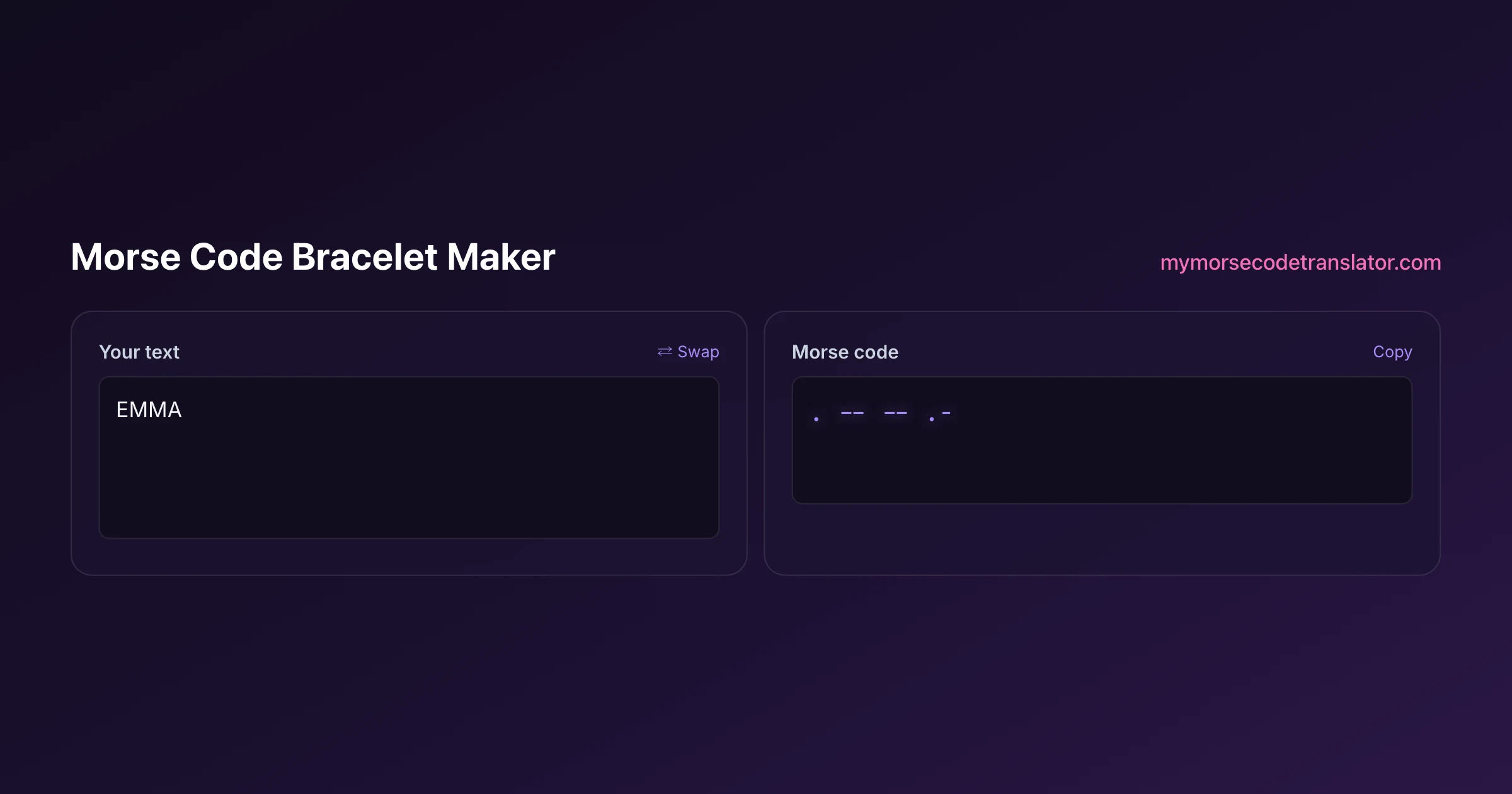
The bead language: dot, dash, gap
A Morse bracelet is a code you can wear, and the whole system rests on three bead types.
- Dot = a small round bead. Think a single seed bead or a little sphere.
- Dash = a long bead. A bugle bead, a tube bead, or a longer oval — anything visibly longer than your dot bead.
- Gap = a spacer bead in a contrasting or neutral color, or a small knot, marking the space between letters and words.
That's the entire vocabulary. Once your eye learns it, you can read a stranger's bracelet across a coffee shop table, which is half the fun. The contrast between the round dot and the long dash is what makes the message legible, so the bigger the visual difference between those two bead shapes, the easier your bracelet is to read.
From word to pattern in three steps
Here's the whole workflow, and it starts with our translator.
First, type your word into the English-to-Morse translator on this site and copy the dots and dashes it gives you. For example, "LOVE" comes out as .-.. --- ...- . — that's L, O, V, E.
Second, translate each symbol to a bead: every dot becomes a round bead, every dash becomes a long bead, and the space between letters becomes one spacer bead.
Third, write your bead sequence on paper before you string anything. For "LOVE" you'd lay out: round, long, round, round (that's L), spacer, long, long, long (O), spacer, round, round, round, long (V), spacer, round (E). Getting it on paper first saves you from unstringing the whole thing when you realize bead eleven is wrong.
What people actually spell
The magic of these bracelets is that they look like abstract jewelry to strangers but carry a private meaning for the wearer. The most common messages I've seen people encode:
- Names — a child's, a partner's, a late loved one's.
- Dates — a wedding, a birth, a sobriety date, an anniversary, written as numbers.
- "I love you" — far and away the most popular phrase, compact and sweet.
- Short mantras — "brave," "breathe," "stay," "hope," a single grounding word.
- Inside jokes and initials — meaningful to two people and no one else.
Because the code is hidden in plain sight, these make deeply personal gifts. A dash-and-dot bracelet spelling a grandmother's name reads as a pretty accessory to everyone but the person wearing it, and that secret is the whole point.
Reading numbers and dates
Dates are one of the most popular things to encode, so it's worth knowing that numbers have their own tidy Morse pattern.
Every digit is exactly five elements long, which makes them satisfying to bead because each number is the same length. The digit 1 is one dot then four dashes; 2 is two dots then three dashes, and so on up to 5, which is five dots. Then it mirrors: 6 is a dash then four dots, working back down to 0, which is five dashes. So a date like "2024" becomes four groups of five beads each, separated by spacers — a clean, rhythmic pattern that looks intentional on the wrist. If you're encoding a date, our number translator will spell out the digits for you so you don't have to memorize the pattern.
Choosing beads that read clearly
A Morse bracelet only works if someone could, in principle, decode it — so contrast is everything.
Pick a dot bead and a dash bead that are obviously different lengths. If your round beads and your long beads are nearly the same size, the message turns to visual mush and nobody, including you in six months, will be able to read it. Many makers use one color for all the message beads (dots and dashes both) and a second, contrasting color only for the spacers, so the word-and-letter breaks pop. Others use a single neutral palette and rely purely on bead shape. Both work; what fails is low contrast in both color and shape at once. Lay a test row on a bead mat and photograph it — if you can't read the code in the photo, neither can anyone else.
Materials and stringing basics
You don't need much to make one, which is part of why the craft is so popular.
Stretch cord (elastic) is the beginner-friendly choice — no clasp needed, and it slips over the hand. For a more durable piece, use beading wire with a crimp and a clasp. Your beads can be anything from inexpensive glass seed beads to freshwater pearls to gold-filled tubes, depending on your budget and the occasion. A bead mat keeps everything from rolling away while you lay out your pattern, and a pair of scissors plus a dab of glue on the elastic knot finishes it. The total materials cost for a simple stretch bracelet is often a couple of dollars, which is exactly why designing your own instead of buying a fifteen-to-thirty-dollar Etsy listing adds up fast if you make several.
For length, measure your wrist and add a little slack — most adult bracelets land around seven inches, but a Morse pattern has its own length dictated by the message, so a long phrase may force you to use smaller beads to fit. This is the quiet reason short words win: "HOPE" fits comfortably, while a full sentence can wrap the wrist twice. If your message runs long, either shrink the beads, pick a shorter phrase, or lean into a wrap-style bracelet that's meant to loop several times.
Turning it into a gift with a decoder card
The one weakness of a secret bracelet is that the secret can be too good — the wearer forgets what it says, or a gift recipient never learns the meaning at all.
The fix that makes these gifts land is a little decoder card. On a folded card, write the message in plain text on the inside, and on the outside draw the bead legend: "round = dot, long = dash, spacer = new letter." Now the recipient gets the reveal and can re-read their own wrist forever. For a wedding or memorial piece, I like adding one line explaining why that word or date was chosen — the bracelet carries the code, and the card carries the story.
If you sell your bracelets, a decoder card doubles as a professional touch and cuts down on "what does mine say?" messages later. It costs a scrap of paper and turns a pretty bracelet into a keepsake someone understands.
Why this page doesn't have a bead widget (yet)
Full honesty: this is a content-and-design guide, not a click-to-render bead simulator — at least for now.
The reason is that a real bracelet involves choices software can't make for you: bead size, cord length for your specific wrist, color, and whether you want the message to start at the center or the clasp. So instead of a half-useful visualizer, the workflow here leans on the translator you already trust: get your dots and dashes, map them to beads with the rules above, and sketch the row on paper. A dedicated bead-layout visual tool is on my list to build, but I'd rather ship a guide that actually helps you string a correct bracelet today than a gimmick that doesn't.
Common mistakes that ruin a Morse bracelet
A few pitfalls turn a lovely idea into an unreadable jumble, and they're all easy to avoid.
- Forgetting the letter gaps: without spacer beads between letters, "SO" and a five-dot run look identical. Gaps aren't decoration; they're grammar.
- Same-length beads: if the dot and dash beads are nearly equal, the code can't be read. Maximize the length difference.
- Stringing before sketching: always write the full bead sequence on paper first, then string.
- Word gaps too subtle: the space between whole words needs a bigger break — often two spacer beads or a distinctly different spacer — than the space between letters.
- Trusting memory over the translator: even people who know Morse fumble a letter. Let our translator generate the code so the pattern is correct before a single bead goes on the cord.
I made my first Morse bracelet spelling my dog's name and skipped the paper-sketch step because I was impatient. I got the letter gaps wrong on the second word, restrung the whole thing twice, and learned the hard way that the spacer beads are the grammar — not the decoration.
Frequently Asked Questions
Q. How do I turn a word into a bead pattern?
Type the word into our English-to-Morse translator, copy the dots and dashes, then map each one to a bead: a round bead for every dot, a long bead for every dash, and a spacer bead for the gap between letters. Sketch the full sequence on paper before you string it.
Q. Which bead is a dot and which is a dash?
A small round bead is a dot; a long bead — a bugle, tube, or oval — is a dash. The gaps between letters and words are marked with plain spacer beads. The bigger the visual difference between your dot and dash beads, the easier the bracelet is to read.
Q. Can I encode a date on a bracelet?
Yes, and dates are one of the most popular choices. Each digit in Morse is exactly five elements long, so a four-digit year becomes four neat groups of five beads separated by spacers. Use our number translator to get the digit patterns.
Q. How do I make it readable to other people?
Contrast is everything. Use a dot bead and a dash bead that are clearly different lengths, and consider a contrasting color for the spacer beads so letter and word breaks stand out. If you can read the code in a photo of a test row, so can everyone else.
Q. What's the most popular phrase people encode?
"I love you" is by far the most common — it's short, sweet, and hides in plain sight. Names, meaningful dates, and single grounding words like "brave" or "breathe" are close behind.
Q. Do I need special beading skills?
No. A simple stretch-cord bracelet needs only elastic, beads, scissors, and a dab of glue on the knot — no clasp, no crimping. The hardest part is planning the pattern, and the translator does the Morse for you.
Q. Why is 'I love you' so popular on Etsy Morse jewelry?
Morse jewelry is one of Etsy's larger handmade niches precisely because it hides a private message in something that looks like ordinary beadwork. "I love you" is compact enough to fit a slim bracelet and universal enough to sell endlessly, which is why you'll see it in thousands of listings.
Q. How do I mark the space between words?
Use a bigger break than you use between letters — often two spacer beads, or a distinctly different spacer. In Morse the word gap is much longer than the letter gap, and your beading should reflect that so multi-word messages stay readable.
Q. Can I make one without knowing Morse?
Absolutely. You never have to memorize the code — type your word into the translator, copy the output, and follow the bead-mapping rules. Even people who know Morse use the translator to avoid fumbling a letter mid-pattern.
Q. Does this page have a click-to-render bead tool?
Not yet — this is a design guide that pairs with the translator, because a real bracelet involves bead size, wrist length, and color choices software can't make for you. A dedicated bead-layout visualizer is on the build list, but the paper-and-translator method makes a correct bracelet today.
Related guides
← Back to the My Morse Code Translator home page.

By Sukie
Sukie is the creator of My Morse Code Translator — a puzzle nerd and gadget tinkerer who fell down the Morse code rabbit hole and decided to build the most fun Morse translator on the web. When she's not adding new sound packs or reveal animations, she's decoding hidden messages in songs or designing Morse code bracelets for friends.
Last updated: 2026-07-08