How to Read Morse Code by Ear and by Timing
How to read morse code stumps most beginners for the same reason: all they hear is a stream of beeps that seem to blur together into noise. The secret isn't memorizing more dots and dashes — it's understanding timing. Morse is built entirely on the length of its sounds and, just as importantly, the length of the silences between them. Once you internalize the small set of timing rules below, a chaotic string of beeps resolves cleanly into letters, words, and full sentences.
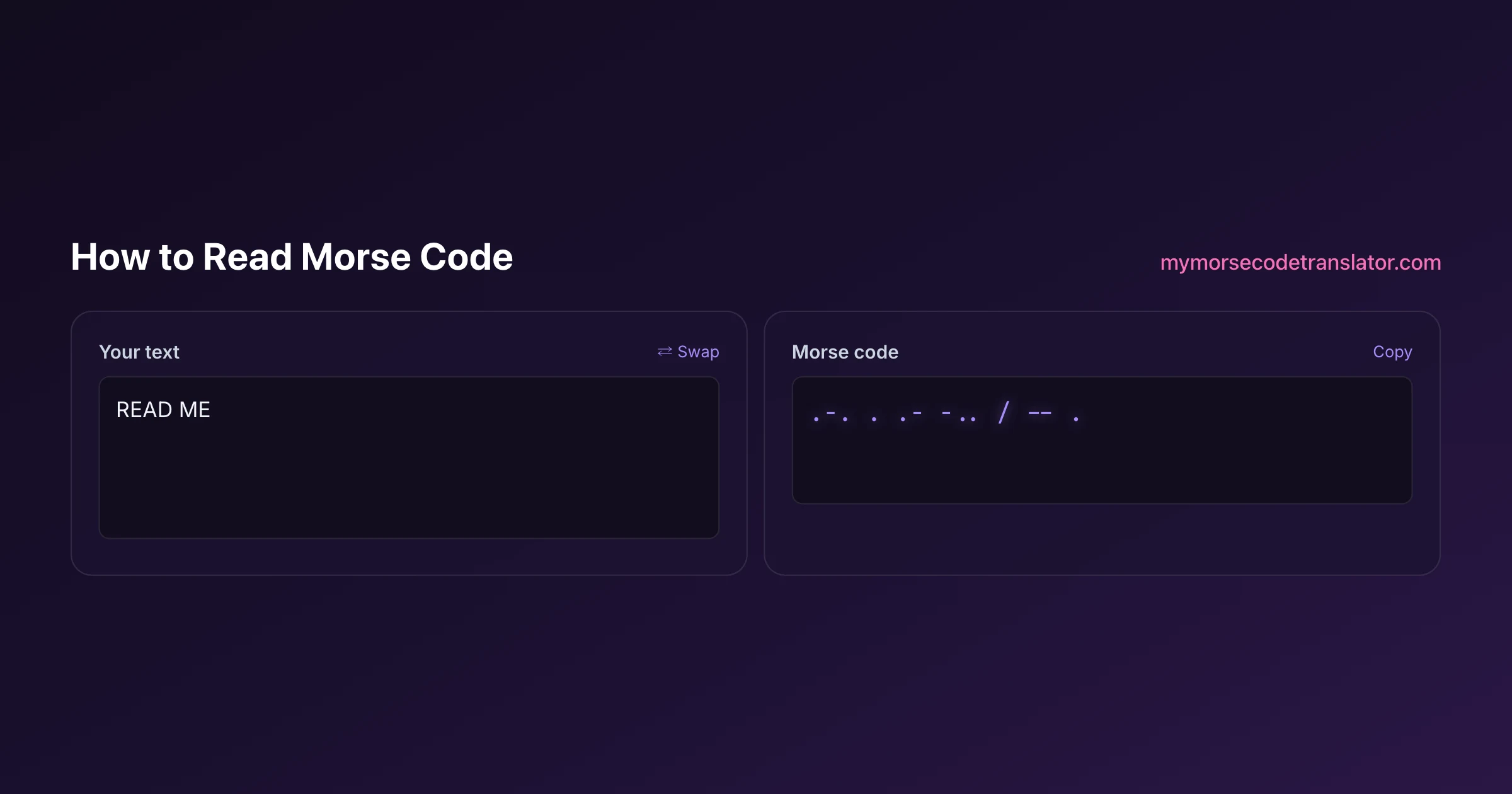
Everything is measured in one unit of time
Morse has exactly two sounds — a short one and a long one — and the entire system is defined by ratios built on a single base measurement called the "unit." Get these five ratios and you can read anything:
- A dot (dit) = 1 unit of sound.
- A dash (dah) = 3 units of sound.
- The gap between dots and dashes inside one letter = 1 unit of silence.
- The gap between two letters = 3 units of silence.
- The gap between two words = 7 units of silence.
That's the entire framework. A dash is three times the length of a dot; the silences come in three sizes — 1, 3, and 7. Everything else in reading Morse is just the skill of hearing those silences and instantly knowing which of the three you just heard. Notice how the numbers escalate: 1 inside a letter, 3 between letters, 7 between words. That spread is deliberate, so the three gaps never get confused with each other.
The gaps are where reading actually happens
Beginners obsess over telling a dot from a dash, but that's the easy part — one is clearly shorter than the other and your ear picks it up within a day. The genuine skill of reading Morse is hearing the silences, because the gaps are what tell you where one letter ends and the next begins.
Consider the sequence ···––––··· with no gaps marked. Is that S, O, S? Or a run of E's and T's? Or something else entirely? Only the silences disambiguate it. A 1-unit gap means "same letter, keep listening." A 3-unit gap means "that letter is finished, a new one is starting." A 7-unit gap means "the whole word is done." If you train your ear to feel the difference between a short in-letter gap and a longer between-letter gap, the letters snap apart cleanly and the message assembles itself. Miss the gaps, and even perfect dots and dashes dissolve into meaningless mush. This is why experienced operators say they listen to the spaces as much as the sounds.
The PARIS standard: what "words per minute" means
Morse speed is measured in words per minute (WPM), but a "word" needs a fixed, agreed definition or the number is meaningless — English words vary wildly in length. The universally accepted reference word is PARIS, because when you spell P-A-R-I-S in Morse — including all the standard internal gaps plus one word-space after it — it comes to exactly 50 units of time.
So 50 units equals one standard word by definition. If you can send or copy PARIS ten times in one minute, that's 500 units per minute, or 10 WPM. This PARIS standard is why a 20 WPM signal from a ham operator in Germany plays at exactly the same real speed as a 20 WPM signal transmitted anywhere else on the planet. It converts a fuzzy question — "how fast are you sending?" — into a precise, portable, universally comparable measurement. Every trainer, radio, and translator speed dial is calibrated against PARIS.
The formula: how long is a dot in milliseconds?
Because PARIS fixes a word at 50 units, you can calculate the exact duration of a single dot at any speed with one clean formula:
dot length in milliseconds = 1200 / WPM
At 20 WPM, a dot is 1200 / 20 = 60 milliseconds. At 5 WPM it's 240 milliseconds — four times longer. From that one number, everything else follows automatically: a dash is three times the dot (180 ms at 20 WPM), a letter gap is three dots long, and a word gap is seven dots long.
Where does the magic number 1200 come from? A standard word is 50 units, and there are 60,000 milliseconds in a minute, so at W words per minute you have 50 × W units per minute. One unit is therefore 60,000 / (50 × W) = 1200 / W milliseconds. The 1200 is simply 60,000 divided by 50 — the arithmetic sitting behind every Morse trainer's speed control. Knowing the formula means you can reason about timing precisely instead of guessing, and it's what makes software playback sound authentic at any speed you choose.
A worked example: decoding letter by letter
Let's read ·–·· ·– –·· ·–· –·–· by hand, taking it one letter at a time and using the 3-unit gaps to break it apart:
- ·–·· → L
- ·– → A
- –·· → D
- ·–· → R
- –·–· → C
Decode as each gap closes and you build the message piece by piece. The habit to develop is decoding continuously in real time: identify each letter the instant its between-letter gap arrives, hold the growing string in a short mental buffer, and let the long 7-unit word gap tell you when to "read out" the completed word. Don't wait for the whole transmission to finish and then try to reconstruct it — that overloads your memory and falls apart on anything longer than a few characters. Read as it flows, exactly the way you read this sentence one word at a time rather than staring at the whole paragraph first. You can always check yourself by typing the same letters into a translator and comparing the dots and dashes it produces.
Reading by ear versus reading on paper
There are two quite different reading skills, and it helps to know which one you're building at any given moment.
Reading by ear — often called head copy — is the real-time skill operators use on the air: you hear the audio and letters simply form in your mind, without writing anything down. It's fast and fluent but demands that every character has become an automatic reflex, recognized as a single sound-shape rather than decoded step by step.
Reading on paper or on screen is decoding a written or flashing sequence of dots and dashes at your own pace, using a chart if you need one. It's slower and far more forgiving, and it's a perfectly valid place to start — there's no shame in it.
Most people begin with the visual, self-paced version to learn the characters, then transition to reading by ear for genuine fluency. Both rely on exactly the same timing rules above; the only real difference is whether the clock is set by the sender or by you. A translator that displays the dots and dashes and also plays the audio at an adjustable WPM lets you bridge the two worlds neatly: read a message on screen first, then close your eyes and read the identical message by ear until the sound alone is enough.
There's also a middle skill many people overlook: reading Morse by feel. Vibration works exactly like sound for timing purposes, so a phone buzzing dots and dashes, or a finger tapping them onto your palm, follows the same 1-3-7 gap rules you've learned here. It's how some assistive devices deliver Morse to people who can't easily see a screen or hear a tone. Whichever sense you use — sight, hearing, or touch — the underlying grammar of units and gaps never changes, which is the quiet genius of the whole system: learn the timing once and you can read it through any channel.
These timings come straight from the International Telecommunication Union standard for Morse code, ITU-R M.1677 — the same reference professional radio operators rely on.
The concept that finally clicked for me was that I'd been listening for the wrong thing. I'd strain to catch every dot and dash; the day I started listening for the silences instead — feeling the difference between a short in-letter gap and the longer between-letter gap — my accuracy on copying real words jumped noticeably in a single evening. I built our audio playback with an adjustable WPM slider specifically so people can stretch those gaps out and train that exact ear.
Frequently Asked Questions
Q. How do you tell a dot from a dash?
By length. A dash lasts exactly three times as long as a dot. When reading by ear you hear one clearly short sound (the dot) and one clearly long sound (the dash). The three-to-one ratio between them is fixed at every speed, so it stays consistent whether you're at 5 or 30 WPM.
Q. How do I know where one letter ends?
By the length of the silence. Inside a letter the gaps are 1 unit long; between letters the gap is 3 units. That longer three-unit silence is your signal that the current letter is finished and the next one is beginning. Reading Morse is largely about hearing these gaps.
Q. What is the PARIS standard?
PARIS is the reference word used to define Morse speed. Spelled out with all standard spacing, P-A-R-I-S plus a trailing word gap equals exactly 50 time units. Words per minute is then calculated as how many times that 50-unit word could be sent in one minute.
Q. How do I calculate the length of a dot?
Use the formula dot milliseconds = 1200 / WPM. At 20 words per minute a dot is 60 ms; at 10 WPM it's 120 ms. Everything else scales from that single value: a dash is three dots, a letter gap is three dots, and a word gap is seven dots.
Q. Why is the gap between words 7 units?
The 7-unit word gap is long enough to be unmistakably different from the 3-unit gap between letters, so a listener never confuses the end of a word with the end of a letter. Clear separation between the three gap sizes — 1, 3, and 7 — is what keeps whole messages readable.
Q. Can I read Morse code without hearing it?
Yes. You can read written dots and dashes, or watch a flashing light or feel a vibration, using the exact same timing rules. The gaps still tell you where letters and words end. Visual or on-paper reading is often how beginners start before moving on to reading by ear.
Q. What does head copy mean?
Head copy is reading Morse by ear in real time without writing anything down — the letters and words simply form in your mind as you listen. It's the goal for fluent operators and requires each character to be an instant, automatic reflex rather than something you consciously decode.
Q. How fast can experienced operators read?
Skilled amateur radio operators commonly copy 20–30 words per minute, and contest specialists can exceed 40 WPM. The world speed records for receiving Morse are above 60 WPM. Most hobbyists settle very comfortably somewhere around 15–20 WPM for everyday use.
Q. Should I count the dots as I listen?
No. Counting is the telltale sign that you're still reading rather than hearing. The goal is to recognize each letter as a single rhythmic sound-shape. If you catch yourself counting, slow the message down using Farnsworth-style spacing rather than slowing the characters themselves.
Q. Does a translator help me learn to read?
Yes. Typing text and playing it back at an adjustable speed lets you hear correct rhythms and gaps, then check your copy against the displayed dots and dashes. It's a fast, honest feedback loop for training both on-screen reading and reading by ear at the same time.
Related guides
← Back to the My Morse Code Translator home page.

By Sukie
Sukie is the creator of My Morse Code Translator — a puzzle nerd and gadget tinkerer who fell down the Morse code rabbit hole and decided to build the most fun Morse translator on the web. When she's not adding new sound packs or reveal animations, she's decoding hidden messages in songs or designing Morse code bracelets for friends.
Last updated: 2026-07-08