The Morse Code Alphabet: All 26 Letters A–Z
Morse code alphabet charts are where almost everyone begins, and for good reason: these 26 letter patterns — each a short sequence of dots (·) and dashes (–) for A through Z — are the foundation the entire system is built on. Learn them and you can spell any English word, send a name, or engrave a secret message. Below is the full chart, the surprisingly clever logic that makes it easier than it looks, and the fastest ways I've found to lock all 26 letters into memory.
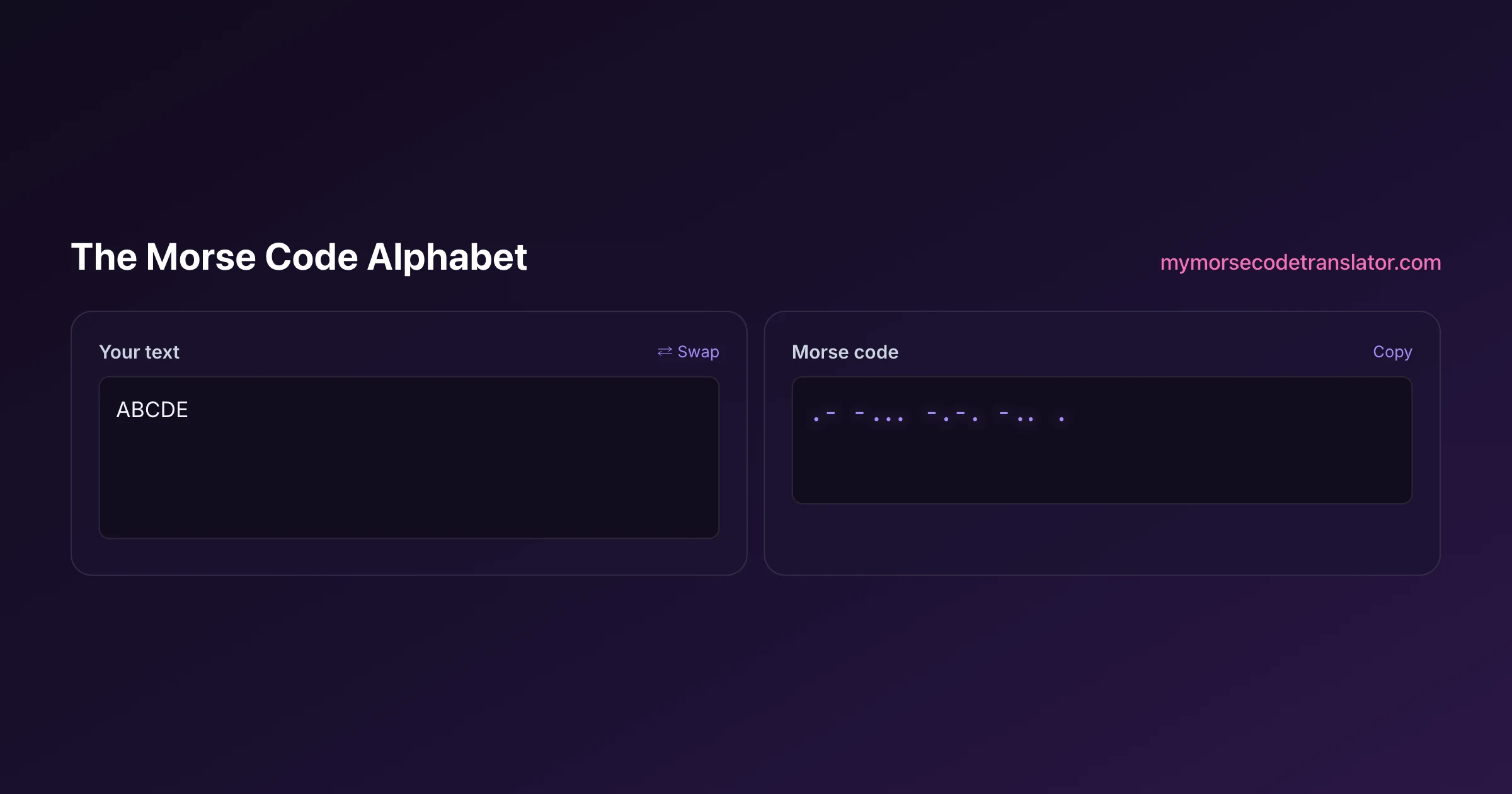
👀 Preview
Press ▶ Play — this shows what you'll see and hear.
Customize your message
Your picture appears in Play and downloaded videos. Note: it can't be included in a shared link — links carry the message only.
Share as a secret message
The message is hidden inside the link and decodes with sound & light when your friend opens it.
The full A–Z chart in dots and dashes
Here is the complete morse code alphabet. A dot (·) is a short signal, written as a period, and a dash (–) is a long signal roughly three times its length. Read each line as "letter: pattern."
- A: .-
- B: -...
- C: -.-.
- D: -..
- E: .
- F: ..-.
- G: --.
- H: ....
- I: ..
- J: .---
- K: -.-
- L: .-..
- M: --
- N: -.
- O: ---
- P: .--.
- Q: --.-
- R: .-.
- S: ...
- T: -
- U: ..-
- V: ...-
- W: .--
- X: -..-
- Y: -.--
- Z: --..
That's it — the entire alphabet fits on a single card. Notice that the shortest, most common letters (E is a single dot, T is a single dash) are also the letters you use most in English. That is no accident, and it's the first clue to how the whole code was designed.
Why the short letters are the common ones
When Samuel Morse and his collaborator Alfred Vail built the code in the 1830s and 1840s, they wanted messages to move fast down a telegraph wire. So instead of assigning patterns randomly, Vail reportedly walked into a local newspaper's print shop and counted how many pieces of movable type the printers kept on hand for each letter — a rough but shrewd proxy for how often each letter appears in written English.
The letters printers stocked the most got the shortest codes. That is why E (·) and T (–) are single elements, while rare letters like Q (--.-) and Y (-.--) get four longer ones. This frequency-weighting means an average English sentence is quicker to send than it would be with a fixed-length code where every letter took the same time. It's an early, elegant example of what engineers now call variable-length encoding — the same core idea that powers modern file compression, worked out with printer's type nearly two centuries ago.
Patterns hiding inside the alphabet
The 26 letters look random at first, but there are internal patterns that make them much easier to swallow in chunks rather than one at a time.
- The all-dot ladder: E (·), I (··), S (···), H (····). Each adds one more dot.
- The all-dash ladder: T (–), M (– –), O (– – –). Each adds one more dash.
- Mirror pairs: several letters are reverses of each other. A (·–) and N (–·) are mirrors; D (–··) and U (··–) are mirrors; G (– –·) and W (·– –) are mirrors; B (–···) and V (···–) are mirrors.
- Near-opposites: K (–·–) and R (·–·) share a shape but swap dots and dashes.
Spotting these relationships turns "26 things to memorize" into a handful of small families. Learn the two ladders first — that's seven letters in a few minutes — then pick up the mirror pairs together, and the alphabet stops feeling like a wall of symbols.
How to actually memorize all 26 letters
Staring at the chart won't make it stick. These are the tricks I lean on hardest when teaching someone from zero:
- Learn by sound, not by sight. Morse is fundamentally an audio language. Say "di" for a dot and "dah" for a dash out loud: A is "di-dah," G is "dah-dah-di," C is "dah-di-dah-dit." Your ear will remember rhythms your eyes forget within an hour.
- Group by shape. Use the ladders and mirror pairs above so you learn letters in related sets instead of alphabetically. Alphabetical order is the worst possible order for learning Morse.
- Use mnemonics for the stubborn ones. Q (--.-) is the "God Save the Queen" cadence; C (-.-.) sits neatly on the "Coca-Cola" jingle; the F, L, and P patterns each respond well to a silly phrase you invent yourself.
- Drill in tiny daily doses. Five minutes every day beats an hour once a week, because recognition is muscle memory.
Avoid one common trap: never memorize the dots and dashes as a visual picture and then try to "read" incoming code by counting the symbols. Fluent operators hear a whole letter as one sound-shape, the way you hear a spoken word rather than spelling it out letter by letter.
Sending the alphabet: spacing matters as much as the letters
Knowing that A is ·– is only half the battle. The gaps between signals carry just as much meaning as the signals themselves. Inside a single letter, dots and dashes are separated by one unit of silence. Between two letters you leave a three-unit gap, and between two words a full seven-unit gap.
Get the spacing wrong and even perfect letters turn to mush — "SOS" (··· ––– ···) can smear into an unreadable run of dots and dashes if the gaps collapse. A helpful mental model is that the gaps are the punctuation of Morse: they tell the reader where one letter ends and the next begins. When you type into a translator like the one on this page, the software handles all of that timing automatically. But if you're keying by hand, flashing a light, or tapping on a wall, rhythm is everything, and clean spacing is what separates a legible message from noise.
This is the international standard, not just one version
The chart above is the ITU International Morse Code — the version standardized worldwide and formally documented in the ITU-R M.1677 recommendation from the International Telecommunication Union. It replaced the older "American Morse" code that ran on 19th-century US landline telegraphs, which used slightly different patterns and some awkward internal spaces that suited a clicking sounder but worked poorly over radio.
Because the international version is universal, the same 26 letters work whether you're a ham radio operator in Japan, a scout earning a badge in Brazil, or someone tapping a message on a phone flashlight in the dark. Wikipedia's Morse code article is a solid free reference if you ever want to cross-check a letter, and it uses this exact ITU standard. Every letter on this site follows it precisely, so what you memorize here will be read the same way by anyone who knows Morse, anywhere on Earth.
Beyond the letters: what comes next
The 26 letters are the foundation, but the full system layers on more once you're comfortable:
- Numbers 0–9, each made of exactly five elements in a tidy, symmetrical pattern.
- Punctuation such as the period (·–·–·–), comma (––··––), question mark (··––··), and slash (–··–·).
- Prosigns — special letter combinations run together as one continuous symbol, such as SOS (···–––···) or AR to mark the end of a message.
Don't rush to these. Get the alphabet automatic first — to the point where you don't have to think — and everything else clicks into place quickly, because it's all built from the same dots, dashes, and gaps. Most learners find the letters deliver 80 percent of the practical value on their own: with the alphabet alone you can spell a name, flash a distress word, decode a bracelet, or send a hidden message to a friend.
What the alphabet doesn't cover
It's worth being clear about the edges of the 26-letter alphabet so you're not caught out later. Standard International Morse Code was built around the basic Latin letters, so a few things sit outside the core chart:
- Accented and non-English letters. Languages like French, German, and Spanish add characters such as é, ä, ñ, and ü, which have their own agreed Morse patterns but aren't part of the 26 you'll learn first.
- Case. As noted above, there's simply no uppercase or lowercase — the code doesn't distinguish them at all.
- Modern symbols. There's no native pattern for things like @, though the ITU did add one (·––·–·) in 2004 for email addresses, which is a rare example of the standard being updated in the internet age.
None of this should worry a beginner. The 26 English letters carry the overwhelming majority of real-world use, and you can add the extras later if a specific language or callsign ever demands them. Learn the core chart first, thoroughly, and treat everything else as optional bonus material.
The single letters people look up most
A large share of visitors to this page want exactly one letter, so here are the most-requested ones spelled out, with something worth knowing about each.
A is .- — dot dash, the first letter most people learn after E and T, and one half of the most-confused pair in the alphabet (its mirror is N, dash dot).
E is . — a single dot, the shortest signal in the entire system, assigned to the most common letter in English.
I is .. — two dots. Blink it, tap it, or send it; it is about as simple as a letter gets.
J is .--- — dot dash dash dash, one of the longest and most distinctive letters, and one of the few that ends in three dashes.
S is ... — three dots, famous as the first third of SOS.
O is --- — three dashes, the middle of SOS and the longest-sounding of the common letters.
Z is --.. — dash dash dot dot, which beginners regularly mix up with G (--.) and Q (--.-).
If the letter you need is not in this shortlist, the full chart above has all twenty-six — or type it into the translator and hear it played back, which fixes the spelling and the rhythm in one go.
The mirror-image pairs that trip everyone up
Six pairs of letters use identical marks in opposite order, and they cause more decoding errors than everything else combined:
- A (
.-) and N (-.) - D (
-..) and U (..-) - G (
--.) and W (.--) - B (
-...) and V (...-) - F (
..-.) and L (.-..) - Q (
--.-) and Y (-.--)
The practical advice is to learn these as pairs, deliberately, rather than meeting them separately in alphabetical order. Drill A against N until the rising rhythm of dot-dash and the falling rhythm of dash-dot feel like different words rather than the same marks rearranged. Every one of these pairs is distinguishable by feel long before it is distinguishable by counting — and counting is exactly the habit you want to avoid building.
Saying the alphabet out loud: dits and dahs
Operators do not say "dot" and "dash" when they voice Morse — they say dit and dah, because those syllables can be spoken at the same rhythm the code is sent. A is di-dah. C is dah-di-dah-dit. The convention is that a dit inside a letter is voiced di and only the final one gets the full dit.
This sounds like trivia but it is genuinely useful for learning. Saying di-dah-di-dit for L while you write it engages your ear as well as your eye, and the whole point of the alphabet is eventually to be heard rather than read. If you practise voicing letters as you look them up on this page, you are quietly building the exact skill that reading by ear requires.
It is also the fastest way to communicate a letter to another person without a tool — spelling a name over a noisy phone line as di-dah, dah-di-dit is unambiguous in a way that "A as in... apple?" never quite is.
Using the alphabet for names and initials
The most common real-world use of this page is not radio and not survival — it is converting a name or a pair of initials for something personal: a bracelet, an engraving, a card, a tattoo.
A few things matter more for names than for ordinary text. First, double letters are easy to lose: HANNAH has two Ns and two As back to back in the middle, and dropping one changes the name. Second, initials sent together need a clear gap between the letters or they merge — J.M. as .--- -- reads fine with proper spacing and becomes an unreadable seven-mark run without it. Third, always decode your final pattern backwards before committing it to metal, beads or skin: paste the dots and dashes into the decoder and confirm the name comes back exactly right.
For anything longer than initials, type the name into the translator above rather than assembling it letter by letter from the chart — hand-assembly is where the single-dot errors creep in.
When I first drilled the alphabet I made paper flashcards with the letter on one side and the rhythm on the other — but the day I switched to saying "di-dah" out loud on my walk to work, my recall roughly doubled within a week. The letters that had felt slippery for a month (F, L, Q) suddenly clicked, because I was finally learning them as sounds instead of shapes.
Frequently Asked Questions
Q. How many letters are in the Morse code alphabet?
Twenty-six — one pattern of dots and dashes for each letter A through Z in the standard English alphabet. Numbers and punctuation exist too but are counted and learned separately from the core 26-letter alphabet.
Q. What is the easiest letter in Morse code?
E is the single easiest: it's one dot (·). T is just as simple at one dash (–). These two are the most common letters in English, which is exactly why the code's designers gave them the shortest possible patterns.
Q. What is the hardest letter to remember?
Most beginners struggle with the four-element letters that mix dots and dashes unpredictably, like Q (--.-), Y (-.--), and C (-.-.). Rhythm mnemonics such as the "God Save the Queen" cadence for Q make them far stickier than rote memorization.
Q. Is the Morse code alphabet the same in every country?
Yes, for the Latin letters. The ITU International Morse Code is a global standard (ITU-R M.1677), so A is ·– everywhere. Some languages add extra characters for accented letters, but the 26 core letters are identical worldwide.
Q. Should I learn Morse by reading the dots or hearing them?
By hearing them. Morse is fundamentally a sound-based language. Learning the visual dots and dashes first actually slows most people down, because fluent reading depends on recognizing each letter as a rhythm rather than counting symbols on a page.
Q. Do capital and lowercase letters differ in Morse code?
No. Morse code has no concept of upper or lowercase. The pattern for A is the same whether you mean "a" or "A," so case is simply dropped when text is encoded into dots and dashes.
Q. What order should I learn the letters in?
Not alphabetically. Learn the all-dot ladder (E, I, S, H) and all-dash ladder (T, M, O) first, then mirror pairs like A/N and D/U. Grouping related shapes together is much faster than plowing through A to Z in order.
Q. Can I type letters and get Morse instantly?
Yes — the translator on this page converts any letters you type into the correct dots and dashes in real time, with proper spacing, and can play them back as audio so you learn the sound of each letter as well as its shape.
Related guides
← Back to the My Morse Code Translator home page.

By Sukie
Sukie is the creator of My Morse Code Translator — a puzzle nerd and gadget tinkerer who fell down the Morse code rabbit hole and decided to build the most fun Morse translator on the web. When she's not adding new sound packs or reveal animations, she's decoding hidden messages in songs or designing Morse code bracelets for friends.
Last updated: 2026-07-08