Send a Secret Morse Message With a Shareable Link
Send a secret morse message the way spies wish they could: you type something, the tool hands you a single link, and whoever opens it sees the message revealed in flashing light and dit-dah sound. Here's the part I'm proud of — the message rides inside the link itself, not on any server. I never see it, no database stores it, and there's nothing to leak or delete. The secret lives only in the URL, and only for as long as that link exists in your chat.
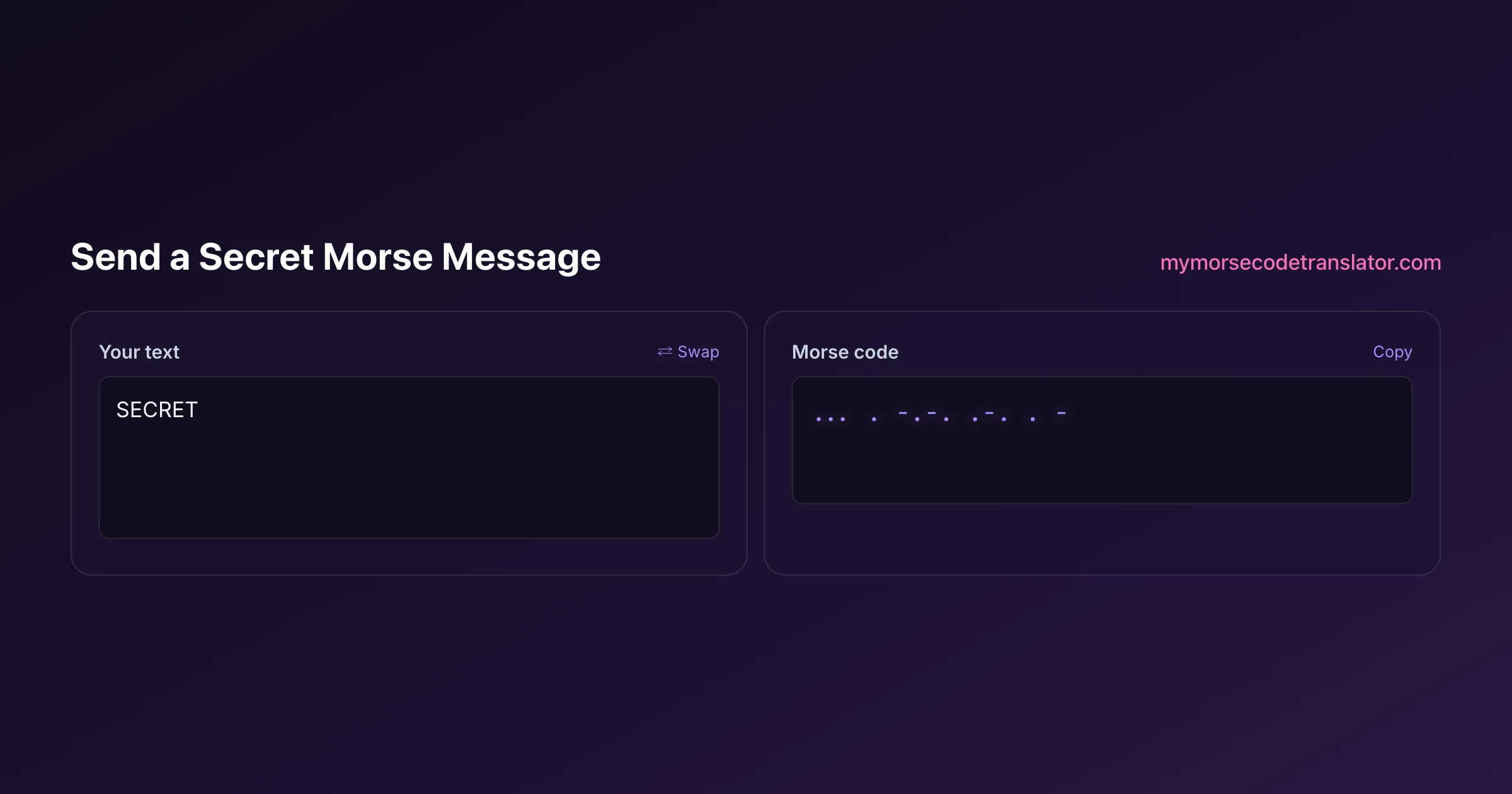
No secret message in this link yet. Create one with the translator below and tap “Copy link” to send it to a friend.
👀 Preview
Press ▶ Play — this shows what you'll see and hear.
Customize your message
Your picture appears in Play and downloaded videos. Note: it can't be included in a shared link — links carry the message only.
Share as a secret message
The message is hidden inside the link and decodes with sound & light when your friend opens it.
How the secret hides inside the link
When you create a message, the tool doesn't save it anywhere. It encodes your text and packs it into the web address itself — specifically into the part of the URL after a # symbol, called the fragment.
That detail is the whole trick, and it's a nice one. Browsers never send the fragment portion of a URL to the server. So even the act of opening the link doesn't transmit your message to me or anyone else; the browser reads the fragment locally and reveals the message right there on the recipient's device. It's genuinely serverless secrecy: the message exists in the link, in your chat history, and nowhere else. There's no "delete my data" button because there's no data of yours for me to hold in the first place.
This is the same fragment-URL technique used by a number of privacy-first note tools, and I chose it deliberately over a database because the most private message is one that was never stored.
What the recipient experiences
Opening the link isn't like reading a text — it's a small reveal, which is most of the fun.
The recipient lands on a page that plays the message out: the screen flashes the code in real Morse timing while the matching beeps sound, dot by dot and dash by dash. If they know Morse, they can read it live off the light or the audio. If they don't, the page can also show the decoded plain-text answer, so nobody's locked out of their own surprise. You can lean either way — send it to a fellow code nerd as a pure light-and-sound puzzle, or send it to a partner with the reveal so they get the romance without the homework. Because it plays with both flash and tone, it works whether they're somewhere they can look at a screen or somewhere they can only listen.
That dual-channel reveal is deliberate. A message that only flashed would be useless to someone on a bright bus; a message that only beeped would be useless to someone in a silent library. By carrying the same code as both light and sound, the reveal adapts to wherever the recipient happens to be, and it also quietly teaches: someone who watches the flash while hearing the matching beep starts to connect the visual and audible shape of each letter without even trying. Several people have told me they accidentally learned a few letters of Morse just from opening secret links their friends sent them, which is exactly the kind of sneaky education I'm happy to be responsible for.
Fun ways people use it
A secret-message link is a tiny gift, and people have gotten wonderfully creative with it.
- Digital love notes: encode "I love you" or an inside joke and drop the link into a text with no explanation.
- Scavenger hunts: each clue is a Morse link leading to the next location.
- Proposals and reveals: a coded message that decodes to "marry me" or a baby's due date.
- Party invites: a mysterious flashing link that decodes to the address and time.
- Two-person ciphers: a running private channel where you and one friend send coded links back and forth for fun.
- Classroom puzzles: a teacher shares one link and the class races to decode the flashing message.
Because the whole message is in the link, sending it is as easy as pasting a URL into any app — text, email, a chat, a note tucked into a card as a QR code.
How private is it, really?
Let me be precise, because "secret" is a strong word and I don't want to oversell it.
What's true: your message is never stored on my server and never transmitted to me, because the fragment stays in the browser. There's no account, no log, no database entry. In that sense it's more private than almost any messaging app, where the text sits on a company's servers.
What's also true: the link itself contains the message in an encoded — not encrypted — form, so anyone who has the link can reveal it. If it lands in the wrong chat, or someone reads over a shoulder, the secret is out, exactly as it would be with a note passed in class. Treat it as a playful cipher and a private toy, not as protection for anything that would genuinely harm you if seen. For real secrets, use proper end-to-end encrypted messaging. For a flirty coded note, a scavenger-hunt clue, or a surprise reveal, this is perfect — and the fact that nothing is ever stored means it can't be quietly harvested later. That balance is exactly what I was going for.
Morse as a cipher: old idea, new delivery
Using Morse to hide a message isn't a modern invention — it's one of the oldest tricks in the book, and knowing the history makes this tool more fun to use.
Morse was never designed as a secret code; it was designed to be as clear and universal as possible, which is why the international standard (ITU-R M.1677) keeps it rigidly consistent worldwide. But because most people can't read it at a glance, it has always doubled as a light cipher — a message hidden not by scrambling it but by writing it in a script most eyes skip over. Prisoners of war famously blinked it in filmed "confessions"; scouts and spies signalled it across valleys; kids have passed dot-dash notes for generations.
What this tool changes is the delivery. Instead of a lamp or a tapped pipe, the carrier is a URL, and instead of the recipient needing to know Morse, the page can flash it, beep it, and decode it for them. It's the same century-old idea — hide meaning in rhythm — wearing modern clothes. That lineage is exactly why I leaned into light and sound for the reveal rather than just showing text: it honors how the code was always meant to travel.
Making the reveal land: a few tips
A secret link is only as good as the moment someone opens it, so here's how to make that moment hit.
- Keep the message short for a first-time recipient. A single word or a name reveals cleanly; a paragraph turns into a long light show they'll skip.
- Send it with zero explanation. The mystery of an unlabeled link is half the magic — let them wonder before they open.
- Tell them to turn their sound on and dim the lights if the reveal uses the flash, so the light-and-beep effect actually lands.
- For a proposal or big reveal, do it in person and watch their face as the message resolves — the pacing of Morse builds a little suspense you don't get from a plain text.
- Chain links for a hunt: each revealed message names where to find the next link. A five-link Morse trail is a genuinely memorable birthday surprise.
The tool does the encoding; you supply the timing and the theatre. A well-placed secret Morse link punches far above the two minutes it takes to make.
I tested the privacy claim myself by opening a secret link with my browser's network tab recording. The message text never appeared in a single outgoing request — the fragment after the # genuinely stayed on my device. Watching that empty request log is what convinced me the fragment approach was worth building around.
Frequently Asked Questions
Q. Where is my secret message actually stored?
Nowhere on a server. The message is encoded into the fragment of the link — the part after the # — which browsers never send to the server. It exists only in the link itself and wherever you've pasted that link, like your chat history.
Q. Can you read the messages people send?
No. Because the message lives in the URL fragment and browsers don't transmit that part to the server, your text never reaches me. There's no database, no log, and nothing for me to read, sell, or leak.
Q. How does the recipient see the message?
They open the link and the page plays it out in flashing light and matching Morse beeps. If they know code they can read it live; if not, the page can also show the decoded plain text so they're never locked out of their own surprise.
Q. Do I need an account to send one?
No account, no sign-up, no app. You type your message, copy the link the tool generates, and paste it wherever you want. That's the whole process.
Q. Can anyone with the link read it?
Yes. The message is encoded, not encrypted, so whoever holds the link can reveal it. Treat it like a note passed in class — private and fun, but readable by anyone who gets their hands on the link.
Q. Is this secure enough for truly sensitive information?
No. It's a playful cipher, not a security tool. Nothing is stored on a server, which is great for privacy, but the link itself carries the message in readable-if-you-have-it form. For anything genuinely sensitive, use a proper end-to-end encrypted messaging app.
Q. What happens if I lose the link?
The message is gone, because nothing is stored anywhere else. The only copy of the secret is the link. That's a feature for privacy, but it means you should keep the link if you want to send it again.
Q. Can I send it through any app?
Yes. It's just a URL, so it pastes into texts, email, chat apps, notes, or even a printed QR code. If the app can carry a link, it can carry your secret Morse message.
Q. Does it work if the recipient doesn't know Morse?
Yes. The reveal page can display the decoded plain-text message alongside the flashing light and sound, so a recipient who doesn't read code still gets the message — with the fun of the light-and-beep reveal on top.
Q. Can I use it for a scavenger hunt or proposal?
Those are two of the most popular uses. Chain several links as hunt clues, or encode a single big reveal like "marry me" or a due date. The mysterious flashing link builds anticipation before the message resolves.
Q. Will the message expire?
There's no timer, because there's nothing stored to expire. The link works as long as it exists. If you want it to disappear, just delete the message containing the link from your chat — that's the only copy.
Q. Does opening the link send my data anywhere?
No. The reveal happens entirely in the recipient's browser by reading the URL fragment locally. Even opening the link doesn't transmit the message to any server, which is the core reason this method is so private. You can verify it yourself by opening a link with your browser's developer tools recording network traffic — the message text never appears in a single outgoing request, because everything after the # stays on the device.
Related guides
← Back to the My Morse Code Translator home page.

By Sukie
Sukie is the creator of My Morse Code Translator — a puzzle nerd and gadget tinkerer who fell down the Morse code rabbit hole and decided to build the most fun Morse translator on the web. When she's not adding new sound packs or reveal animations, she's decoding hidden messages in songs or designing Morse code bracelets for friends.
Last updated: 2026-07-08