What Is Morse Code? History, How It Works, and Why It Endures
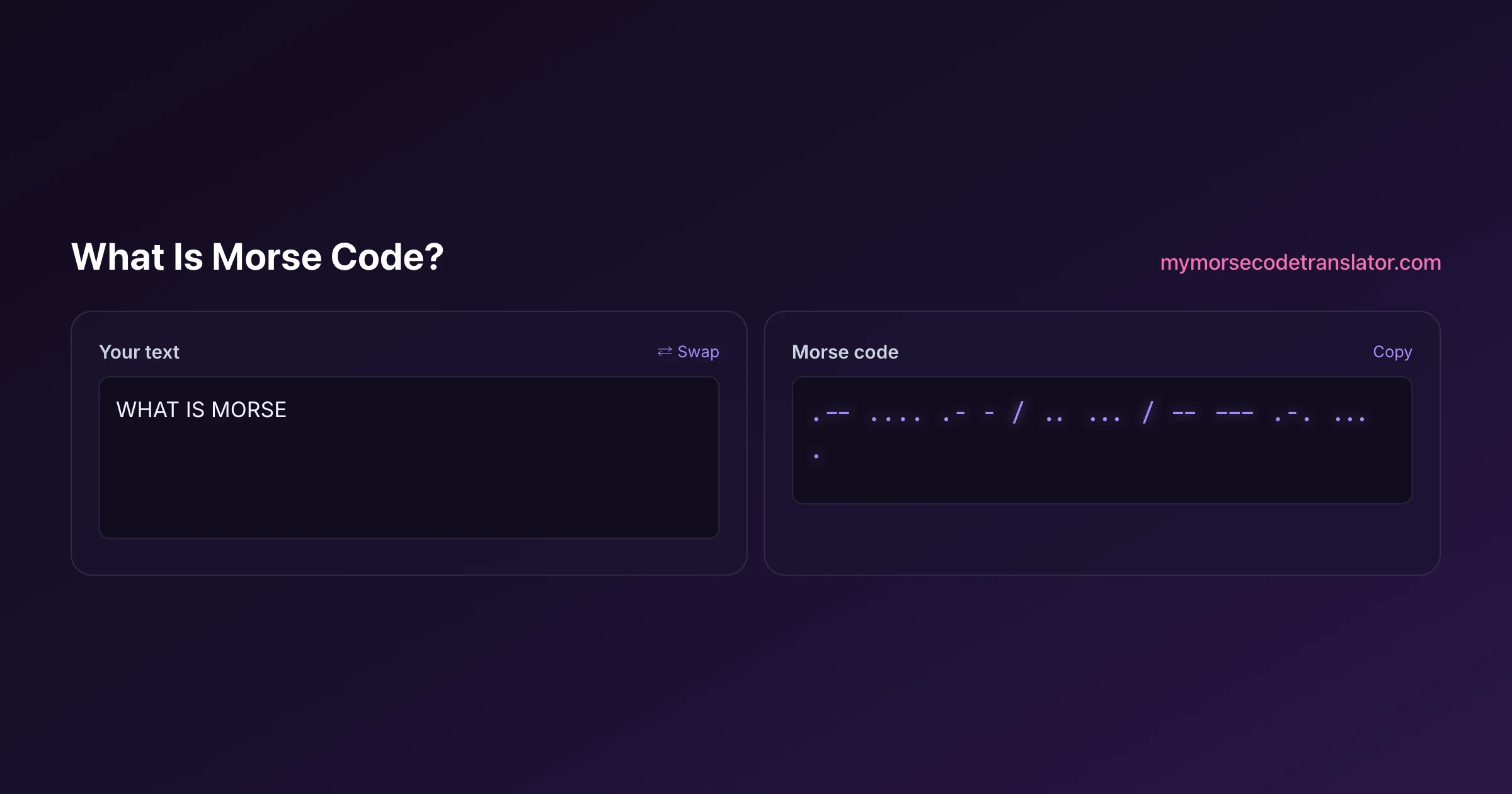
What is morse code? It's a method of representing letters, numbers, and punctuation as sequences of two simple signals — short ones called dots and long ones called dashes — that can be sent as sound, light, or electrical pulses. Invented in the 1830s to carry messages down telegraph wires, it became the first technology to let people communicate across continents in near real time, and nearly two centuries later it's still saving lives and fascinating hobbyists. Here's the full story of where it came from and why it endures.
The short definition
At its core, Morse code is a way to spell out text using just two states: on and off, short and long. Each character in the alphabet, each digit from 0 to 9, and each common punctuation mark gets its own unique pattern of dots and dashes.
Because it needs only two distinguishable signals, Morse can travel over almost any channel imaginable: a beeping tone, a flashing lamp, a tapping finger, a pulse of electricity down a wire, or even a series of deliberate eye blinks. That flexibility — one code, countless possible carriers — is precisely why it has outlasted the specific technology it was born on. The telegraph is a museum piece; the code that ran on it is still in daily use.
Samuel Morse and the birth of the telegraph
The code carries the name of Samuel F. B. Morse, an accomplished American painter who turned inventor. Together with his collaborator Alfred Vail and building on the earlier electromagnetic work of physicist Joseph Henry, Morse developed a practical electric telegraph in the 1830s. The often-told story is that Morse became fixated on rapid long-distance communication after a painful personal loss: while he was away working on a portrait, his wife fell ill and died, and the letter carrying the news reached him too late for him to return in time. Whether or not that single event drove him, the problem he set out to solve was real — information moved only as fast as a horse or a ship could carry it.
The first message sent over Morse's experimental line between Washington, D.C., and Baltimore in 1844 was "What hath God wrought," a biblical phrase chosen by Annie Ellsworth, the daughter of a friend. It was a genuine turning point in human history: for the first time, information could move faster than any person carrying it. Within decades, telegraph wires laced across nations and continents, and by 1866 a durable cable spanned the Atlantic Ocean, linking Europe and North America in minutes rather than weeks.
How the code actually works
Morse encodes text with a clever economy that still impresses engineers today. Common letters get short codes and rare letters get long ones, so an average message sends quickly. E, the most common letter in English, is a single dot; T is a single dash; the rarely used Q is dash-dash-dot-dash. This deliberate weighting toward frequent letters is an early form of what we now call variable-length encoding — the same principle that underlies modern data compression.
The system also depends entirely on timing. A dash is exactly three times as long as a dot. The silences do real work too: a short one-unit gap separates the dots and dashes within a single letter, a longer three-unit gap separates one letter from the next, and the longest seven-unit gap separates one word from another. Get the timing right and the message is crystal clear; let the gaps collapse and even correct dots and dashes turn to nonsense. In a real sense, the silences are as much a part of the code as the sounds.
American Morse versus International Morse
There have actually been two main versions of the code, and confusing them is a common mistake. The original "American Morse" (sometimes called Railroad Morse) was used on 19th-century US landline telegraphs. It included some awkward internal spaces and dots of different lengths that worked acceptably on a clicking mechanical sounder but performed poorly once signals moved onto radio, where those subtle timing quirks were easily lost in static.
As telegraphy went international and later shifted to radio, a cleaner variant known as International Morse Code — originally called Continental Morse — won out decisively. It's the version used everywhere in the world today, and it's formally documented by the International Telecommunication Union in its ITU-R M.1677 recommendation. When people say "Morse code" now, they almost always mean this international standard: the same version used on every page of this site, and the one you should learn.
SOS, the Titanic, and Morse at sea
Morse code became the backbone of maritime safety for the better part of a century. Ships used spark-gap radio to send Morse across open water where no other form of communication could reach. The famous distress signal SOS — dot-dot-dot, dash-dash-dash, dot-dot-dot — was adopted as the international standard by the International Radiotelegraph Convention, agreed in 1906 and coming into force in 1908. It was chosen purely because it is simple, symmetrical, and unmistakable, not because it stands for "Save Our Souls," which is a later invented explanation.
When the RMS Titanic struck an iceberg in 1912, her wireless operators sent Morse distress calls — using both the older CQD signal and the newer SOS — that summoned the RMS Carpathia to rescue the survivors from the freezing North Atlantic. The disaster led directly to stronger international rules requiring passenger ships to keep their radios staffed around the clock, so a distress call would never again go unheard because an operator had gone to bed. That reform cemented Morse code's role in saving lives at sea for the rest of the century.
Morse in war and espionage
Through both World Wars, Morse code carried the bulk of military communication, and its greatest strength was something that sounds like a weakness: its very low bandwidth. A faint, noisy signal that would be completely useless for voice transmission could still be copied dot by dot by a skilled operator wearing headphones. That resilience made Morse indispensable when conditions were bad, range was extreme, or transmitter power was tiny.
Its adaptability also made it perfect for covert use. Prisoners of war famously exploited the fact that Morse can be hidden in almost anything — a cough, a tap on a wall, the blink of an eye. The most legendary example came in 1966, when captured US Navy pilot Jeremiah Denton, forced to appear in a propaganda interview, blinked the word "T-O-R-T-U-R-E" in Morse code while answering questions on camera, secretly confirming to intelligence analysts back home that American prisoners were being mistreated. A code you can transmit as light, sound, or the smallest physical gesture is a quietly powerful tool, and it stayed useful long after voice radio existed.
Where Morse code lives today
Morse is no longer required for a ham radio license in most countries — the United States dropped the requirement in 2007 — and commercial maritime Morse officially ended in 1999. Yet the code is far from dead. Its modern homes are surprisingly varied:
- Amateur radio, where thousands of enthusiasts prize "CW" (continuous wave) for its efficiency and its ability to reach across the world on just a few watts of power.
- Aviation, where many ground-based navigation beacons still identify themselves by transmitting their letter codes in Morse.
- Accessibility, where people with limited mobility use Morse input to type and speak through assistive communication devices, controlling a computer with as little as a single switch.
- Emergency signaling, where flashing SOS with a torch, whistle, or mirror remains a universally taught survival skill.
- Culture and craft, where people encode initials, names, and dates into jewelry, tattoos, and even the hidden rhythms of pop songs.
For a thorough, well-sourced overview, Wikipedia's Morse code article is an excellent free reference, and the ARRL — the American Radio Relay League — maintains active resources for the amateur radio community that keeps the skill alive and growing.
Why it has lasted almost 200 years
Very few technologies from the 1830s are still in genuine daily use. Morse survives because it is, in effect, the minimum viable communication system: two signals, no special equipment required beyond something that can turn on and off, and a design efficient enough to punch through noise that defeats far more sophisticated systems. When everything else fails — the power, the network, the fancy hardware — a person who knows Morse can still get a message out with a flashlight or a piece of metal to tap on.
It is also a deeply human skill. Learning Morse is learning a rhythm, and experienced operators say they can recognize a friend's "fist" — their personal, slightly idiosyncratic keying style — the way you'd recognize a familiar voice on the phone. In an age of instant global messaging, the slow, deliberate craft of sending dots and dashes has become something people choose to do for the pleasure and the connection of it, rather than out of necessity. That may be the most durable reason of all: Morse endures not just because it works, but because people love it.
Where Morse code is still used today
It is commonly said that Morse is obsolete. That is true of its original job and false of the code itself, which is still in daily working use in several places.
Amateur radio. This is the largest active community by far. CW remains popular because it works at signal strengths where voice does not — a weak Morse signal is readable through noise that renders speech unintelligible, and it needs a fraction of the bandwidth and power. There are daily conversations and organised contests on the shortwave bands.
Aviation navigation. Non-directional beacons and VOR stations identify themselves by transmitting a two or three letter code in Morse, continuously. Pilots verify they have tuned the right station by listening for it, and instrument training still includes recognising those identifiers.
Assistive technology. For people with severe motor impairments, Morse can be an input method — a single switch operated by whatever movement is available, translated into text. Two distinguishable durations is a very low bar for an input device, which makes it viable where a keyboard is not.
Emergency signalling. SOS remains the internationally recognised distress pattern, and the ability to send it with a torch, a mirror, a whistle or by tapping is genuinely taught in survival and maritime training.
Accessibility and alerts. Some devices use Morse-derived patterns for haptic or audible notification, on the same principle that made it useful in the first place: it survives a channel that carries almost no information.
What is genuinely gone is commercial and maritime Morse. The requirement for ships to maintain a Morse watch ended in 1999, and the commercial telegraph networks closed long before that. The code outlived the industry that created it because it turns out to be the most robust way to push language through a channel that can only be on or off.
I fell down the Titanic rabbit hole while building this site and spent an evening reading the actual transcripts of the 1912 wireless traffic — the mix of the older CQD and the newer SOS in those logs is what made the 1906–1908 changeover feel real to me rather than a dry date in a textbook. It's also why I double-checked every historical claim on this page against the ITU standard and primary accounts instead of trusting the popular myths that float around online.
Frequently Asked Questions
Q. Is morse code still used today?
Yes, though not commercially. Amateur radio operators use it daily, aviation beacons transmit their identifiers in it, it serves as an input method in some assistive technology, and SOS remains the recognised distress signal. Maritime Morse watch requirements ended in 1999.
Q. Why does morse code work when voice does not?
Because it needs far less bandwidth and power, and because a listener can pull a simple on-off tone out of noise that would render speech unintelligible. That robustness is why it persists on radio and in emergency signalling.
Q. Do you still need morse code for a radio licence?
In most countries, no. The Morse proficiency requirement for amateur licences was dropped internationally in 2003 and has since been removed by nearly every national authority. Plenty of operators still learn it because they want to, not because they must.
Q. What is Morse code in simple terms?
It's a way of spelling out text using two signals — short dots and long dashes — that can be sent as sound, light, or electrical pulses. Each letter and number has its own unique dot-and-dash pattern, so any message can be encoded and decoded using just those two building blocks.
Q. Who invented Morse code?
It's credited to Samuel F. B. Morse, working with Alfred Vail, in the 1830s and 1840s as part of developing the electric telegraph. Vail is thought to have refined the actual dot-and-dash assignments, cleverly giving the most common letters the shortest codes.
Q. Does SOS stand for anything?
No. SOS was chosen in 1906 and adopted internationally in 1908 simply because its pattern — dot-dot-dot, dash-dash-dash, dot-dot-dot — is easy to send and impossible to mistake. Phrases like Save Our Souls or Save Our Ship were invented afterward as memory aids.
Q. Did Morse code save the Titanic's survivors?
Morse distress calls from the Titanic in 1912 summoned the RMS Carpathia, which rescued roughly 700 survivors. The disaster also led to new rules requiring ships to monitor their radios continuously, which strengthened Morse's role in maritime safety for decades afterward.
Q. Is Morse code still used today?
Yes. It remains popular in amateur radio, identifies aviation navigation beacons, powers some assistive communication devices, and is still a taught emergency-signaling method. It's no longer legally required for radio licenses in most countries, but a large hobbyist community keeps it thriving.
Q. What is the difference between American and International Morse code?
American Morse was the original 19th-century US landline version, with some irregular spacing that suited clicking telegraph sounders. International Morse Code is the cleaner, globally standardized version used today, defined in the ITU-R M.1677 recommendation and used on radio worldwide.
Q. Why is Morse code so hard to jam or lose in noise?
Because it needs only two distinguishable states, a Morse signal can be copied even when it's extremely faint or buried in static — conditions that would make voice transmission unintelligible. A skilled operator can pull dots and dashes out of noise that carries almost no other usable information.
Related guides
← Back to the My Morse Code Translator home page.

By Sukie
Sukie is the creator of My Morse Code Translator — a puzzle nerd and gadget tinkerer who fell down the Morse code rabbit hole and decided to build the most fun Morse translator on the web. When she's not adding new sound packs or reveal animations, she's decoding hidden messages in songs or designing Morse code bracelets for friends.
Last updated: 2026-07-08