Emoji Morse Code: A Playful Way to Hide Messages in Dots and Dashes
Emoji morse code started, for me, as a dare. A friend bet I couldn't send her a birthday message that looked like nothing but a row of hearts and stars — no letters at all — and still have it decode to real words. Emoji morse code is exactly that trick: you keep the dot-and-dash structure of real Morse but swap the marks for emoji, so a wall of symbols quietly spells something out. It looks like keyboard confetti and reads like a secret.
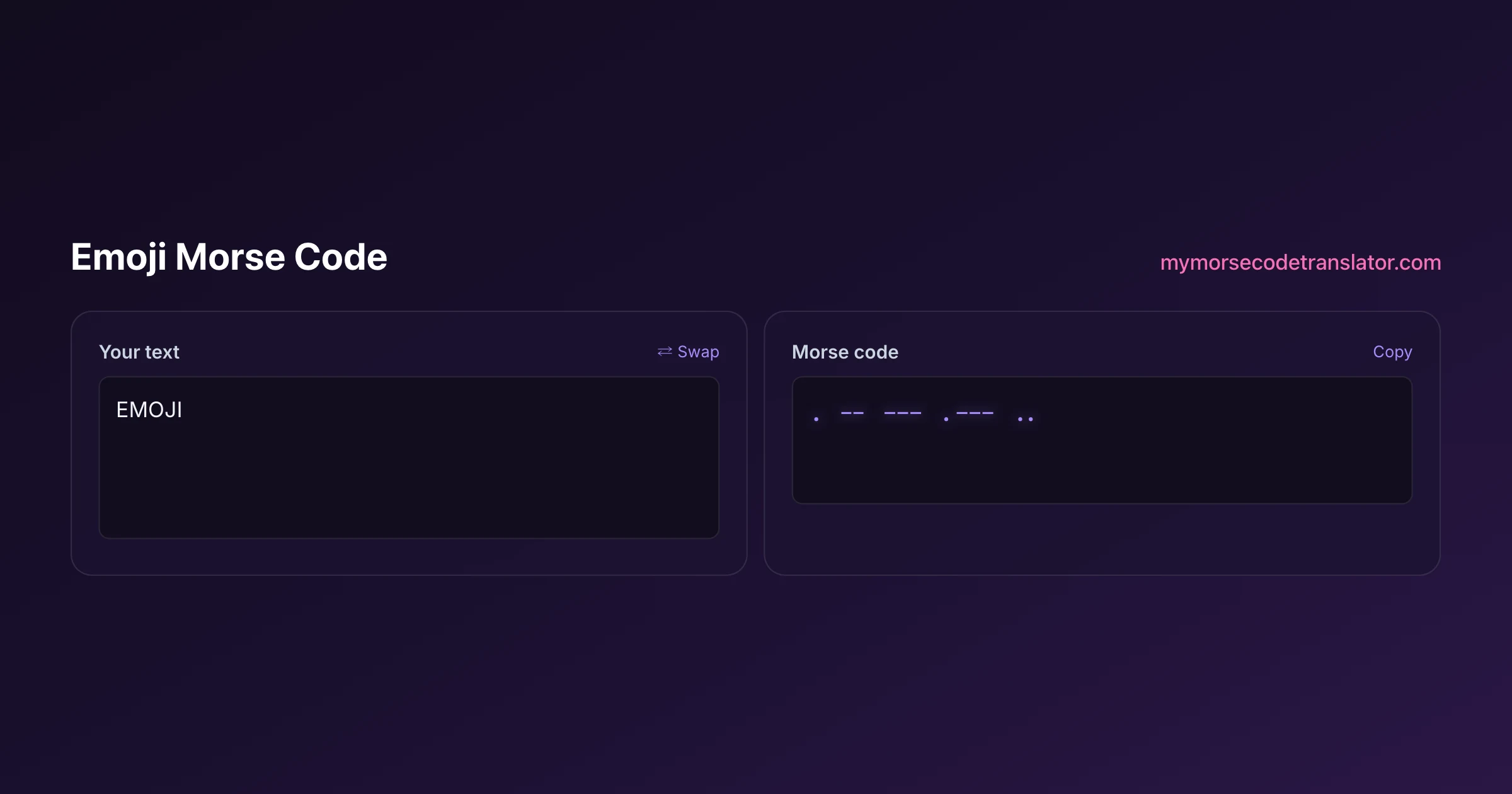
So what is emoji morse code, really?
Here's the thing people get wrong first: emoji morse code is not a brand-new alphabet where a smiley face means a specific letter. That would collapse the moment you ran out of emoji or forgot which face was which.
Instead, it's ordinary Morse code wearing a costume. Underneath, every letter is still made of the same dots and dashes defined by the international ITU-R M.1677 Morse standard. The only change is cosmetic: you pick one emoji to stand in for the dot and a different emoji to stand in for the dash, and you keep the gaps that separate letters and words.
Say you choose a heart for the dot and a star for the dash. The letter A, which is dot-dash, becomes heart-star. The letter N, which is dash-dot, becomes star-heart. Decode it by translating each emoji back to its mark, and you're reading normal Morse again.
That's the whole secret. The intelligence lives in the rhythm and the spacing; the emoji are just paint. Which is also why it's so forgiving and so fun — you can restyle the same hidden message a hundred different ways without ever touching the underlying code.
Turning a message into emoji morse code, without losing your mind
Walk through a tiny one with me — the word HI, because it's short and photogenic.
First, get the plain Morse. H is four dots. I is two dots. So HI is: dot dot dot dot (gap) dot dot.
Now pick your two emoji. Let's say a small blue dot emoji for the dot and a long dash-like emoji, or honestly just a fire emoji, for the dash. Since HI happens to be all dots, it becomes six dot-emoji with a visible gap in the middle to separate the H from the I.
The gap is the part everyone under-thinks. Between marks inside one letter, keep them touching. Between letters, leave a clear space — a plain blank space works, or a neutral emoji you agree means 'letter break.' Between whole words, leave an even bigger gap, or drop in a slash or a distinctive emoji as a word separator.
If you skip the spacing, your reader gets one uninterrupted smear of symbols and no way to tell where H ends and I begins. I learned this the embarrassing way — see below. Get the plain Morse right first, choose your two emoji, then dress it up. Never try to compose directly in emoji; you'll drop a mark and never find it.
Fun places emoji morse code actually shines
This is squarely a for-fun encoding, and that's the point. A few uses that people genuinely enjoy:
- Sneaky social posts. A caption that's just a string of emoji looks like decoration to everyone scrolling past, but the one friend you tipped off can decode a hidden note. It's a low-stakes inside joke that survives in plain sight.
- Anniversary and birthday messages. Encoding a short phrase like a nickname or a date into hearts and sparkles makes a card feel handmade without a single readable word giving it away.
- Puzzle and party games. Hand players a napkin covered in fruit emoji and tell them it's a message. The 'aha' when someone realizes there are only two emoji, alternating in patterns, is the best part.
- Themed profiles and bios. Gamers and hobby communities love hiding a tag or a catchphrase in a status line using emoji that match their theme.
What it is not, to be crystal clear, is security. Like all Morse, it's a public, reversible encoding — anyone who notices there are exactly two repeating emoji can crack it in minutes. Treat it as a wink, never a lock.
The Unicode problem nobody warns you about
Emoji look simple but are secretly messy, and that messiness bites emoji morse code in three specific ways.
First, some emoji aren't a single character. Many — flags, people with skin-tone modifiers, family combos — are actually several Unicode code points glued together by the emoji standard the Unicode Consortium publishes each year. If your dot emoji is secretly a two-part sequence, copying and splitting it can shatter it into pieces and wreck the pattern. Stick to simple, single-code-point emoji for your dot and dash.
Second, rendering varies by device. The same code point can look like a filled heart on one phone and an outlined one on another, or show as an empty box on an older machine. If your reader's device draws your dash-emoji as a blank tofu square, the rhythm becomes unreadable. Choose common, boring, universally supported emoji.
Third, invisible width. Some emoji render wider than others, which visually distorts where the letter gaps sit even when the underlying data is perfect. Pick a dot and a dash emoji of similar visual weight so the eye can still parse the grouping. None of this is a flaw in Morse — it's the modern emoji ecosystem being complicated, and knowing it up front saves you a baffled evening.
Choosing emoji that carry a little extra meaning
Because the emoji themselves are pure decoration, you get a free layer of storytelling most codes don't offer — the choice of symbols can hint at the message without giving it away.
Sending a message about the ocean? Make your dot a water drop and your dash a wave. A message tied to a football team? Use the team's colors or a ball for one of the marks. The decoded words are what matter, but the theme of the emoji sets a mood and can be a clue in itself for puzzle games. I've watched players crack a message faster simply because the emoji nudged them toward the right topic.
There's a gentle art to it, though. The two mark-emoji still need to be easy to tell apart, so don't sacrifice clarity for theme — a wave and a water drop can look too similar in a small font. Pick a themed pair only if they read as clearly distinct at a glance. And keep any separator emoji visually neutral and obviously different from your two marks, so it never gets mistaken for a dot or a dash.
My favorite combination for a warm message is a heart for the dot and a sparkle for the dash: high contrast, universally supported on every device I've tested, and it makes even a plain nickname feel like a little celebration when it finally decodes.
Tips for emoji morse code that actually decodes on the other end
A short field guide from sending far too many of these:
- Agree on the key first. The receiver has to know which emoji is the dot and which is the dash. Without that, they're staring at art. A one-line 'heart = dot, star = dash' at the top is enough, or send it separately if you want the mystery.
- Use exactly two emoji for the marks. The instant a third symbol appears, decoding gets ambiguous. Reserve any extra symbol strictly for spacing, and say so.
- Make the two emoji obviously different. A blue circle and a red circle are too similar at a glance; a heart and a lightning bolt read cleanly. Contrast helps the eye chunk letters.
- Keep messages short. Emoji morse code balloons in length — a single word can be dozens of symbols — so a full sentence becomes an exhausting wall. Nicknames, single words, and short dates are the sweet spot.
- Verify by decoding your own message before you send it. Run it back through a translator, or read it aloud as dots and dashes, to catch a dropped mark. I never send one without this round-trip check anymore.
For my friend's birthday I sent a caption that was just hearts and stars and hit post feeling clever — then realized I'd left zero gaps, so it decoded to one 22-letter nonsense word. Now I always paste my emoji string back through the translator before sending; that single round-trip check has saved me from at least a dozen unreadable messages.
Frequently Asked Questions
Q. Is emoji morse code a real, standardized code?
No. It's regular Morse code with emoji swapped in for the dots and dashes. The underlying rhythm follows the standard ITU Morse alphabet, but the choice of which emoji means dot and which means dash is something you and your reader agree on privately.
Q. Does each emoji stand for a letter?
Not in the usual version. One emoji stands for the dot and another for the dash, and letters are built from those marks just like in normal Morse. Trying to assign a unique emoji to every letter is a different, clunkier system that most people don't use.
Q. How do I show spaces between letters and words?
Keep marks within a single letter touching, put a clear blank space or an agreed neutral emoji between letters, and use an even bigger gap, a slash, or a distinct separator emoji between words. Spacing is what makes it decodable.
Q. Why does my emoji Morse look broken on someone else's phone?
Emoji rendering varies across devices and operating systems, and some emoji are multi-part Unicode sequences that can split apart when copied. Use common, single-code-point emoji of similar visual size to avoid boxes, mismatched shapes, and distorted spacing.
Q. Can I use more than two emoji?
For the marks themselves, stick to exactly two — one dot, one dash — or decoding gets ambiguous fast. You can use one or two additional symbols purely as spacers for letter and word breaks, as long as your reader knows the rule.
Q. Is emoji morse code secure for private messages?
No. It's a fun disguise, not encryption. Anyone who notices there are only two repeating emoji can reverse it with a standard Morse chart in minutes. Use it for playful, low-stakes secrets, never for anything sensitive.
Q. What's the easiest message to start with?
A short word that's mostly dots, like HI or EEE for practice, so the pattern is easy to eyeball. Then try a nickname or a date. Long sentences become huge walls of symbols and are frustrating to read.
Q. How do I decode emoji morse code someone sent me?
First find out which emoji is the dot and which is the dash. Replace each emoji with its mark to recover plain Morse, respect the gaps as letter and word breaks, then translate the Morse to text with a chart or a translator.
Q. Can I convert emoji Morse back to normal text automatically?
Yes, once it's expressed as standard dots and dashes. Swap the emoji for real dot and dash characters, keep the spacing intact, and paste it into a Morse translator to get the plain text back.
Q. Does emoji morse code work with numbers and punctuation?
It works for anything standard Morse supports, since it's just Morse in disguise. Numbers have Morse patterns and a few punctuation marks do too, so those convert fine. Characters Morse doesn't cover, like most special symbols, simply won't translate.
Related guides
← Back to the My Morse Code Translator home page.

By Sukie
Sukie is the creator of My Morse Code Translator — a puzzle nerd and gadget tinkerer who fell down the Morse code rabbit hole and decided to build the most fun Morse translator on the web. When she's not adding new sound packs or reveal animations, she's decoding hidden messages in songs or designing Morse code bracelets for friends.
Last updated: 2026-07-08