Morse Code Bracelet Translator
A morse code bracelet translator answers the question most people have while holding a piece of jewellery: does this actually say what the seller claimed? Beaded Morse bracelets encode a word or name as small round beads for dots and longer tube beads for dashes, and because the whole thing is a physical object with no labels, decoding one is a matter of reading the beads correctly before you type them in. This page covers how to read a bracelet you already own, how to check one you are about to buy, and the spacing conventions that decide whether a piece is readable at all.
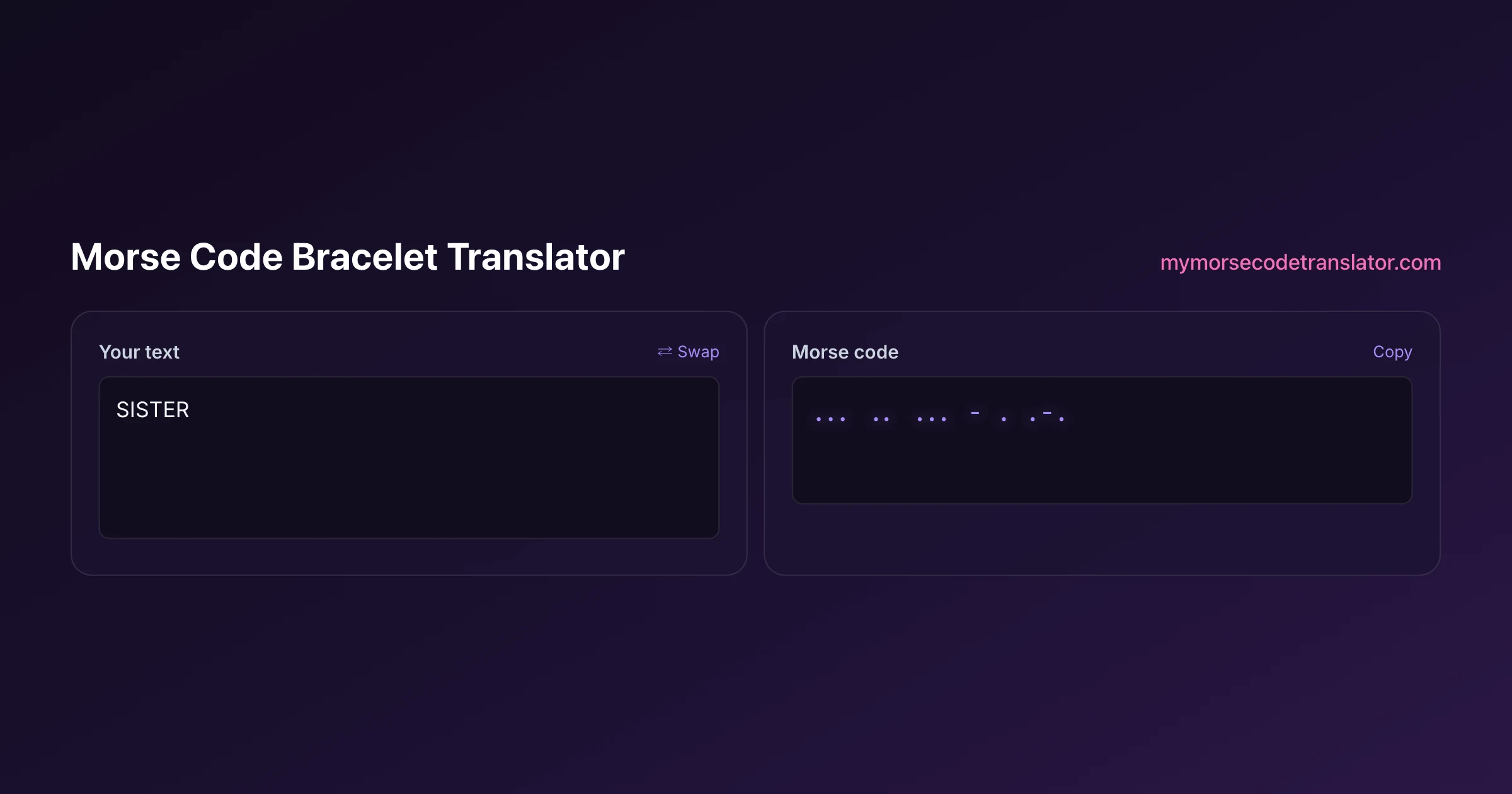
👀 Preview
Press ▶ Play — this shows what you'll see and hear.
Customize your message
Your picture appears in Play and downloaded videos. Note: it can't be included in a shared link — links carry the message only.
Share as a secret message
The message is hidden inside the link and decodes with sound & light when your friend opens it.
Reading the beads: dots, dashes and gaps
Every Morse bracelet uses three visual elements, and identifying them correctly is the entire job.
Dots are the small round beads. Dashes are the elongated tube or bar beads, usually about three times as long as a dot bead is wide — mirroring the timing ratio in audible Morse. Gaps are the spaces, and they come in three sizes: a small space between beads inside one letter, a larger space between letters, and the largest between words.
The most common decoding failure is not misreading a dot as a dash. It is missing a gap. If the maker used the same spacing between letters as between the beads within a letter, then a run of four dots is genuinely ambiguous — it could be H, or two Is, or four Es — and no amount of squinting will resolve it. In that situation the only way to know is to ask the maker what it was supposed to say.
Well-made bracelets usually solve this with spacer beads: a tiny neutral bead or a visible knot between letters, and a larger one between words. If you can see spacers, use them as your letter boundaries and the decode becomes straightforward.
Finding the beginning
A bracelet is a loop, so there is no inherent starting point, and reading from the wrong place produces confident nonsense.
Look for these, roughly in order of reliability:
- The clasp. Most designs place the message so it reads starting from one side of the clasp. Try clasp-first, left to right, as your default.
- A decorative or feature bead. Many makers put a distinctive bead — a charm, a different colour, a metal accent — at the start or as bookends around the message.
- The largest gap. A word gap is the biggest space in the piece. If there is exactly one unusually large space, the message likely starts just after it.
- Asymmetry in the pattern. If one end has a long run of plain filler beads, the message probably starts where the filler stops.
If none of that helps, decode it in both directions. Morse read backwards almost always produces gibberish, so whichever direction gives you real letters is the right one. This takes two minutes and settles the question.
Getting it into the translator
Once you can see the pattern, write it out as text. Use a full stop for each round bead, a hyphen for each tube bead, a space where you see a letter gap, and a forward slash where you see a word gap.
So a bracelet reading small-small-small, gap, long-long-long, gap, small-small-small becomes ... --- ... and decodes as SOS.
Paste that into the decoder on this page and it converts instantly. If the result contains # symbols, those are groups that do not match any letter, which nearly always means a gap has been placed wrongly — try shifting a boundary one bead left or right and re-run it.
There is also an image option. If the bracelet is laid flat, photographed straight down in good even light against a plain background, the image reader can often pick out the beads directly. Curved surfaces, shadows and busy backgrounds all hurt it considerably, so flatten the piece and crop tight to just the beads. Being honest: a clean typed transcription is more reliable than a photograph of a curved object, so if the photo struggles, type it.
Checking a bracelet before you buy it
This is worth doing, because errors in commercially sold Morse jewellery are not rare.
From a product photo you can usually count the beads well enough to decode the claimed word. Zoom in, transcribe, run it through the decoder, and compare against what the listing says it means. It takes under a minute.
The errors I have seen fall into three groups. Missing gaps — the piece is technically correct but unreadable because letters run together. A single wrong bead — one dot where a dash should be, which silently changes a letter. Decorative licence — a design where the spacing was chosen for looks rather than meaning, so it does not decode at all.
None of this means avoid buying. Plenty of makers get it exactly right, and marketplaces like Etsy are full of careful independent sellers who will tell you their spacing convention if you ask. But for a gift with a name on it, checking before it ships is a great deal cheaper than checking after.
Why so many bracelets are ambiguous
It is worth understanding the design tension, because it explains most of what you will encounter.
Strictly correct Morse spacing looks unbalanced on a wrist. The word gap is seven units — meaning a conspicuous empty stretch — and a strictly proportioned bracelet for a long word ends up mostly space. Makers routinely compress the gaps to keep the piece attractive, and once the letter gap is no longer clearly larger than the intra-letter gap, ambiguity creeps in.
The good compromises use a different bead rather than a bigger space: a small silver spacer between letters and a larger one between words keeps the piece compact while preserving the boundaries. That is the design to look for and to ask for.
The result is that many bracelets are best understood as a keepsake carrying a private meaning rather than a message a stranger can read. That is a perfectly good thing for a bracelet to be. It just means that if you cannot decode one, the piece may not be wrong — it may simply have been made for the wearer rather than for the reader.
Decoding other Morse jewellery
The same method applies to the rest of the category, with small adjustments.
Necklaces and bars are usually engraved rather than beaded, with dots and dashes cut into metal. These are typically easier to read than bracelets because the spacing is set in a design file rather than by hand, and there is an obvious left-to-right orientation.
Rings are hard. The circumference is short, the marks are tiny, and the loop problem is worse than on a bracelet. A macro photo and patience are usually required.
Knotted or macramé pieces use knot styles rather than bead shapes — often a single knot for a dot and a doubled or elongated knot for a dash. Identify the two knot types first, then proceed as normal.
Tattoos follow the same rules, and carry the highest stakes, since there is no returning them. If you are planning one, decode the intended pattern backwards before the needle goes anywhere near you.
Making one rather than reading one
If you are designing rather than decoding, the same knowledge tells you what to do.
Decide your spacing convention before you start and hold to it: one spacer between letters, two or a distinctly larger one between words, nothing between beads inside a letter. Write the full pattern out on paper first, count the beads, and lay them out before threading anything.
Then do the check that saves the piece: take the pattern you are about to make, type it into the decoder, and confirm it returns the word you intended. Doing this before you thread is the difference between a bracelet that says what you meant and one that says something close.
The bracelet maker on this site will generate the full bead layout from a word for exactly this reason — it does the counting and shows you where the spacers go, so the pattern you are working from is already verified.
A worked example
Take a bracelet with this layout, clasp on the left:
small, small, small, small — spacer — small — spacer — small, long, small, small — spacer — small, long, small, small — spacer — long, long, long
Transcribed: .... . .-.. .-.. ---
Decoded: HELLO
Now imagine the same beads with no spacers at all. You would be looking at fourteen beads in a row with no letter boundaries — and there are dozens of ways to divide that string into valid letters. The spacers are not decoration. They are the punctuation, and they are what makes the difference between a bracelet that carries a message and one that carries a pattern.
A friend's bracelet was sold as her daughter's name. Photographed flat and decoded bead by bead, it was one tube bead short in the fourth letter and actually spelled something else entirely. The seller replaced it — but only because we could show exactly which bead was wrong.
Frequently Asked Questions
Q. How do I decode a morse code bracelet?
Identify the small round beads as dots and the long tube beads as dashes, note where the spacers or larger gaps fall as letter and word boundaries, write it out as dots and dashes, and paste it into the decoder on this page.
Q. Where does a morse code bracelet start?
Usually at the clasp, reading in one direction. A feature bead or the largest gap are the other common markers. If you are unsure, decode both directions — the wrong direction almost always produces gibberish, so the readable one is correct.
Q. What do the different bead shapes mean?
Small round beads are dots and elongated tube or bar beads are dashes, typically about three times the length of a dot to mirror Morse timing. Neutral spacer beads mark the boundaries between letters and words.
Q. Do you put spacers between letters in morse code jewellery?
Yes, and it is the single most important design decision. Without a visible boundary between letters the piece is ambiguous — four dots could be H, two Is or four Es. The usual convention is one small spacer between letters and a larger one between words.
Q. My bracelet decodes to gibberish. What went wrong?
Almost always the gap placement. Try shifting a letter boundary one bead in either direction, or reading from the other end. If the maker compressed the spacing so letters and intra-letter gaps look identical, the piece may genuinely be undecodable without asking them.
Q. Can I decode a bracelet from a photo?
Sometimes. Lay it flat, shoot straight down in even light against a plain background, and crop tight to the beads. Curved surfaces and shadows hurt accuracy a lot, so a typed transcription is more reliable if the photo struggles.
Q. How do I check a bracelet before buying it?
Zoom into the product photo, count the beads, transcribe them, and run the result through the decoder. Compare it against what the listing claims it says. It takes about a minute and catches the single-bead errors that are common.
Q. Are morse code bracelets usually accurate?
Many are, but errors do occur — a wrong bead, or spacing chosen for appearance rather than readability. Careful makers will happily tell you their spacing convention if you ask before ordering.
Q. How do I decode a morse code ring?
The same way, but it is harder — the circumference is short and the marks are tiny. Use a macro photo, find the start from any feature or the largest gap, and expect to try both directions.
Q. What about knotted or macramé morse bracelets?
Identify the two knot types first — usually a single knot for a dot and a doubled or longer knot for a dash — then read them exactly as you would beads, watching for the wider spaces that mark letter boundaries.
Q. How do I make sure my own bracelet is correct?
Write out the full pattern before threading, then paste it into the decoder and confirm it returns your intended word. The bracelet maker on this site generates the verified layout including spacer positions, which removes the counting errors entirely.
Related guides
← Back to the My Morse Code Translator home page.

By Sukie
Sukie is the creator of My Morse Code Translator — a puzzle nerd and gadget tinkerer who fell down the Morse code rabbit hole and decided to build the most fun Morse translator on the web. When she's not adding new sound packs or reveal animations, she's decoding hidden messages in songs or designing Morse code bracelets for friends.
Last updated: 2026-09-23