American Morse Code Translator
An american morse code translator is what you need when the dots and dashes in front of you refuse to make sense — because if a message came from a 19th-century American telegraph line, a railroad office, or an old family document, it may not be written in the code that every modern tool assumes. American Morse and International Morse are genuinely different alphabets that share a name and a few letters. This page explains how they differ, how to tell which one you are looking at, and what to do about it.
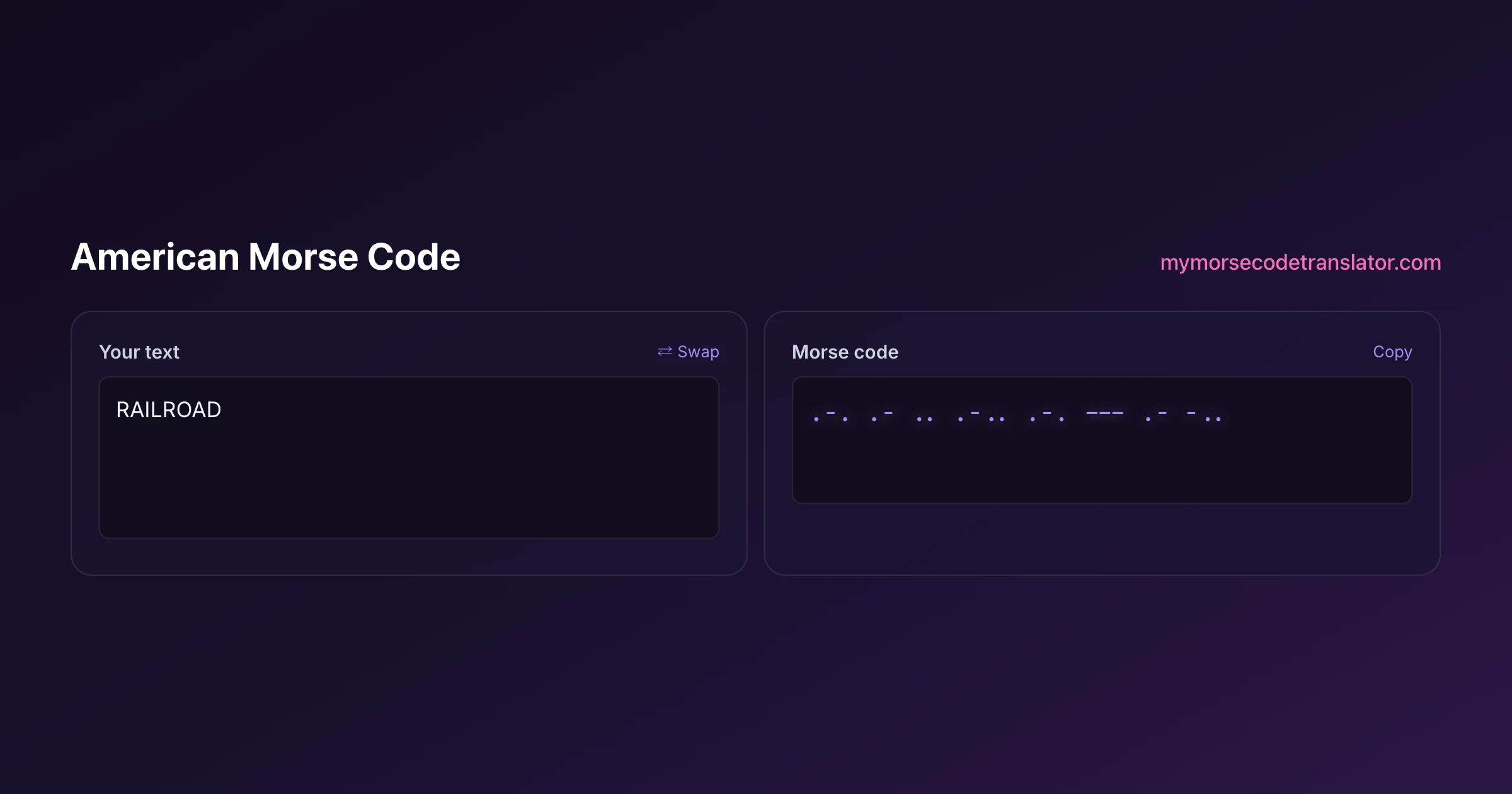
👀 Preview
Press ▶ Play — this shows what you'll see and hear.
Customize your message
Your picture appears in Play and downloaded videos. Note: it can't be included in a shared link — links carry the message only.
Share as a secret message
The message is hidden inside the link and decodes with sound & light when your friend opens it.
Two codes, one name
The code developed in the United States in the 1840s for landline telegraphy — variously called American Morse, Railroad Morse or Landline Morse — is the original. It is the one Samuel Morse and Alfred Vail worked out, and it ran American telegraph and railroad wires for the better part of a century.
The code the rest of the world uses today is a later revision, developed in Germany in the 1850s and refined internationally. It went by Continental Morse or International Morse, and it is what the ITU standardised and what every modern translator, radio operator and app means by "Morse code".
They overlap substantially — a great many letters are identical — which is precisely what makes mixing them up so confusing. A message in the wrong code does not come out as obvious gibberish. It comes out as nearly readable, with a scattering of letters that are subtly wrong, which is far more frustrating than complete nonsense.
What actually changed
Three things distinguish American Morse from the International code, and the first is the important one.
Internal spaces inside characters. American Morse uses gaps within some letters as part of the letter itself. C is two dots, a small space, then a dot. O is a dot, a space, a dot. R is a dot, a space, two dots. International Morse has nothing of this kind — every character is a continuous run of marks with only the standard one-unit gaps between them.
Dashes of different lengths. American Morse uses more than one length of dash. There is the ordinary dash, a longer dash used for L, and a longer one still used for zero. International Morse has exactly one dash length, three units, and no exceptions.
Different assignments. Beyond the structural differences, a number of letters simply have different patterns in the two codes.
The first two points are why the American code lost. Internal spaces and multiple dash lengths are perfectly workable on a wire, where the signal is clean and the operator is listening to a mechanical sounder in a quiet room. Over radio, with fading, static and interference, distinguishing a within-letter space from a between-letter space — or a long dash from a normal one — is unreliable. International Morse was designed to be robust in exactly the conditions where American Morse was fragile.
The letters that differ
The letters below are the ones where the two codes disagree. Everything not listed here — A, B, D, E, G, H, I, K, M, N, S, T, U, V, W — is the same in both.
- C — American: dot dot, space, dot · International:
-.-. - F — American: dot dash dot · International:
..-. - J — American: dash dot dash dot · International:
.--- - L — American: a single extended dash · International:
.-.. - O — American: dot, space, dot · International:
--- - P — American: five dots · International:
.--. - Q — American: dot dot dash dot · International:
--.- - R — American: dot, space, dot dot · International:
.-. - X — American: dot dash dot dot · International:
-..- - Y — American: dot dot, space, dot dot · International:
-.-- - Z — American: dot dot dot, space, dot · International:
--.. - Zero — American: an especially long dash · International:
-----
Some of the collisions are outright traps. J in American Morse is -.-., which is exactly C in International Morse. A message containing J will decode, silently and wrongly, as though it contained C. Nothing flags an error; you simply get the wrong word.
How to tell which code you are looking at
There are reasonably reliable tells, especially if you have a decent length of message.
Look for internal spaces. If the transcription shows characters that appear to contain a gap — patterns written like .. . or . .. as a single letter — that is American Morse. International Morse never does this.
Look for varied dash lengths. If some dashes are noticeably longer than others in a written transcription or a recording, that points to American Morse. International uses one length only.
Try decoding it as International and read the output. This is the practical test. If you get a plausible-looking result with a handful of nonsense letters sprinkled through it — words that are almost right — you are probably looking at American Morse being read by an International decoder.
Consider the source. American landline telegraphy, US railroad traffic, and American documents from roughly the 1840s to the mid-20th century are the natural habitat. Anything transmitted by radio, anything from outside the United States, and anything modern is overwhelmingly likely to be International.
What this translator does and does not do
Being straightforward about scope: the translator on this site works in International Morse, the ITU standard. That is the right default, because it covers essentially everything you will encounter — every radio transmission, every bracelet, every tattoo, every puzzle, every app, and every modern message.
It does not decode American Morse, and that is a deliberate limitation rather than an oversight. Automatically distinguishing the two is genuinely difficult, because the internal spaces that define American Morse are the same thing that separates characters in International Morse. A tool that tried to guess would produce confidently wrong output some of the time, which is worse than a tool that tells you what it does.
So if you have established that your message is American Morse, what this page gives you is the table above and the ability to work through it by hand. For a short message — a family telegram, a line from a document, a museum exhibit — that is entirely practical. For anything long, specialist resources aimed at telegraph historians are the better route.
Why the American code is worth knowing about anyway
It is easy to treat this as a footnote, but the American code shaped a great deal.
It was the code of the American telegraph network at its peak, and by extension the code of the railroads, the press wire services, and commercial messaging for decades. A large volume of surviving 19th-century American documents, transcripts and artefacts is in it. Genealogists and local historians run into it regularly.
It also explains something about the International code's design. The features that were removed — internal spaces, variable dash lengths — were removed for a reason, and understanding what was dropped clarifies why International Morse is built the way it is. The modern code's rigid, uniform timing is not arbitrary tidiness; it is what makes it survivable over a noisy radio path.
There is also a small, dedicated community that still practises landline Morse on restored equipment, keeping the original sounder-and-key operating tradition alive. If you have inherited a telegraph key or a sounder, that is where to look — and the ARRL and various telegraph historical societies are reasonable starting points.
The sounder, and why American operators listened differently
There is a piece of equipment history that explains a great deal about why the American code looks the way it does.
International Morse over radio is heard as a tone — a continuous audio note that is either present or absent. The length of the note is the information. American landline Morse was not heard that way at all. It was read on a sounder, an electromagnet that pulled an armature down with a click when the circuit closed and released it with a second, differently-pitched click when the circuit opened.
So the operator was not listening to long and short tones. They were listening to the interval between two clicks — click-clack close together for a dot, click...clack further apart for a dash. It is a rhythmic, percussive way of hearing code, quite unlike the musical quality of radio CW.
This is why internal spaces inside characters were workable. On a sounder the clicks are crisp and the silences are clean, so a small gap inside a letter is easy to distinguish from a larger gap between letters. Put that same distinction on a fading shortwave signal with static crashes and it falls apart immediately.
It also explains why some experienced landline operators found radio Morse harder rather than easier at first. They had trained their ears on a fundamentally different physical signal, and the transition was not merely a matter of learning a dozen changed letters.
Decoding an old message step by step
If you have something you believe is American Morse, here is the sequence that works.
First, transcribe carefully and preserve the spacing exactly as you see it. This is the step that decides everything. Note where marks are close together and where there is a visible gap, because in American Morse those gaps may be inside a letter rather than between letters. If you flatten the spacing while transcribing, the information is gone.
Second, note any dashes that look longer than the others. Mark them differently — a double hyphen, say — so you can recognise L and zero later.
Third, try it as International Morse first, using the decoder here. If it reads cleanly, you were wrong about the code and you are done.
Fourth, if it does not, work through the table above by hand, letter by letter, treating the internal spaces as part of the characters. Write the letters underneath the marks as you go rather than trying to hold them in your head.
Fifth, use context. Old telegrams are full of predictable words — place names, dates, ARRIVING, STOP, station identifiers. Getting one word gives you several letters, and those letters unlock others. It is a crossword more than a calculation, and it goes faster than it sounds.
Someone sent me a photographed telegram fragment that decoded as near-nonsense with recognisable words scattered through it. The tell was a letter written as two marks with a clear gap between them — an internal space, impossible in International Morse. Re-read as American Morse against the table, it was a railway arrival notice.
Frequently Asked Questions
Q. What is the difference between American and International morse code?
American Morse uses spaces inside some characters and more than one length of dash, and assigns different patterns to about a dozen letters. International Morse has one dash length, no internal spaces, and is the ITU standard used worldwide today.
Q. Why did International morse code replace American morse code?
Because American Morse was fragile over radio. Internal spaces and variable dash lengths are readable on a clean wire but easily corrupted by fading and static, so the more uniform International code became the standard for radio and then for everything else.
Q. Can this translator decode American morse code?
No — it works in International Morse, the modern ITU standard, which covers essentially everything you will encounter today. Automatically telling the two codes apart is unreliable, so the tool does one thing correctly rather than guessing between them.
Q. How do I know which code an old message uses?
Look for characters that seem to contain a gap and for dashes of noticeably different lengths — both indicate American Morse. Decoding it as International and getting almost-readable text with scattered wrong letters is another strong sign.
Q. Which letters are the same in both codes?
A, B, D, E, G, H, I, K, M, N, S, T, U, V and W are identical. The differences are concentrated in C, F, J, L, O, P, Q, R, X, Y, Z and zero — and J in American Morse is the same pattern as C in International, which causes silent mistranslations.
Related guides
← Back to the My Morse Code Translator home page.

By Sukie
Sukie is the creator of My Morse Code Translator — a puzzle nerd and gadget tinkerer who fell down the Morse code rabbit hole and decided to build the most fun Morse translator on the web. When she's not adding new sound packs or reveal animations, she's decoding hidden messages in songs or designing Morse code bracelets for friends.
Last updated: 2026-09-28