Learn Morse Code
Learn morse code and you gain something genuinely unusual: a second way to carry language, through sound, light, touch or a tapped finger, that works when almost nothing else does. It is also far more achievable than people expect — most of the difficulty comes from learning it in the wrong order, not from the code being hard. This page is the map. It lays out what to study first, what to deliberately skip at the start, and links every guide on this site in the sequence that actually works.
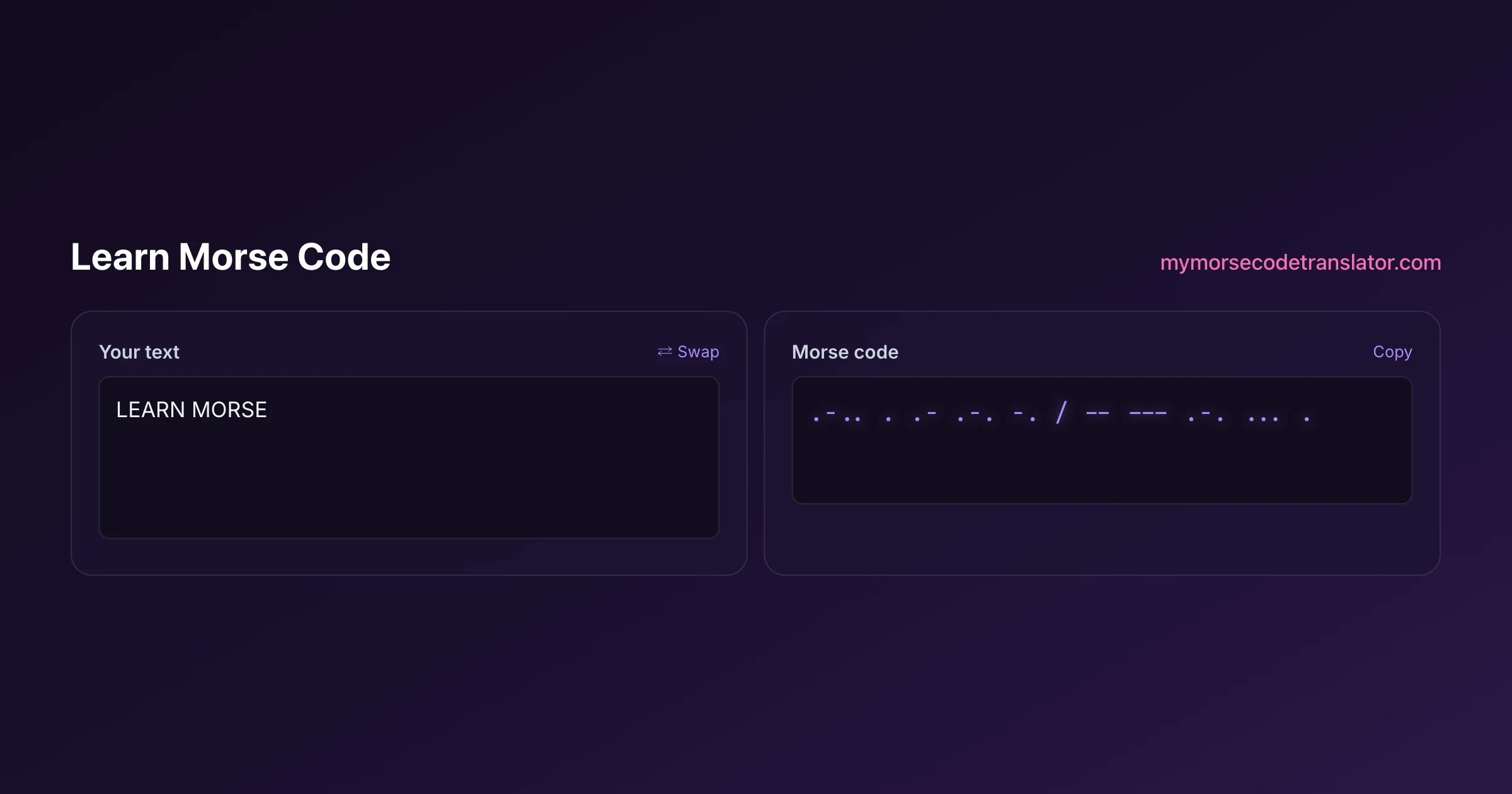
👀 Preview
Press ▶ Play — this shows what you'll see and hear.
Customize your message
Your picture appears in Play and downloaded videos. Note: it can't be included in a shared link — links carry the message only.
Share as a secret message
The message is hidden inside the link and decodes with sound & light when your friend opens it.
The one decision that determines whether this goes well
Before any chart or app, there is a fork that shapes everything after it: do you want to look Morse up, or do you want to read it?
If you want to look it up — convert a name for a bracelet, decode a puzzle, check what a tattoo says — you need no memorisation whatsoever. Use the translator on this page and skip straight to the reference material. That is a completely legitimate goal and most visitors here have it.
If you want to read it — hear a stream of beeps and know what it says — then there is one rule that matters more than all the others combined: learn each character as a sound, not as a picture of dots and dashes.
People who learn visually build an invisible extra step: hear the beeps, picture the marks, count them, read off the letter. That works fine at slow speeds and becomes an absolute ceiling later, because at any real speed there is no time to count. Unlearning it is harder than learning correctly in the first place. Everything below assumes you want to avoid that trap.
The order that works
Follow these in sequence. Each one assumes the previous.
1. Understand what you are learning — what is morse code covers where it came from, why it is built the way it is, and where it is still used today. Fifteen minutes here makes everything else make sense.
2. Meet the characters — morse code letters walks the alphabet one letter at a time, grouped so the confusable pairs are learned together rather than separately. The morse code alphabet page is the chart version if you want the whole thing at a glance.
3. Learn the timing — morse code timing explains the ratios that hold the characters apart. This is the step people skip and then wonder why their code is unreadable.
4. Learn the method — how to learn morse code covers the Koch and Farnsworth approaches, a realistic timeline, and the practice habits that work.
5. Practise reading — how to read morse code is about copying: transcribing marks first and decoding after, rather than trying to identify letters live.
6. Add numbers — morse code numbers comes last only because it is easy. The digits follow a strikingly regular pattern and take an afternoon.
Reference material to keep beside you
These are lookup resources rather than lessons — useful while you are learning and afterwards.
- Printable morse code chart — one page, black and white, free, for a wall or a rucksack.
- Morse code chart — the full table of letters, numbers and punctuation, plus the prosigns that charts normally leave out.
- Morse code letters — every letter individually, with why it was assigned that pattern.
- Morse code numbers — the digits and their regular structure.
- Common words in morse code — yes, no, hello, help, I love you and the rest, written out ready to copy.
- SOS in morse code — the distress signal, what it does and does not stand for, and why it is sent as one continuous run.
- I love you in morse code — the single most-requested phrase, and the one most often engraved or beaded.
- Hearing morse code — for the other kind of question entirely: what that beeping actually is.
- Love in morse code — the word itself plus every phrase built around it, written out ready to copy.
- Names in morse code — spelling a name correctly, and the doubled letters that quietly go missing.
A word on charts: they are excellent for checking one character and actively counterproductive as a learning tool, for the reason in the first section. Use them to look things up, not to drill.
Realistic expectations about time
People routinely give up on Morse because their expectations were set by a chart with 26 rows on it, which makes it look like a vocabulary list you could memorise in an evening.
A more honest picture: recognising a handful of characters takes an afternoon. Knowing all 26 by sound, slowly, takes a few weeks of short daily sessions. Copying real text at a useful speed takes a few months. And the curve is not smooth — nearly everyone hits a plateau somewhere in the middle where progress seems to stop entirely for a week or two before suddenly resuming.
The single strongest predictor of success is not talent or time available; it is consistency. Fifteen minutes every day comfortably beats two hours once a week, because the skill is pattern recognition and pattern recognition consolidates between sessions rather than during them.
The organisations that teach this at scale — the ARRL and the Long Island CW Club among them — say the same thing, and their beginner material is worth using precisely because it is built around short, frequent, sound-first practice.
Using the tool on this page as a practice partner
The translator here is genuinely useful for drilling, not just converting. A few specific ways:
Turn on Farnsworth timing. This sends each character fast enough that you cannot count it, while stretching the gaps so you still have thinking time. It is the single most effective setting for a learner, and it means the rhythms you are learning are the ones you will hear at full speed.
Drill confusable pairs directly. Type ANANANAN and play it. Then DUDUDUDU. Then GWGWGWGW. Ten minutes of this fixes the mirror-image problem that otherwise persists for months.
Practise with words you care about. Your own name, a friend's name, the town you live in. Meaning is a memory aid, and a letter you have heard fifty times inside your own name is a letter you own.
Use the light option to bridge from visual to audio. If you are a strong visual learner making the transition, seeing and hearing the same character together for a while helps — then turn the visuals off.
Slow down when it blurs, speed up when it feels automatic. The right speed is the one where you are slightly uncomfortable and still succeeding.
Where people get stuck, and what to do
Four plateaus account for most of them.
"I can do it slowly but not faster." You are counting. This is the visual-learning trap, and the fix is Farnsworth: raise the character speed past the point where counting is possible and stretch the gaps instead. It will feel worse for a few days.
"I mix up A and N constantly." You learned them separately. Drill them as a pair, back to back, until the rising and falling rhythms feel like different things. Same for D/U, G/W, B/V, F/L, Q/Y.
"I lose the thread halfway through a word." You are trying to decode live. Transcribe marks first, decode after — this is covered on how to read morse code and it is a habit, not a talent.
"My own sending is unreadable." Almost always spacing rather than the marks. Read morse code timing, then record yourself and decode it back; errors show up immediately as wrong or unknown characters.
Learning it for a specific reason
Plenty of people arrive with a concrete goal rather than a general interest, and the path is shorter for most of them.
For a bracelet, tattoo or engraving — you need accuracy, not fluency. Use the translator, then decode your pattern backwards to verify it, and read morse code timing for the spacing rules that make a physical piece readable. See also the morse code tools hub.
For puzzles and games — the morse code decoder plus the morse code chart will handle almost everything. Roblox morse code covers in-game use specifically.
For amateur radio — you want sound-first learning from day one, Farnsworth timing, and the ARRL's beginner material. Note that Morse is no longer required for a licence in most countries; people learn it now because they want to.
For scouting or signalling badges — the light side matters as much as the code. Morse code light translator covers flashing, including the safety point about flash rates.
For curiosity about music and culture — morse code in songs is a genuinely fun rabbit hole.
How to tell whether you are actually improving
Progress in Morse is genuinely hard to feel from the inside, because the plateaus are long and the gains arrive in steps rather than smoothly. A few concrete measures beat relying on how it feels.
Track characters-known, not hours-spent. Keep a simple list of which characters you can identify reliably without hesitating. Watching that list grow from six to twelve to twenty is far more motivating than logging practice time, and it tells you what to drill next.
Test at a fixed speed, not your comfortable one. Once a week, copy something at a speed slightly above where you practise. If last month's uncomfortable speed is this month's comfortable one, you are moving even if it does not feel like it.
Count the hesitations. Copy a short passage and mark every character where you had to stop and think. The raw number matters less than the trend — hesitations should be concentrated on fewer and fewer specific characters, which tells you exactly what to drill.
Notice when you stop counting. This is the real milestone. There is a moment when a character stops being "dot dash dot, that's three, that's R" and simply becomes R. It arrives per-character rather than all at once, and it is the thing that actually determines your ceiling.
Do not measure by whether you enjoy it. Plateaus are demoralising and normal. The people who get there are not the ones who never plateaued; they are the ones who kept doing fifteen minutes a day through it.
The rest of the site
This hub covers learning. Three others cover the rest:
Morse code translators collects every conversion tool — text, audio, image, numbers, historical variants and other languages — with guidance on which to use when.
Morse code tools is the creative side: bracelets, tattoos, videos, flashlights, and secret messages that decode themselves when a friend opens the link.
Morse code converter handles conversions from other encodings, such as binary and emoji.
And the main translator itself is on the homepage, where you can hear and flash anything you type while you learn.
A closing note on why it is worth it
There is a fair question underneath all of this: why learn a code that no commercial service has used in decades?
The practical answer is that Morse survives conditions nothing else does. A signal too weak to carry speech will still carry Morse. A torch, a mirror, a whistle, a car horn, a finger on a table — anything that can be on or off can carry it. That robustness is why amateur operators still use it daily, why aviation beacons still identify in it, and why it appears in assistive technology for people who can operate exactly one switch.
The honest answer is that most people do not learn it for any of those reasons. They learn it because there is something quietly satisfying about hearing a pattern of beeps resolve into words — a small, private decoding that happens in your head and nowhere else. It is a skill with almost no practical urgency and a surprising amount of pleasure in it, which is a good enough reason on its own.
I learned the alphabet from a printed chart first and spent the following two months undoing it — every character arrived as a picture I had to count before I could name it. Restarting sound-first with Farnsworth timing got me past my old ceiling in about three weeks.
Frequently Asked Questions
Q. How long does it take to learn morse code?
A handful of characters in an afternoon, all 26 by sound in a few weeks of short daily sessions, and useful copying speed in a few months. Consistency matters far more than total hours — fifteen minutes daily beats two hours weekly.
Q. What is the best way to start learning morse code?
Learn each character as a distinct sound rather than as a picture of dots and dashes, and use Farnsworth timing so you cannot count the marks. Starting from a visual chart builds a hear-picture-count-read habit that becomes a hard speed ceiling later.
Q. Should I learn the alphabet in order, A to Z?
No. Alphabetical order separates the mirror-image pairs — A and N, D and U, G and W — which are exactly the letters that need to be contrasted directly. Learning them as pairs fixes in days what alphabetical order leaves broken for months.
Q. Do I need to learn morse code to use this site?
Not at all. The translator converts both directions instantly, so you can encode or decode without knowing a single character. Learning it is only worthwhile if you want to read code by ear.
Q. Is morse code still worth learning today?
For practical use, in narrow but real cases — amateur radio, emergency signalling, aviation beacon identifiers, some assistive technology. For most people the honest reason is that decoding sound into words in your own head is genuinely satisfying.
Q. Why do I get stuck at a certain speed?
Almost always because you are counting marks rather than recognising whole-character rhythms. Raise the character speed past the point where counting is possible and stretch the gaps instead — it feels worse for a few days and then breaks the plateau.
Q. Do I need a radio licence to learn morse code?
No. Learning and practising requires nothing at all. A licence is needed to transmit on amateur bands, but Morse proficiency itself was dropped as a licence requirement internationally in 2003.
Q. What should I practise with?
Words that mean something to you — your name, a friend's name, places you know. Meaning aids memory. Beyond that, drill the confusable pairs directly rather than waiting to meet them by accident in random text.
Q. Is it harder to learn as an adult?
No. Adults learn it routinely. The skill is pattern recognition, which is not meaningfully age-limited, and consistency predicts success far better than age does.
Related guides
← Back to the My Morse Code Translator home page.

By Sukie
Sukie is the creator of My Morse Code Translator — a puzzle nerd and gadget tinkerer who fell down the Morse code rabbit hole and decided to build the most fun Morse translator on the web. When she's not adding new sound packs or reveal animations, she's decoding hidden messages in songs or designing Morse code bracelets for friends.
Last updated: 2026-08-14