Morse Code Number Translator
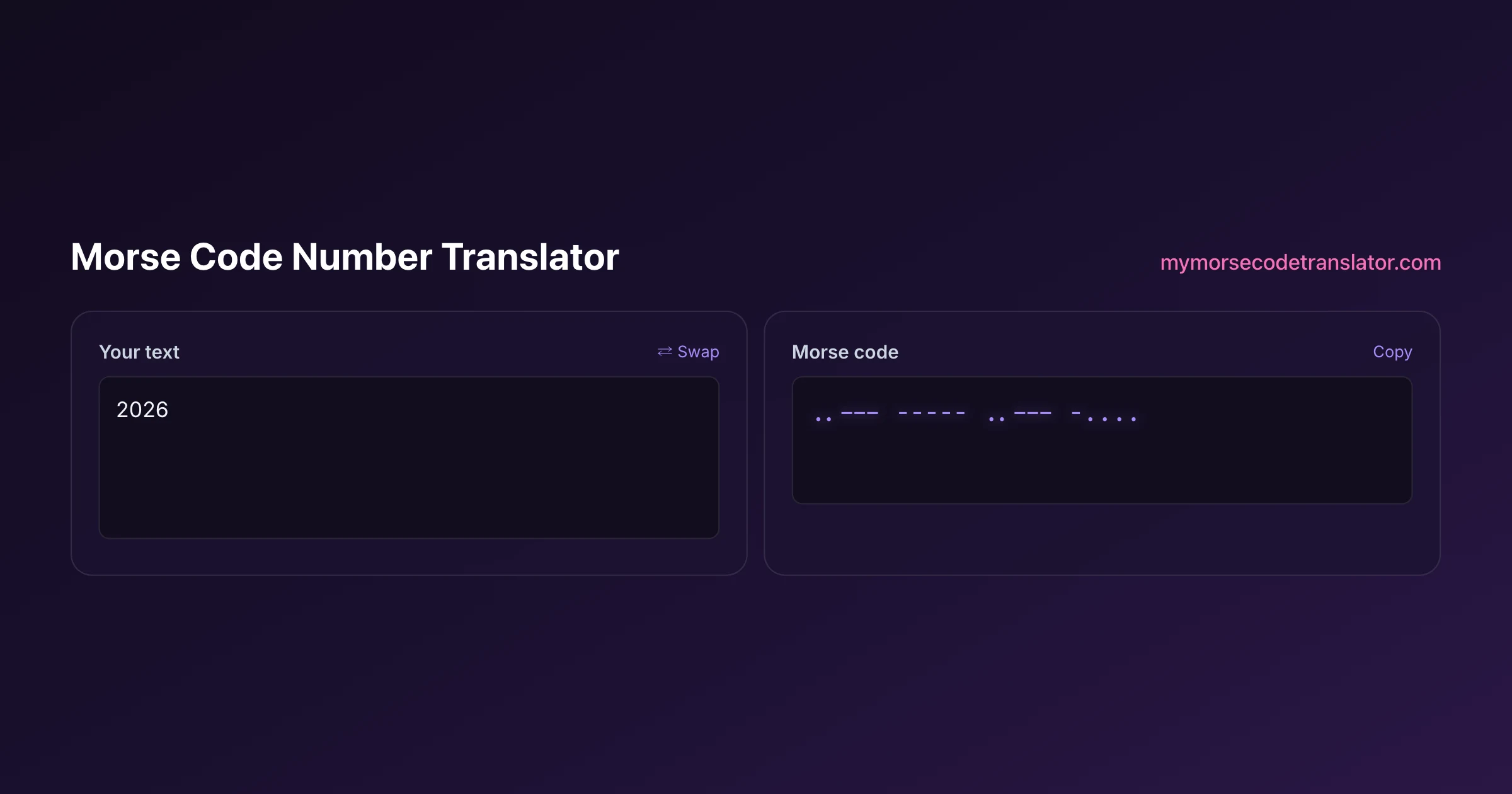
Every digit in Morse is exactly five symbols long, which makes a morse code number translator delightfully predictable: 1 is .----, 5 is ....., 0 is -----, and there is a clean pattern connecting them all. Type any number above and it encodes instantly, or paste dots and dashes to read the figures back. Whether you are sending a phone number, a date, a lock combination, or coordinates, this tool keeps every five-symbol group tidy and correctly spaced.
👀 Preview
Press ▶ Play — this shows what you'll see and hear.
Customize your message
Your picture appears in Play and downloaded videos. Note: it can't be included in a shared link — links carry the message only.
Share as a secret message
The message is hidden inside the link and decodes with sound & light when your friend opens it.
The five-symbol pattern that makes numbers easy
Numbers are the friendliest part of Morse, because unlike letters they follow one consistent rule: each digit is five symbols, and they march in order. Start at 1, which is one dot followed by four dashes (.----). Each higher number swaps one more dash for a dot from the left, so 2 is ..---, 3 is ...--, 4 is ....-, and 5 is all dots (.....). Then it mirrors: 6 is -...., 7 is --..., 8 is ---.., 9 is ----., and 0 is all dashes (-----).
Once that click happens, you can reconstruct any digit in your head. Count the leading dots for 1 through 5, or count the leading dashes for 6 through 0. It is one of the few corners of Morse you can genuinely learn in a single sitting, which is why teachers often start beginners on numbers before letters.
Here is the full set:
- 1 .---- 2 ..--- 3 ...-- 4 ....- 5 .....
- 6 -.... 7 --... 8 ---.. 9 ----. 0 -----
Sending phone numbers, dates, and codes
The translator shines on real strings of figures. A phone number like 5551234 becomes seven five-symbol groups, each separated by a letter gap, and you can read them off in order. A date such as 07 08 2026 is just groups of digits with word gaps where the spaces are, so it stays legible. A padlock combination, a set of GPS coordinates, or a room number all encode the same clean way.
One practical tip: when a number matters and cannot be misheard, send it slowly and leave clear gaps. Because every digit is the same length, a rushed or sloppy signal turns 8 (---..) into something that blurs toward 9 (----.) or 0 (-----). The extra second of spacing is cheap insurance, and it is exactly why operators reading out critical figures over radio slow right down for the numbers.
Mixing numbers and letters in the same message adds one more thing to watch: the gap between a digit and an adjacent letter has to be a clear letter-gap, or the two can smear together into a pattern that is neither. A callsign like W1AW, beloved of the American Radio Relay League as its own station identifier, is a perfect little drill, because it alternates letters and a number and forces you to keep every gap honest. Try encoding a few real-world mixed strings, a licence plate, a product code, a flight number, and you quickly feel how numbers demand more spacing discipline than plain words do. Words have shape and context to fall back on; a lone digit in the middle of letters has neither, so the only thing telling the receiver "this is a five, not two runaway letters" is the clean gap you leave on each side of it. Once that habit sets in, mixed alphanumeric Morse stops being intimidating and becomes just another rhythm.
Cut numbers: how operators send figures faster
Here is a fun piece of real operator culture. Because full digits are a slow five symbols each, contesting ham radio operators use "cut numbers", shorthand where a letter stands in for a digit to save time. The most common is T for 0 (a single dash instead of five) and N for 9. You will hear 599, the classic signal report, sent as 5NN, which is much faster to key.
Other cut numbers include A for 1, U for 2, V for 3, and E or 5 blurred together, though usage varies and only a few are truly standard. The American Radio Relay League (ARRL) contest community keeps these alive, and if you ever copy a fast contest exchange and get a stray letter where a number should be, cut numbers are probably why. This translator sticks to full standard digits so nothing is ambiguous, but it is worth knowing the shorthand exists.
Grouping figures so they never get misheard
There is a real craft to sending numbers that operators learned the hard way, and it is worth borrowing even if you never touch a radio. Because all ten digits share the same five-symbol length, a listener has no word-shape to lean on the way they do with letters, so a single dropped gap can shift where a number begins and turn 1234 into a mush. The professional habit is to send figures in deliberate groups and, when it truly matters, to send the whole number twice.
A few grouping conventions that make numeric Morse robust:
- Break long numbers into chunks of three to five digits, the same way you naturally read a phone number
- Leave a clear word gap between logical groups, like area code and local number, so the listener can bracket them
- For anything mission-critical, coordinates, a combination, a callsign suffix, send it, pause, and send it again
- Say or note the number of digits you expect, so a group that comes up short is obviously an error
These are not fussy rules for their own sake. They exist because a five-symbol code carries no redundancy, so the structure you add around it is the only error-checking the listener gets. When I encode something like a lock combination for a friend to decode, I always chunk it and repeat it, and the misreads simply stop happening.
Numbers in puzzles, geocaching, and coordinates
Numeric Morse shows up in more games than almost any other part of the code, and there is a good reason: a five-symbol pattern is satisfyingly regular, so puzzle designers love hiding digits in it. Escape rooms use Morse numbers for safe combinations. Geocachers encode latitude and longitude in dots and dashes so a cache's real location only reveals itself to someone who decodes carefully. Alternate-reality games and CTF security challenges drop numeric Morse into audio clips and images as a layer of the puzzle.
If you are a puzzle setter, the number translator is your friend for building these, and a few tips keep your puzzle fair rather than frustrating. Use clean, even spacing so the solver's difficulty is the decoding, not your sloppy gaps. Separate coordinate components with obvious word gaps. If you include a decimal point, remember it has its own Morse pattern (.-.-.-) and will read as punctuation, not a digit. And test your own puzzle by decoding it back before you publish, because nothing deflates a treasure hunt like coordinates that were garbled at the source. A quick round-trip through the translator, encode then decode, catches that every time.
On the solving side, the biggest kindness you can do yourself is to write the dots and dashes down before naming any digit. Numbers come fast and they all look alike at a glance, so scribbling the raw pattern and decoding afterward beats trying to recognise 6 versus 7 versus 8 in real time under puzzle pressure.
Where numeric Morse actually gets used
Numbers in Morse are not just an exercise. Signal reports, callsign suffixes, and contest exchanges in amateur radio are full of digits. Aviation and marine navigation beacons historically identified themselves in Morse, sometimes including numeric identifiers, and the International Telecommunication Union standard that defines these codes underpins those uses. Puzzle hunts and escape rooms love numeric Morse because a five-symbol pattern is satisfying to crack, and geocachers hide coordinates in it constantly.
The standard digit table this translator uses is the International Morse Code documented by the ITU and on Wikipedia's Morse code article, so a number you encode here reads identically to one an operator anywhere in the world would send. Encode a set of coordinates and a cacher on the other side of the planet decodes the same figures.
One last quirk worth knowing is how Morse handles the boundary between numbers and the punctuation that often travels with them. A decimal point uses the full-stop code, a minus sign or hyphen has its own pattern, and a slash separates values like a date or a fraction. That means a coordinate string, a temperature, or a time can all be sent unambiguously if you include the right punctuation rather than leaning on spacing alone. It is a small detail, but it is the difference between sending '37.5' cleanly and sending three digits that the receiver has to guess the decimal into. When you type those characters, the translator inserts the correct patterns for you, so a figure like a price or a measurement survives the trip intact instead of arriving as a bare run of digits. For anything where the exact value matters, spell the punctuation out; Morse has the symbols for it, and using them is what keeps a number honest from one end of the signal to the other.
I set myself a timer to learn the digits cold and had all ten down in under seven minutes using the count-from-the-left rule — faster than I learned any five letters. Then I keyed my own phone number and immediately mixed up 8 and 0 at speed, which taught me the real lesson: knowing the pattern and sending it cleanly are two different skills.
Frequently Asked Questions
Q. Why is every number in the morse code number translator five symbols long?
It is by design. Samuel Morse and Alfred Vail gave all ten digits a uniform five-symbol length so they would be unambiguous and easy to count, unlike letters, which vary in length by how common they are. That uniformity is what makes numbers the easiest part of Morse to learn.
Q. What is the easiest way to memorise the digits?
Count from the left. For 1 to 5, the number equals how many dots come first: 3 is three dots then two dashes. For 6 to 0, count the leading dashes instead: 8 is three dashes then two dots, and 0 is all five dashes. That rule covers all ten.
Q. What are cut numbers?
Cut numbers are shorthand where a letter replaces a digit to save keying time, common in ham radio contests. T stands for 0 and N for 9, so the report 599 is often sent as 5NN. This translator uses full digits to stay unambiguous, but you will hear cut numbers on the air.
Q. How do I send a phone number?
Type the digits and the translator encodes each as a five-symbol group with a letter gap between them. Send it slowly with clear gaps so similar-looking numbers like 8, 9, and 0 do not blur together. Grouping matters more than speed when a number has to be exact.
Q. Can I include a decimal point or dash in a number?
Yes. The full stop and the hyphen both have their own Morse codes, so a decimal or a hyphenated code encodes correctly alongside the digits. The translator inserts the right punctuation pattern automatically.
Q. Do numbers and letters ever get confused?
They can if spacing is sloppy, because a rushed digit can drift toward a letter or a neighbouring number. Clear letter gaps prevent it. When numbers are critical, operators slow down specifically to keep each five-symbol group distinct.
Q. Can it decode numbers back to figures?
Yes. Paste five-symbol groups of dots and dashes and the translator returns the digits. It is the same tool in reverse, which is handy for checking coordinates or a code you received against what you expected.
Related guides
← Back to the My Morse Code Translator home page.

By Sukie
Sukie is the creator of My Morse Code Translator — a puzzle nerd and gadget tinkerer who fell down the Morse code rabbit hole and decided to build the most fun Morse translator on the web. When she's not adding new sound packs or reveal animations, she's decoding hidden messages in songs or designing Morse code bracelets for friends.
Last updated: 2026-07-08