SOS Morse Code: The World's Most Famous Signal
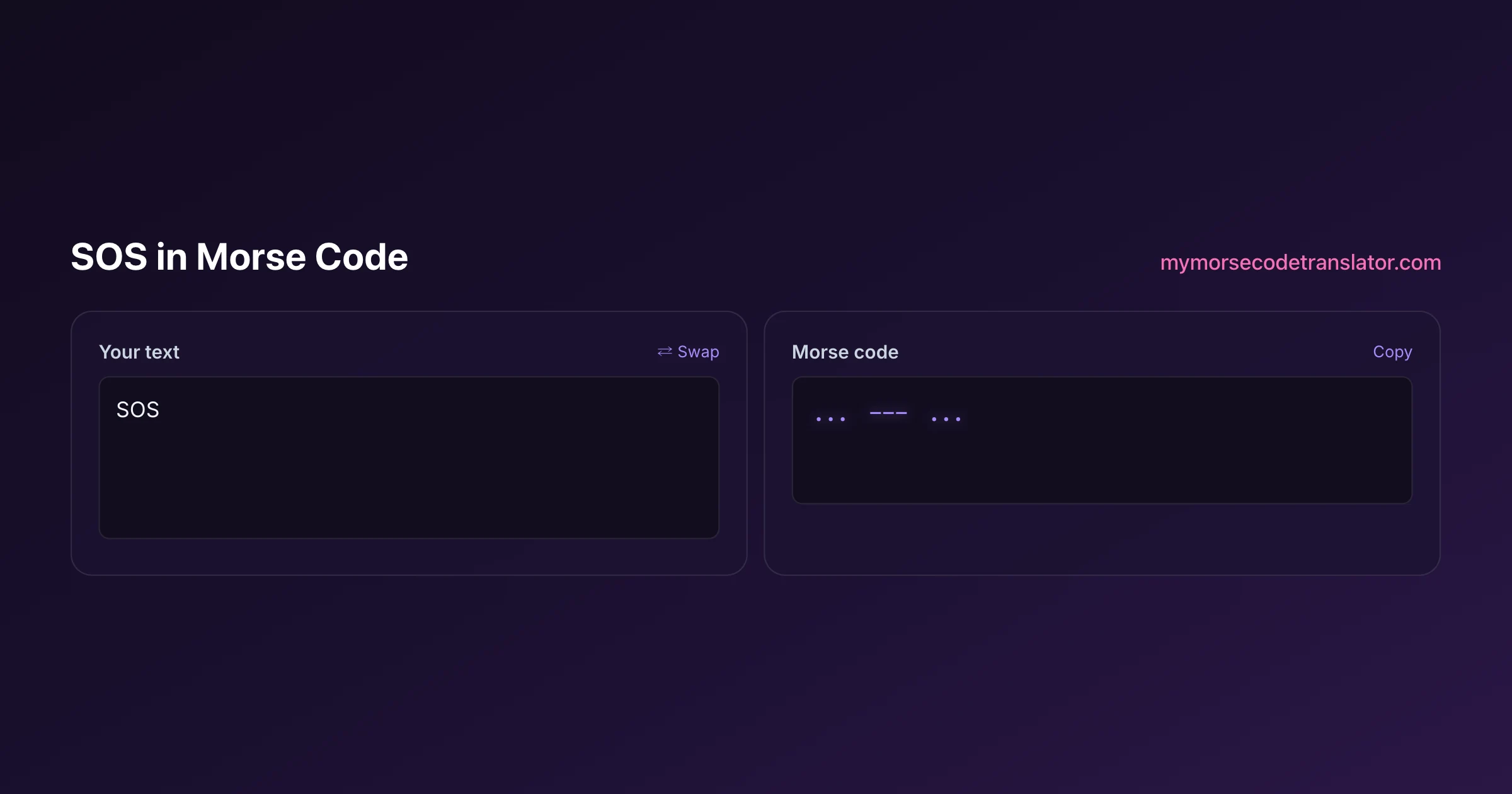
SOS morse code — · · · – – – · · · — is the most recognized distress signal on Earth: three dots, three dashes, three dots, sent as one unbroken sequence. A stranded hiker can flash it with a torch; a sinking ship can key it over radio. Yet almost everyone gets one thing about it wrong. Let me show you what SOS is, how to send it, why this pattern was chosen, and the myth that refuses to die.
👀 Preview
Press ▶ Play — this shows what you'll see and hear.
Customize your message
Your picture appears in Play and downloaded videos. Note: it can't be included in a shared link — links carry the message only.
Share as a secret message
The message is hidden inside the link and decodes with sound & light when your friend opens it.
The signal itself
SOS is three short signals, three long signals, and three short signals: · · · – – – · · ·
If you break it into letters it looks like S (· · ·), O (– – –), S (· · ·) — which is why we write it as "SOS." But here's the detail that trips almost everyone up: it is not actually sent as three separate letters. It's transmitted as one continuous string with no letter-gaps between the S, the O, and the S. In formal Morse notation, a bar drawn over the letters marks it as a single indivisible symbol — what operators call a prosign. Sending it as one flowing, rhythmic burst is a large part of what makes it instantly recognizable, even to someone who has never formally studied a single letter of Morse. The rhythm itself is the message.
That continuous-signal detail is also why SOS looks slightly different from how you'd write plain text. Spelled as ordinary letters, S-O-S would carry a normal three-unit gap between each letter, breaking it into three separate sounds. As the distress prosign, those gaps are removed, and the nine elements flow together into one long, even pattern. The difference is subtle on paper but obvious to the ear — and it's precisely that unbroken flow that a rescuer's brain latches onto as "someone is deliberately calling for help."
The myth: SOS does not stand for anything
This is the part nearly everyone gets wrong, so it's worth stating plainly: SOS does not stand for "Save Our Souls," "Save Our Ship," or "Send Out Succour." Those phrases were all invented after the fact as handy memory aids — linguists call them backronyms, meanings reverse-engineered onto letters that never had them.
SOS was chosen for one reason and one reason only: its Morse pattern is simple, symmetrical, and impossible to confuse with anything else. Three, three, three; short, long, short. It reads the same forwards and backwards. When you are panicking, injured, freezing, or fading in and out of consciousness, an easy and unmistakable rhythm is worth infinitely more than a clever acronym you'd have to remember to spell. The letters S-O-S are simply the most convenient way to write that rhythm down on paper. The meaning came from the pattern, never the other way around — a fact that surprises most people the first time they hear it.
Why this exact pattern won
Before SOS existed, distress calls at sea were a dangerous mess. The Marconi company's operators used "CQD" (a general call, CQ, plus D for distress), German stations used their own signals, and there was no single worldwide standard — a genuinely deadly situation when ships from different nations shared the same crowded waters and couldn't reliably understand each other's emergencies.
At the International Radiotelegraph Convention of 1906, delegates from the major maritime nations agreed on a single universal distress signal, and SOS came into force in 1908. Its advantages over the alternatives were obvious the moment you looked at them:
- It's short and quick to send, even by an exhausted or injured operator with failing equipment.
- Its distinctive nine-element rhythm won't be mistaken for ordinary message traffic passing on the same frequency.
- It's perfectly symmetric, so it still reads correctly even if a listener starts copying it partway through.
- It works identically in any medium — radio tone, sound, flashing light, or taps on metal.
That combination is exactly why, more than a century later, no one has ever felt a serious need to replace it. It was engineered to be foolproof under the worst possible conditions, and it succeeded.
How to send SOS in an emergency
You don't need a radio to use SOS — and that is the whole beauty of it. Because the signal is just on and off, short and long, it works through any channel you can switch on and off with your hands.
- With a flashlight or phone torch: three quick flashes, then three slower flashes, then three quick flashes, then a pause, then repeat.
- With sound: three short whistle blasts, three long blasts, three short blasts. A whistle carries far further than your voice and takes far less energy than shouting.
- By tapping: on a pipe, a wall, or a ship's hull — the same short-short-short, long-long-long, short-short-short rhythm, which travels through solid material to rescuers you can't see.
- With a mirror or any reflective surface: short and long flashes of reflected sunlight aimed toward a distant rescuer, aircraft, or vessel.
The key in every case is the pause-and-repeat. Send the full SOS, wait a few seconds, and send it again, steadily and rhythmically. A repeating, deliberate signal reads as human and intentional — search-and-rescue crews are specifically trained to look and listen for exactly that pattern, and to distinguish it from random light or noise. Conveniently, the built-in emergency function on modern iPhones and many dedicated flashlights flashes this SOS rhythm automatically, so even someone who's never learned Morse can trigger a correct distress signal at the tap of a button.
SOS in the real world
SOS earned its towering reputation in genuine emergencies. It was among the signals sent from the RMS Titanic in 1912 as she went down, helping to summon the RMS Carpathia to rescue the survivors — one of the earliest and most famous uses of the then-new international standard. Throughout the 20th century, the SOS rhythm was quite literally the sound of maritime crisis, tapped out by wireless operators on ships in trouble across every ocean, from wartime sinkings to peacetime storms.
While professional maritime communication switched to automated satellite distress systems in 1999, retiring Morse from official commercial duty, SOS itself never went away. It remains the distress signal taught in wilderness survival courses, printed in outdoor and boating safety guides, and understood across every language barrier on the planet. Wikipedia's article on SOS and the ITU's radio regulations both document its formal history in detail if you want to dig deeper into the dates and conventions. There's a simple reason SOS is the one piece of Morse code that almost every person alive can recognize: it was built to be universal, and for over a hundred years it has quietly done exactly that.
SOS versus Mayday: they aren't the same thing
People often lump SOS and "Mayday" together, but they belong to two different worlds. SOS is a Morse code signal — a rhythm of dots and dashes designed for the telegraph and radio-telegraph era, sent as light, sound, or tone. "Mayday," by contrast, is the spoken-voice distress call used on radio, chosen in the 1920s because it sounds distinct and carries clearly over the airwaves (it comes from the French "m'aidez," meaning "help me").
So the rule of thumb is simple: if you're keying, flashing, or tapping, you send SOS; if you're speaking into a radio, you say "Mayday" three times. Both mean the same desperate thing — grave and imminent danger, immediate assistance required — but they evolved for different technologies. Knowing the difference matters, because using the wrong one for your medium just wastes precious time. On a phone torch in the wilderness, SOS is your tool; on a marine VHF radio, Mayday is.
There's a common cousin worth knowing too: three of almost anything is the universal signal for distress. Three whistle blasts, three fires, three flashes, three gunshots, three piles of rocks — search-and-rescue teaches the "rule of three" precisely because it echoes the same logic that made SOS work. A single sound or light can be an accident; three, evenly spaced and repeated, reads as a deliberate cry for help. So even if you blank on the exact SOS rhythm in a real emergency, defaulting to groups of three and repeating them steadily will still be understood by anyone trained to look for it. SOS is simply the most precise, most famous member of that family — the one that crossed oceans and outlived the technology that created it.
I tested the SOS flash on my own iPhone one night to see how obvious it really looks from a distance. Standing at the far end of a dark car park, my partner said the three-three-three rhythm was unmistakable even without knowing any Morse — but the first time I sent it as three separate letters with clear gaps, she just read it as random blinking. Running the S-O-S together into one continuous burst is exactly what makes it instantly read as a distress call rather than someone fiddling with a torch.
Frequently Asked Questions
Q. What is SOS in Morse code?
SOS is · · · – – – · · · — three dots, three dashes, three dots. It's sent as one continuous signal with no gaps between the parts, which is why it's traditionally written with a bar over the letters to show it's a single distress symbol rather than three separate letters.
Q. Does SOS stand for Save Our Souls?
No. SOS doesn't stand for anything at all. It was chosen in 1906 purely because its Morse pattern is simple and unmistakable. Phrases like Save Our Souls and Save Our Ship were made up afterward as memory aids and were never the original meaning.
Q. Why is SOS sent as one continuous signal?
Sending it without letter-gaps between the S, O, and S creates a single flowing nine-element rhythm that's instantly recognizable, even to people who don't formally know Morse. Breaking it into three separate letters would make it blend in with ordinary message traffic and lose its distinctiveness.
Q. When was SOS adopted?
SOS was agreed as the international distress signal at the International Radiotelegraph Convention of 1906 and came into force in 1908, replacing a confusing patchwork of national signals like the Marconi company's earlier CQD call.
Q. How do I signal SOS with a flashlight?
Flash three quick short flashes, then three longer flashes, then three quick short flashes, then pause for a few seconds and repeat steadily. The repeating, deliberate rhythm is what tells a rescuer the signal is intentional rather than random light.
Q. Can I send SOS without a radio?
Yes. SOS works through any on/off channel — a flashlight, a whistle, tapping on metal, or flashes of reflected sunlight from a mirror. That flexibility is exactly why it was designed to be so simple, so it can be used with whatever you happen to have on hand in an emergency.
Q. Is SOS still an official distress signal?
Yes, though professional maritime radio moved to automated satellite systems in 1999. SOS remains a globally recognized emergency signal taught in survival and first-aid courses, and it's built into features like the emergency flashlight mode on modern smartphones.
Q. Why does SOS read the same backwards?
Its pattern — short-short-short, long-long-long, short-short-short — is symmetrical, so a rescuer who starts copying it partway through still recognizes it immediately. That built-in redundancy was one of the deliberate reasons the pattern was selected back in 1906.
Related guides
← Back to the My Morse Code Translator home page.

By Sukie
Sukie is the creator of My Morse Code Translator — a puzzle nerd and gadget tinkerer who fell down the Morse code rabbit hole and decided to build the most fun Morse translator on the web. When she's not adding new sound packs or reveal animations, she's decoding hidden messages in songs or designing Morse code bracelets for friends.
Last updated: 2026-07-08