I Love You in Morse Code: The Sweetest Hidden Message
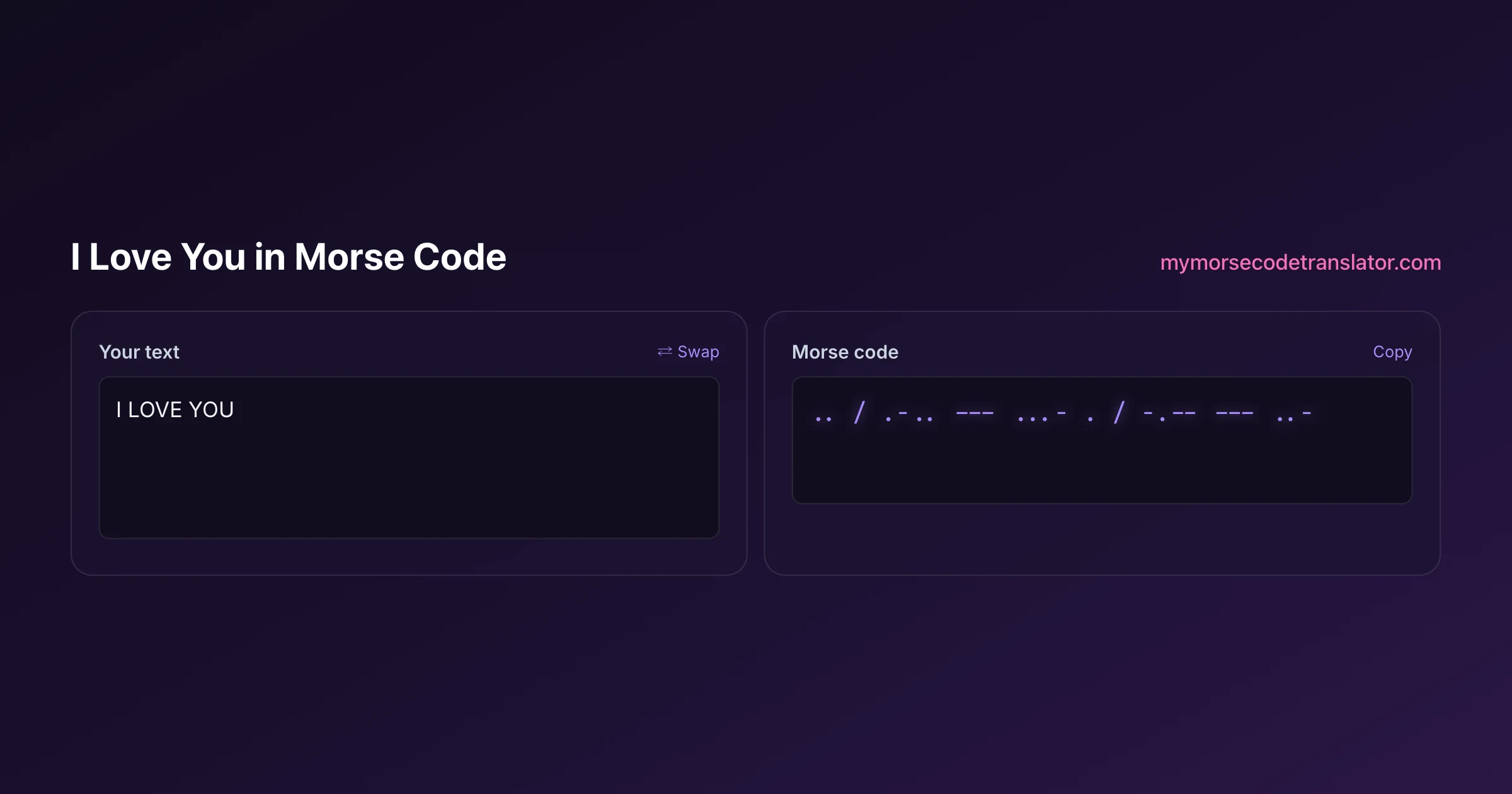
I love you in morse code is .. / .-.. --- ...- . / -.-- --- ..- — a quiet little constellation of dots and dashes that has become one of the most popular secret messages people encode into gifts. There's something irresistibly romantic about a phrase that looks like abstract pattern to everyone except the one person who knows how to read it. This page gives you the exact code, broken down letter by letter, plus the beautiful and permanent ways people choose to wear it.
👀 Preview
Press ▶ Play — this shows what you'll see and hear.
Customize your message
Your picture appears in Play and downloaded videos. Note: it can't be included in a shared link — links carry the message only.
Share as a secret message
The message is hidden inside the link and decodes with sound & light when your friend opens it.
The exact code, letter by letter
Here is "I love you" broken down completely, so you can copy it onto anything with total confidence. Remember the spacing convention: a slash marks a space between words, and a single space separates the letters within a word.
"I" is a word all by itself, just one letter: - I: ..
"LOVE" spells out as four letters: - L: .-.. - O: --- - V: ...- - E: .
"YOU" spells out as three letters: - Y: -.-- - O: --- - U: ..-
Put it all together, with the wider gaps between the three words, and you get:
.. / .-.. --- ...- . / -.-- --- ..-
Spoken aloud as rhythm it's "di-dit, di-dah-di-dit dah-dah-dah di-di-di-dah dit, dah-di-dah-dah dah-dah-dah di-di-dah." Fourteen letters of plain English collapse into a compact, elegant little string that fits neatly on a bracelet, around the inner band of a ring, or along a short strip of skin. Notice that the letter O appears twice — in LOVE and in YOU — as three dashes each time, which gives the whole phrase a pleasing visual rhythm when it's rendered in beads or ink.
Why it became a romantic classic
Encoding "I love you" in Morse works on the heart for the same reason a handwritten note beats a quick text: it takes real effort, and it's genuinely private. To a stranger glancing at your wrist, a Morse bracelet is just a pretty, slightly unusual pattern of beads. To the one person who shares the secret, it's a full sentence — a declaration they can read at a glance from across a room.
That blend of public and private is the entire appeal. You get to wear your feelings out in the open without broadcasting them to everyone. Couples love that the message is literally encoded: you have to be let in on the secret to understand it, which turns the gift itself into a small act of intimacy. There's also a lovely, timeless, analog quality to it in an otherwise digital world — a romance to the idea of a nearly 200-year-old code, born on telegraph wires and once used to save lives at sea, now carrying a love note in 2026. And on a purely practical level, three short words produce a manageable number of dots and dashes, so the finished design never gets overwhelming or cluttered the way a longer phrase might.
Wearable ideas: bracelets, necklaces, tattoos and rings
By far the most popular way to give "I love you" in Morse is as something the recipient can wear every day. Here's how the code usually gets translated into physical form:
- Beaded bracelets: small round beads become the dots and longer bar or tube beads become the dashes, with a plain spacer bead marking the gaps between letters. This is the single most common Morse gift by a wide margin, and it's genuinely easy to make yourself at a kitchen table.
- Necklaces: the same dot-and-dash bead logic strung as a delicate chain, sometimes with the dashes rendered as slim gold or silver bars for a more refined look.
- Tattoos: rows of small filled circles for dots and short filled lines or rectangles for dashes, often placed along a forearm, a collarbone, the inside of a wrist, or a rib. Because it's permanent, triple-checking the code before the needle touches skin is absolutely essential.
- Rings and engravings: the dots and dashes etched into the inner band of a ring or across a slim bar pendant, hidden discreetly against the skin where only the wearer knows they're there.
Whatever the medium, the golden rule is spacing. The reader tells the letters apart by the gaps, so you need a clear space between L, O, V, and E — and a noticeably wider gap between the three words I, LOVE, and YOU. Get the spacing wrong and the message collapses into one long, ambiguous blur that can't be decoded at all, no matter how carefully you placed each individual dot and dash.
Other short phrases people encode alongside it
"I love you" is the headline act, but people rarely stop there once they've caught the bug. A few other short, meaningful phrases that translate beautifully into wearable Morse:
- A single name — a partner's, a child's, a parent's — encoded as a keepsake.
- "LOVE" on its own (.-.. --- ...- .) when you want something even more minimal than the full sentence.
- A meaningful date, encoded in numbers (remember each digit is a full five elements, so a date lengthens the design noticeably).
- Short affirmations like "BRAVE," "HOPE," or "BREATHE" that people choose for tattoos as private reminders rather than romantic messages.
The same rules apply to all of them: verify the exact characters first, decide how you'll show the gaps in your chosen medium, and exaggerate the difference between dots and dashes so the piece stays readable. If you're combining "I love you" with a name or a date, plan the layout so the added characters don't crowd the original phrase — a little breathing room keeps the whole piece legible and elegant.
Getting it right before you commit
Because so many of these gifts are permanent or handmade, accuracy matters more here than almost anywhere else you'll use Morse. A misplaced dash in a text message costs nothing; a misplaced dash in a tattoo is there for life.
A few safeguards genuinely worth taking before you commit:
- Encode it with a reliable translator first and compare the output character by character against the breakdown at the top of this page. Our English-to-Morse translator renders the exact dots and dashes for "I love you" so you have a trustworthy reference to check against.
- Decide, before you start, how you'll represent spacing in your chosen medium — which bead means "gap between letters" and which means "gap between words."
- If it's a tattoo, have the artist sketch the full pattern first and check it against the code twice, ideally with a second person reading it back aloud as dots and dashes.
- Consider whether you want just "I love you" or to add initials or a meaningful date — and remember the extra length that numbers add.
The international standard used here is ITU International Morse Code, the same version documented by the International Telecommunication Union and referenced throughout Wikipedia's Morse code article, so the code above will be read exactly the same way by anyone who knows Morse, anywhere in the world. That universality is quietly part of the gift: your message stays private between the two of you, but the language it's written in is shared by operators on every continent.
Fun ways to give the message, beyond jewelry
Not everyone wants a bracelet or a tattoo, and "I love you" in Morse is flexible enough to hide almost anywhere. A few ideas people have used to lovely effect:
- A flashing message: send .. / .-.. --- ...- . / -.-- --- ..- with a flashlight or phone torch across a dark room, and let them decode it in real time. It turns a confession into a little game.
- A tapped message: tap the rhythm out on a partner's hand or shoulder — three dashes of the O become three slow, deliberate presses. It's astonishingly intimate once they know the code.
- A hidden note: write the dots and dashes as the "decoration" along the border of a card or a letter, with no explanation, and let them puzzle it out.
- A recorded tone: some people set the Morse audio as a custom notification sound, so a private message plays every time their partner messages them.
The common thread is that decoding takes a moment of attention, and that small pause — the beat where they realize what they're looking at or hearing — is where the whole charm lives. It's the opposite of an instant text: it asks the other person to lean in.
If you want to teach them to read it themselves, keep it kind and simple: show them just the three words, point out that dots are short and dashes are long, and let the two repeated O's (three dashes each) act as easy landmarks. Most people can decode "I love you" on their own within a couple of minutes once they know those two things — which means the gift keeps giving, because now they can send it back to you.
I made an "I love you" bracelet for my partner's birthday and learned the hard way that my dash beads were only slightly longer than my dot beads — from across the room the O (three dashes) and the runs of dots looked almost identical, and she couldn't read it. I redid it with tube beads that were unmistakably longer than the round ones, and suddenly it was legible at arm's length. If you're making one, exaggerate the size difference between your dots and dashes far more than you think you need to.
Frequently Asked Questions
Q. What is I love you in Morse code?
It's .. / .-.. --- ...- . / -.-- --- ..- — where I is .., LOVE is .-.. --- ...- ., and YOU is -.-- --- ..- The slashes mark the spaces between the three separate words.
Q. How do I write just the word love in Morse code?
LOVE is .-.. --- ...- . — that's L (.-..), O (---), V (...-), and E (.), each separated by a small gap. It's a popular standalone design for bracelets and pendants when you want a single word rather than the full sentence.
Q. Why is I love you popular as a Morse code gift?
Because it's private and meaningful at the same time. To anyone else the pattern is just an abstract design, but the person who knows the code can read your message instantly. That mix of a public object secretly carrying a full sentence is what makes it feel so romantic.
Q. How are dots and dashes shown on a bracelet?
Small round beads usually represent the dots and longer tube or bar beads represent the dashes, with a plain spacer bead marking the gaps between letters and wider gaps between words. Clear, exaggerated spacing is essential so the message can actually be decoded by eye.
Q. Should I get I love you as a tattoo?
Many people do, placing it along a wrist, forearm, collarbone, or rib as rows of dots and dashes. Because a tattoo is permanent, verify the exact code with a reliable translator first and have your artist double-check the spacing before any ink goes in.
Q. Can I add a name or date to the message?
Yes. You can encode initials as letters or a meaningful date as numbers, though remember each digit uses five elements, so a date makes the design noticeably longer. Plan the spacing carefully so the added characters stay readable alongside I love you rather than crowding it.
Related guides
← Back to the My Morse Code Translator home page.

By Sukie
Sukie is the creator of My Morse Code Translator — a puzzle nerd and gadget tinkerer who fell down the Morse code rabbit hole and decided to build the most fun Morse translator on the web. When she's not adding new sound packs or reveal animations, she's decoding hidden messages in songs or designing Morse code bracelets for friends.
Last updated: 2026-07-08