Morse Code in Other Languages
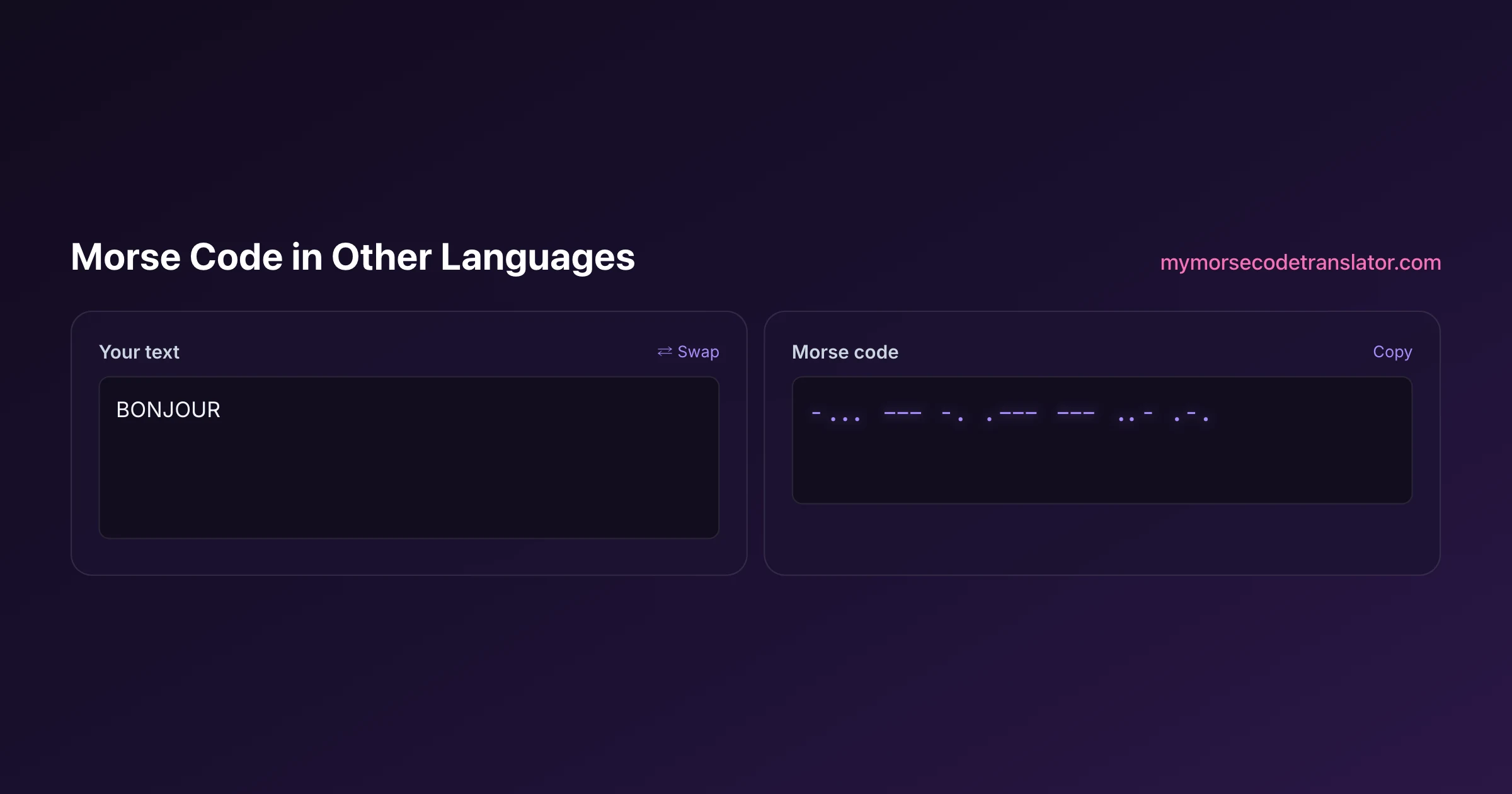
Morse code in other languages works in one of two completely different ways, and knowing which applies to your language saves a great deal of confusion. Languages written in the Latin alphabet — French, German, Spanish, Polish, the Scandinavian languages — use the same core Morse alphabet as English and simply add a handful of extra patterns for their accented characters. Languages written in other scripts, such as Russian, Greek, Japanese and Chinese, do something more radical: they map their own writing systems onto Morse from scratch, producing codes that share the dots and dashes but almost nothing else.
👀 Preview
Press ▶ Play — this shows what you'll see and hear.
Customize your message
Your picture appears in Play and downloaded videos. Note: it can't be included in a shared link — links carry the message only.
Share as a secret message
The message is hidden inside the link and decodes with sound & light when your friend opens it.
The core alphabet is the same everywhere
Before the differences, the important reassurance: the twenty-six Latin letters, the ten digits and the standard punctuation are identical worldwide. A, B, C through Z mean the same thing to an operator in Tokyo, Lima or Helsinki, because they are fixed by the ITU in the international standard.
This is why Morse worked as a global system at all. Two operators with no language in common could still exchange callsigns, signal reports and numbers reliably, because the underlying alphabet never varied. It is also why the amateur radio tradition of abbreviations and Q-codes developed — a shared shorthand layered on a shared alphabet lets people communicate meaningfully across a language barrier.
So if you are converting French or Spanish or German text and it contains no accented characters, you need nothing special at all. The standard translator handles it exactly as it handles English.
Accented letters in the Latin-script languages
For accented characters the international standard defines a set of additional patterns. The commonly used ones are:
- à, å —
.--.- - ä, æ, ą —
.-.- - ç, ĉ, ć —
-.-.. - ð —
..--. - è, ł —
.-..- - é, đ, ę —
..-.. - ĝ —
--.-. - ĵ —
.---. - ñ, ń —
--.-- - ö, ø, ó —
---. - ŝ —
...-. - þ —
.--.. - ü, ŭ —
..-- - ch, š —
----
A few observations worth having. Several patterns are shared between characters from different languages — ö, ø and ó all use the same code, as do ä, æ and ą — so the same signal means different letters depending on which language is being sent. Context resolves it, but a decoder cannot know without being told.
The ---- pattern is particularly notable: in Czech and Slovak it represents the digraph ch, treated as a single letter in those alphabets, while elsewhere it appears as š. This is a good illustration of the general principle that these extensions are conventions rather than universals.
French, Spanish and German in practice
French needs é, è, à, ç and occasionally ù and ê. The most frequent by far is é, and ..-.. is worth knowing if you send any French at all. In practice many French operators simply strip the accents and send plain Latin letters, relying on the reader to reinstate them — ETE is unambiguously été in context.
Spanish needs ñ and the accented vowels á, é, í, ó, ú. ñ (--.--) is the one that genuinely changes meaning — año and ano are different words — so it is the accent least safe to drop. The vowel accents mark stress and are more often omitted without confusion.
German needs ä, ö, ü and ß. The umlauts have standard patterns, and ß has no Morse code of its own at all — the universal practice is to send it as ss, exactly as German itself permits in transliteration.
Across all three, the pragmatic reality is that accent-stripping is extremely common on the air. The extensions exist and are correct, but a message sent in plain Latin letters will be understood by everyone, while a message using the extensions requires the receiver to know them.
Russian and the Cyrillic alphabet
Russian Morse maps the Cyrillic alphabet onto Morse patterns, and it does so by reusing patterns from the Latin set. А is .-, exactly like Latin A. Б is -..., the same as B. В is .-- — which is Latin W.
That last one is the point. The mapping is not phonetic and it is not one-to-one with Latin letters. A signal that an English operator reads as W is read by a Russian operator as В. The same dots and dashes carry a different letter depending on which alphabet you are decoding against.
Cyrillic has 33 letters, more than the Latin 26, so several patterns that serve as punctuation or accented characters in the international set are pressed into service for Cyrillic letters. Ч, Ш, Щ, Ы, Ь, Э, Ю and Я all have assignments that a Latin-only decoder will render as something else entirely.
The practical consequence: an intercepted Russian Morse transmission decoded with an English tool produces plausible-looking Latin gibberish, not an error. If you have a message that decodes to consistent-looking nonsense and you have reason to think it is Russian, that is very likely why.
Greek, Hebrew and other alphabetic scripts
Greek Morse follows the same logic as Russian: each Greek letter is assigned a Morse pattern, largely mirroring the Latin letter it corresponds to phonetically or visually. Α is .-, Β is -..., Γ is --. and so on, which makes it more intuitive than Cyrillic for anyone who knows both alphabets.
Hebrew Morse assigns patterns to the twenty-two Hebrew letters, again reusing Latin patterns. Because Hebrew is written right to left, there is an additional convention question about transmission order — the code is sent in the order the letters are read.
Arabic Morse similarly maps the Arabic letters onto Morse patterns and shares the right-to-left consideration.
In every one of these cases the principle is identical: the dots and dashes are a shared physical alphabet, and each writing system claims them for its own characters. There is no universal decoder, because the same signal genuinely means different things in different systems.
Japanese: Wabun, a genuinely separate code
Japanese takes the most distinct approach. Wabun code encodes the kana syllabary rather than letters, and it is effectively a parallel system with its own table.
Because Japanese kana represent syllables rather than individual sounds, a single Wabun character carries more information than a Latin letter does. イ is .-, ロ is .-.-, ハ is -... and so on across the full kana set, with additional marks for the voiced and semi-voiced modifiers.
Wabun patterns are frequently longer than Latin Morse patterns, some running to five or six marks, because there are far more kana than there are Latin letters. There is also a control signal used to indicate a switch between Wabun and Latin Morse within a transmission, which tells you how routinely operators moved between the two.
A Latin decoder applied to Wabun produces complete nonsense rather than near-nonsense, because the pattern lengths do not line up. In a sense that is helpful: the failure is obvious rather than silent.
Chinese: numbers standing in for characters
Chinese cannot be handled by assigning a Morse pattern to each character — there are far too many. The solution was indirection.
The Chinese telegraph code assigns a four-digit number to each of thousands of Chinese characters. To send Chinese by Morse, an operator looks up each character's four-digit code and transmits those digits using ordinary Morse numerals. The receiving operator writes down the numbers and looks them back up.
So a Chinese Morse transmission, decoded with any standard tool, comes out as a long stream of digits — 2703 0022 6015 and so on. Those digits are not corrupt; they are the message, one code book lookup away from being readable.
This is worth knowing if you ever encounter Morse that decodes to nothing but four-digit number groups. It is not an error and it is not encryption in any meaningful sense. It is a writing system that needed a different bridge to a dots-and-dashes channel.
Korean has its own approach again, with systems mapping Hangul components to Morse patterns.
What this translator supports
Being clear about scope: the tool on this site works in International Morse — the Latin alphabet, digits and standard punctuation as defined by the ITU. That covers English and every Latin-script language written without accents, which is the overwhelming majority of what people convert.
It does not currently encode the accented extensions, and it does not handle Cyrillic, Greek, Wabun or the Chinese telegraph code. Characters it does not recognise are marked in the output rather than silently dropped, so you can see exactly where something did not convert instead of receiving a quietly incomplete result.
The practical workaround for accented Latin languages is the one operators use anyway: strip the accents. Send ETE for été, ANO for año, UBER for über. The message is entirely readable in context, and it is what a large share of real traffic does.
For Cyrillic, Japanese or Chinese, you need a tool built for that system — a Latin decoder will mislead rather than help.
Why the differences exist at all
It would have been possible, in principle, to design one code covering every script. Nobody did, and the reason is historical rather than technical.
Morse spread outward from Western Europe and North America across the second half of the 19th century, arriving in each country as an existing working system built for the Latin alphabet. Each telegraph administration then faced the same problem — our language is not written in these letters — and solved it locally, before there was any international body positioned to impose a single answer.
By the time the ITU was standardising Morse internationally, the national variants were entrenched in trained operators, printed code books and installed equipment. Standardising the Latin core and leaving the rest alone was the only realistic path.
The result is a system that is genuinely universal at its centre and entirely local at its edges. Any two operators anywhere can exchange callsigns and numbers. Sending actual sentences in a non-Latin language requires both ends to share a convention that the international standard never specified.
Practical advice by situation
Converting accented Latin text. Strip the accents and send plain letters, or use the extension patterns above if you know the receiver understands them. Stripping is safer and far more common.
Decoding something that produces near-gibberish. Latin words appearing among nonsense usually means a different alphabet — Cyrillic is the most likely candidate, given how much of its mapping overlaps with Latin patterns.
Decoding something that produces complete nonsense. Check the pattern lengths. Consistently long patterns suggest Wabun. Nothing but four-digit number groups suggests Chinese telegraph code.
Learning Morse in a non-English language. Learn the Latin core first regardless. It is the shared foundation, it is what every international contact uses, and the language-specific additions are a small increment on top of it rather than a separate skill.
I once spent an hour trying to fix a 'corrupted' recording that decoded to endless four-digit number groups. Nothing was wrong with it. It was Chinese telegraph code, and the numbers were the message — I just did not have the code book that turns 2703 into a character.
Frequently Asked Questions
Q. Is morse code the same in every language?
The core Latin alphabet, digits and punctuation are identical worldwide under the ITU standard. Beyond that, languages diverge — Latin-script languages add patterns for accented letters, while Russian, Greek, Japanese and Chinese use entirely separate mappings.
Q. How do you write accented letters like é and ñ in morse code?
The international standard defines extensions: é is ..-.., ñ is --.--, ü is ..--, ö is ---., ç is -.-.. and à is .--.-. In practice many operators simply strip the accents and send plain letters, which is understood in context.
Q. What is morse code for French, German and Spanish?
All three use the standard Latin alphabet plus a few accent patterns — é and è for French, ä ö ü for German (with ß sent as ss), and ñ plus accented vowels for Spanish. Without accented characters, no special handling is needed at all.
Q. How does Russian morse code work?
Cyrillic letters are mapped onto Morse patterns, reusing many of the Latin ones for different letters — the pattern for Latin W is Russian В, for instance. A Latin decoder will therefore turn Russian Morse into plausible-looking gibberish rather than flagging an error.
Q. How is Japanese sent in morse code?
Through Wabun code, a separate system encoding the kana syllabary rather than letters. Its patterns are often longer than Latin ones, and a control signal exists for switching between Wabun and Latin Morse mid-transmission.
Q. How is Chinese sent in morse code?
Indirectly. Each Chinese character has a four-digit number in the Chinese telegraph code, and those digits are sent as ordinary Morse numerals. A decoded Chinese transmission looks like a stream of four-digit groups, which are then looked up to recover the characters.
Related guides
← Back to the My Morse Code Translator home page.

By Sukie
Sukie is the creator of My Morse Code Translator — a puzzle nerd and gadget tinkerer who fell down the Morse code rabbit hole and decided to build the most fun Morse translator on the web. When she's not adding new sound packs or reveal animations, she's decoding hidden messages in songs or designing Morse code bracelets for friends.
Last updated: 2026-10-02