Morse Code Letters
Morse code letters are the twenty-six building blocks everything else rests on, and they are not arbitrary. Each one is a short pattern of dots and dashes chosen, in the main, so that the letters you type most often take the least time to send. That single design decision explains why E is one dot and Q is four symbols long, and once you see it, the whole alphabet stops looking like a list to memorise and starts looking like a system with a reason behind it. This page walks the letters individually, in the order that makes them easiest to learn rather than the order they appear in the alphabet.
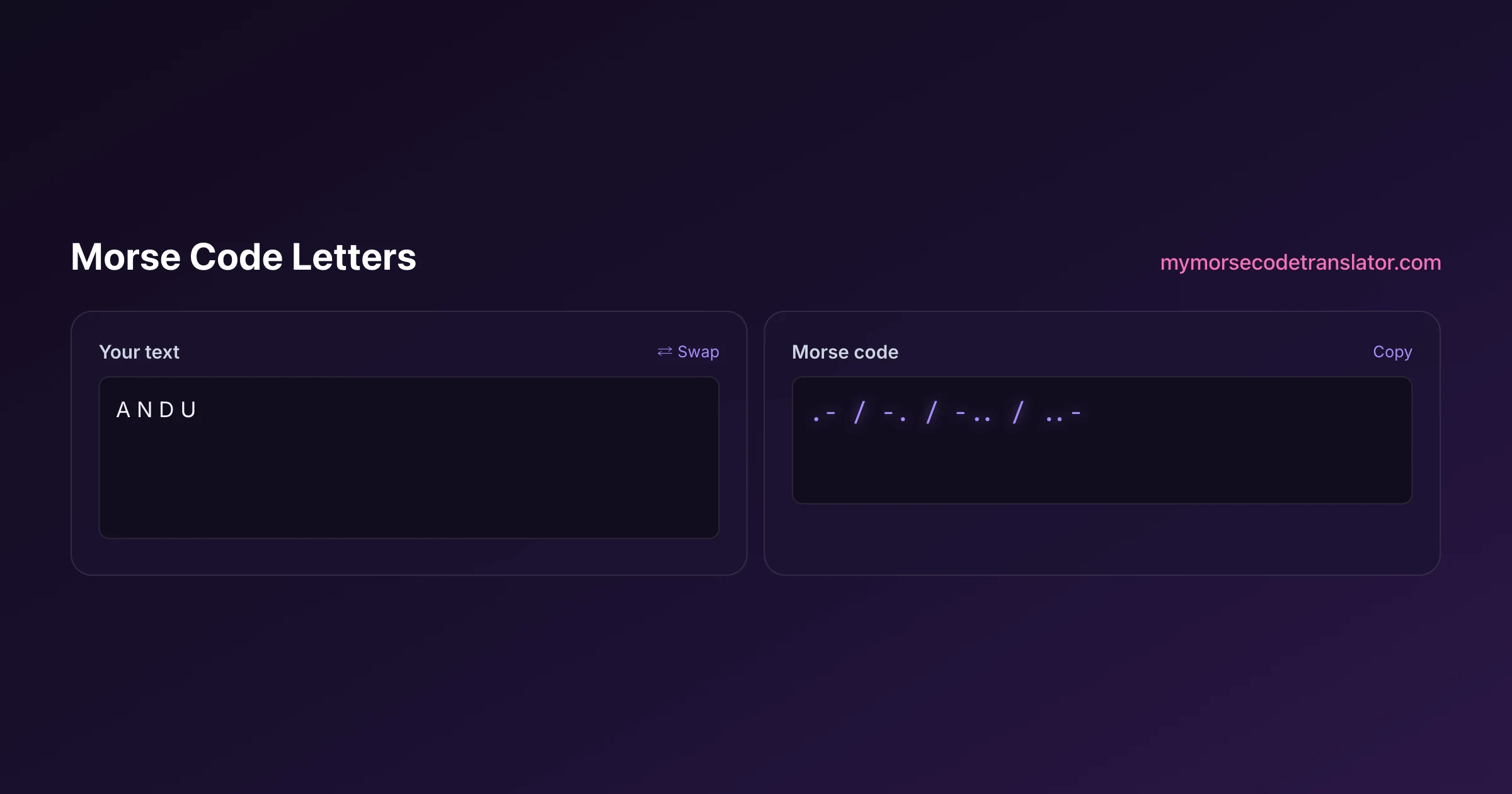
👀 Preview
Press ▶ Play — this shows what you'll see and hear.
Customize your message
Your picture appears in Play and downloaded videos. Note: it can't be included in a shared link — links carry the message only.
Share as a secret message
The message is hidden inside the link and decodes with sound & light when your friend opens it.
The four letters to learn first
Start with the four shortest patterns, because they carry an outsized share of ordinary English and they are impossible to confuse with each other.
- E is a single dot. One sound, over almost before it starts.
- T is a single dash. One sound, held about three times as long.
- I is two dots.
- M is two dashes.
That is it for the one-and-two-symbol letters made of a single kind of mark. E and T are the two most common letters in written English, and they were given the two shortest possible signals. I and M follow directly. If you learn nothing else today, learn these four: you will already be able to pick them out of a stream of code, and they anchor everything that comes next.
Say them out loud as dit, dah, dit-dit, dah-dah. Reading Morse by eye and hearing it are different skills, and the spoken form is what your ear will eventually latch onto.
The letters that mix a dot and a dash
Next come the two-symbol letters that use one of each. There are only two, and they are exact opposites:
- A is dot-dash (dit-dah)
- N is dash-dot (dah-dit)
A and N trip up more beginners than any other pair, because they contain the same two marks in the opposite order and the difference is entirely in which one arrives first. The fix is not to stare harder at the page. It is to learn them as two different rhythms — A rises, N falls — and to always practise them together so your ear is forced to tell them apart rather than guess.
With E, T, I, M, A and N you now know six letters, and between them they cover a startling proportion of everyday text.
The three-symbol letters
Eight letters use exactly three marks. This is where most of the common consonants live.
- S — dot dot dot
- O — dash dash dash
- U — dot dot dash
- R — dot dash dot
- W — dot dash dash
- D — dash dot dot
- K — dash dot dash
- G — dash dash dot
S and O are the pair everyone already knows without realising it, because together they make the distress call. U, R and W all begin with a dot; D, K and G all begin with a dash, which gives you a useful first-fork when you are listening: the opening mark immediately halves the possibilities.
R is worth singling out. Dot-dash-dot is A with an extra dot on the end, and in fast code the two blur together for beginners more than any other pair besides A and N.
The four-symbol letters
Twelve letters use four marks, which makes this the largest group and the one that takes longest to absorb.
- H — dot dot dot dot
- V — dot dot dot dash
- F — dot dot dash dot
- L — dot dash dot dot
- P — dot dash dash dot
- J — dot dash dash dash
- B — dash dot dot dot
- X — dash dot dot dash
- C — dash dot dash dot
- Y — dash dot dash dash
- Z — dash dash dot dot
- Q — dash dash dot dash
A few of these have hooks that make them stick. V is the opening of Beethoven's Fifth — three short and one long — which is why it was used as the "V for Victory" signal in the Second World War. H is simply four dots, the longest run of a single mark in the alphabet. B, X, C, Y, Z and Q all open with a dash, and J is the only letter that is one dot followed by three dashes.
Q deserves a note of its own. Dash-dash-dot-dash is long, and that is deliberate: Q is rare in English, so it was handed one of the more expensive patterns.
Why the letters were assigned this way
The pattern lengths are not random, and understanding the logic makes them far easier to remember. When the code was being worked out, the people designing it wanted the alphabet weighted so that frequently-used letters were quick to send. The story usually told is that the assignment was informed by counting the type in a printer's case — a rough but effective proxy for how often each letter appears in English.
The result is a code where E and T cost one unit of signal, and rare letters like Q, Y and J cost a great deal more. Over a long message that difference compounds enormously. On a hand-keyed circuit, where every extra dash is extra work and extra time on a shared wire, this was not an elegance; it was the difference between a practical system and an impractical one.
It also means the alphabet has an internal grammar. Short patterns are common letters. Long patterns are rare letters. When you are decoding by ear and you catch a long, laboured pattern, the odds are already against it being an E or an A.
Letters that are mirror images of each other
Several letters are exact reversals, and these are the pairs that cause the most errors. Learning them explicitly as pairs, rather than encountering them by accident, saves a lot of frustration:
- A (dot-dash) and N (dash-dot)
- D (dash-dot-dot) and U (dot-dot-dash)
- G (dash-dash-dot) and W (dot-dash-dash)
- B (dash-dot-dot-dot) and V (dot-dot-dot-dash)
- F (dot-dot-dash-dot) and L (dot-dash-dot-dot)
- Q (dash-dash-dot-dash) and Y (dash-dot-dash-dash)
There is a common piece of advice that you should learn the alphabet in order, A through Z. For these pairs specifically, that is the worst possible approach, because it separates letters that need to be contrasted directly. Drill each pair back to back until the difference is a felt rhythm rather than a thing you work out.
Letters that contain other letters
Because Morse has no gap inside a letter that is any longer than the gap between the marks, some letters literally begin with other letters. This is worth knowing, because it is the single biggest cause of decoding errors when the spacing is sloppy.
A few examples: S (three dots) begins with I (two dots), which begins with E (one dot). H (four dots) contains all three. Similarly, O (three dashes) begins with M (two dashes), which begins with T. And A (dot-dash) is the start of both W (dot-dash-dash) and R (dot-dash-dot), each of which is the start of longer letters again.
The consequence is that timing is not decoration in Morse code, it is the grammar. If the gap between characters is not clearly about three times the length of the gap inside a character, a listener genuinely cannot tell whether they heard H or two Is or four Es. Human operators produce this spacing naturally with practice; software produces it exactly.
Hearing the letters instead of reading them
There is a hard truth about learning the letters that trips up nearly everyone who starts with a printed chart: reading dots and dashes on a page and copying code by ear are close to unrelated skills. People who learn visually often build a mental lookup step — hear the sound, picture the dots, then read off the letter — and that intermediate step becomes a ceiling they later have to demolish.
The advice from people who teach this seriously, including the instructors at the Long Island CW Club and the training material published by the ARRL, is consistent: learn each letter as a single sound with its own shape, not as a sequence of marks to be counted. Q is not "dash dash dot dash", it is a specific little tune. The moment you start counting, you fall behind.
A practical way to build that habit is to play the letters at a speed fast enough that counting is impossible while stretching the gaps between them so you still have thinking time. That is what Farnsworth timing does, and the translator on this site supports it directly — set a character speed you cannot count at, then slow the spacing until you can keep up.
Practising individual letters with the translator
The fastest way to lock in a specific letter is to hear it dozens of times in a row, in isolation, until it stops being a puzzle. The tool on this page makes that straightforward:
- Type a single letter and press Play to hear just that character.
- Type the same letter repeated —
AAAAAAA— to drill one rhythm. - Type a confusable pair over and over —
ANANANAN— to force the contrast. - Turn on the light option to see the pattern as well as hear it, which helps if you are a visual learner making the transition to audio.
- Drop the speed if the letter blurs, or raise it once it feels automatic.
And if you want the letters to stick outside of practice sessions, the trick that works surprisingly well is to spell things you actually care about — your own name, a friend's name, the word you keep mistyping. Meaning is a memory aid, and a letter you have sent fifty times inside your own name is a letter you own.
The letters as a quick reference
For everyday lookup, here is the full set in alphabetical order, with the letters grouped by how many marks they use so you can see the structure at a glance.
One mark: E (dot), T (dash)
Two marks: A (dot dash), I (dot dot), M (dash dash), N (dash dot)
Three marks: D (dash dot dot), G (dash dash dot), K (dash dot dash), O (dash dash dash), R (dot dash dot), S (dot dot dot), U (dot dot dash), W (dot dash dash)
Four marks: B (dash dot dot dot), C (dash dot dash dot), F (dot dot dash dot), H (dot dot dot dot), J (dot dash dash dash), L (dot dash dot dot), P (dot dash dash dot), Q (dash dash dot dash), V (dot dot dot dash), X (dash dot dot dash), Y (dash dot dash dash), Z (dash dash dot dot)
These are the International letters, standardised by the ITU and used essentially everywhere outside a few historical American landline circuits. If you are decoding something old and American and the letters come out as nonsense, that is the likely reason.
Where the letters go next
Letters alone will get you a surprisingly long way, but they are one part of a larger set. Numbers follow a beautifully regular pattern that is much easier than the letters. Punctuation is less regular and less used. And the prosigns — the run-together combinations that act as control signals rather than text — are what turn a letter-by-letter reading into something that sounds like an actual conversation.
If you have the letters comfortably, the natural next steps are the timing rules that hold them apart, and then the numbers. Most people find that once the twenty-six letters are automatic, everything after them arrives quickly, because the hard part was never the memorising. It was training your ear to stop counting.
I spent a week drilling letters in alphabetical order and could not tell A from N to save my life. Switching to paired drills — AN, AN, AN for ten minutes, then DU, then GW — fixed it in two sessions. The order you practise in matters more than the hours you put in.
Frequently Asked Questions
Q. What are all 26 morse code letters?
A dot-dash, B dash-dot-dot-dot, C dash-dot-dash-dot, D dash-dot-dot, E dot, F dot-dot-dash-dot, G dash-dash-dot, H dot-dot-dot-dot, I dot-dot, J dot-dash-dash-dash, K dash-dot-dash, L dot-dash-dot-dot, M dash-dash, N dash-dot, O dash-dash-dash, P dot-dash-dash-dot, Q dash-dash-dot-dash, R dot-dash-dot, S dot-dot-dot, T dash, U dot-dot-dash, V dot-dot-dot-dash, W dot-dash-dash, X dash-dot-dot-dash, Y dash-dot-dash-dash, Z dash-dash-dot-dot.
Q. Which morse code letter is the shortest?
E, a single dot, is the shortest. T, a single dash, is the shortest of the dash-based letters but takes about three times as long to send. Both were deliberately given minimal patterns because E and T are the most frequently used letters in English.
Q. Why are some letters so much longer than others?
The code was weighted by how often letters appear in English, so common letters got short patterns and rare ones got long patterns. That is why E is one mark and Q is four. Over a long message the saving is substantial, which mattered enormously when every character was sent by hand.
Q. Which letters get confused most often?
The reversed pairs: A and N, D and U, G and W, B and V, F and L, Q and Y. Each pair uses the same marks in the opposite order, so they are only distinguishable by rhythm. Practising them side by side rather than in alphabetical order fixes this faster than anything else.
Q. Do I need to memorise the letters to use a translator?
No. The translator converts in both directions instantly, so you can encode or decode without knowing a single letter. Memorising becomes worthwhile only if you want to read code by ear, which is a genuinely different and rather satisfying skill.
Q. Are morse code letters the same in every language?
The core 26 Latin letters are the same worldwide under the International standard. Languages with accented characters add extra combinations for letters like é, ä and ñ, and non-Latin scripts use their own separate systems entirely.
Related guides
← Back to the My Morse Code Translator home page.

By Sukie
Sukie is the creator of My Morse Code Translator — a puzzle nerd and gadget tinkerer who fell down the Morse code rabbit hole and decided to build the most fun Morse translator on the web. When she's not adding new sound packs or reveal animations, she's decoding hidden messages in songs or designing Morse code bracelets for friends.
Last updated: 2026-08-24