Morse Code Bracelet
A morse code bracelet spells a hidden word in beads — small round ones for the dots, longer tube-shaped ones for the dashes, and spacers to separate the letters. Worn, it reads as an ordinary piece of jewellery. To anyone who knows the code, or has thirty seconds and a translator, it says a name, a date, or a short phrase. This page covers what they actually say, the styles you will run into, the one flaw that makes a great many of them unreadable, and how to choose or check one before you spend money on it.
👀 Preview
Press ▶ Play — this shows what you'll see and hear.
Customize your message
Your picture appears in Play and downloaded videos. Note: it can't be included in a shared link — links carry the message only.
Share as a secret message
The message is hidden inside the link and decodes with sound & light when your friend opens it.
How a word becomes a row of beads
The idea is simple once you see it. Every letter in Morse is a short run of dots and dashes, and a bracelet gives each mark a bead.
- A dot is a small round bead.
- A dash is a longer bead — usually a tube or bar, roughly three times the length.
- Between the marks inside one letter there is nothing, or a very small gap.
- Between letters there is a spacer — a distinctly different bead, a knot, or a clear gap.
- Between words the gap is bigger still.
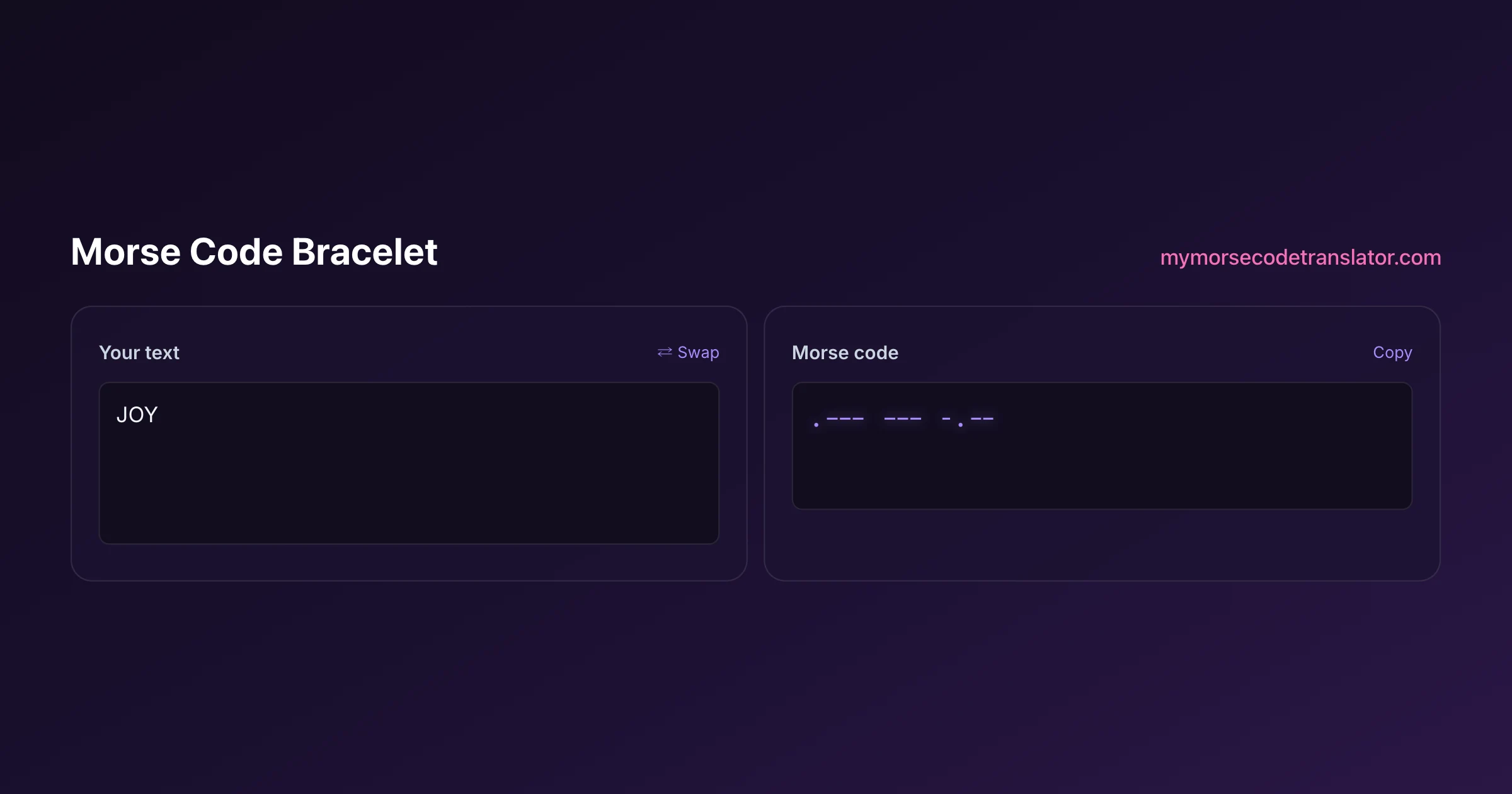
So JOY is .--- --- -.--: dot, three dashes — spacer — three dashes — spacer — dash, dot, dash, dash. Fifteen beads once you add the spacers, for three letters.
That ratio is the thing most people underestimate. Morse is long. A four-letter name is comfortably a bracelet; an eight-letter name is most of an adult wrist; a short phrase is a necklace. The morse code alphabet has every letter if you want to count a specific word before committing to it.
What people actually put on them
After looking at a lot of these, the same handful of choices come up again and again.
Names. By far the most common — a child, a partner, a parent, sometimes a pet. Short names win because they stay readable.
Initials. Two or three letters, often for a couple or a family. The most wearable option of all.
Dates. An anniversary or a birth year in digits. Numbers are always five marks each in Morse, so a four-digit year is twenty marks plus spacers — long, but it lays out with a pleasing regularity.
Short words. LOVE, HOPE, BRAVE, STRONG, MAMA, SISTER, ALWAYS. Six letters is about the practical ceiling.
Private phrases. Something only two people understand, which is really the whole appeal — a message worn in the open that nobody else can read.
If the word is longer than about six letters, the honest advice is to change medium rather than squeeze the spacing. An engraved bar, a necklace, or ink all hold a long word comfortably. A squeezed bracelet stops being readable, which defeats the point.
The styles you will run into
Beaded on cord or elastic. The most common and the easiest to read, because the dot and dash beads are genuinely different shapes. Usually the cheapest, and the easiest to make yourself.
Knotted cord. Knots stand in for the marks, often with beads only for the dashes. Softer looking, more casual, and harder to decode because knot sizes vary.
Engraved bar or cuff. The marks are stamped or engraved into a metal plate. The tidiest option and usually the most expensive. Spacing is fully under the maker's control, so a good one is very readable and a careless one is hopeless.
Chain with fixed segments. Dots and dashes soldered into a fine chain. Delicate, often marketed toward a dressier look, and generally the smallest — check that the marks are still distinguishable at actual size.
Leather or wrap. Beads threaded onto leather, sometimes wrapping twice. The wrap is the thing to watch: if the pattern continues around the second loop, where it starts and stops becomes genuinely ambiguous.
Across all of them the material matters far less than the spacing. A cheap elastic bracelet with clear letter gaps is readable; an expensive gold cuff with even spacing is not.
The flaw that makes most of them unreadable
This is the single most useful thing on the page, so it gets said plainly.
A great many bracelets sold as Morse cannot be decoded by anyone who was not told what they say. Not because the maker picked the wrong beads, but because they used the same gap everywhere.
Morse depends on three different gaps carrying meaning: small inside a letter, medium between letters, large between words. Take that away and the pattern becomes genuinely ambiguous rather than merely difficult. Four round beads in a row with even spacing could be H, or two Is, or four Es. No reader, human or software, can tell which — the information was never encoded.
So when you look at a product photo, ignore the metal and look at the rhythm. Can you see the beads grouping into clumps, with visible breaks between the clumps? That is a real message. Is it an evenly-spaced row of alternating beads? That is decoration.
Decoration is a perfectly fine thing to buy — plenty of these are lovely objects and mean a great deal to the person wearing them. Just know which one you are getting, especially if the appeal was that it says something.
What to check before you buy
Five things, and the whole check takes about a minute.
1. Ask for the exact dots and dashes. Not the word — the pattern. A seller who works from a pattern can produce it instantly. One who cannot usually assembled it by eye, which is where errors come from.
2. Decode that pattern yourself. Paste it into the translator on this page and confirm it returns the word you asked for. This is the entire quality-control process and it costs thirty seconds.
3. Look for letter spacers in the photo. Per the section above. If every gap looks identical, the piece is decorative.
4. Count the doubled letters. EMMA, HANNAH, MOLLY, AARON — any repeated letter is where a bead most often goes missing, and the result is a shorter name that still looks plausible. That is exactly why it slips through.
5. Check the length against your wrist. Ask for the finished measurement rather than trusting a styled photo. Long names photograph well laid flat and do not fit.
Marketplaces like Etsy are full of these, from genuinely careful makers to sellers who bought a job lot. The check above works the same on all of them, and a good seller will not mind being asked.
Reading one you already own
If you were given one and want to know what it says — or you suspect it says the wrong thing — the process is straightforward.
Lay it flat, clasp at one end, and photograph it straight down in soft light against a contrasting background. Then either read it off by eye, writing a dot for each small bead, a dash for each long one and a slash at each spacer, or let the reader do it.
Two practical notes. Direction matters: a bracelet reads from one end and looks like nonsense from the other, so if the first attempt returns gibberish, reverse it before concluding anything. And the clasp is usually the boundary — most makers start the pattern immediately after it.
A full walkthrough, including what to do when the decode comes back ambiguous, is on morse code bracelet translator. For photographing a curved piece so it actually decodes, morse code picture translator covers the technique.
Making one yourself
Making one is genuinely easy and considerably cheaper than buying, and it removes the decoding risk entirely because you control the spacing.
The short version: choose a short word, generate the pattern, count how many round beads, long beads and spacers you need, buy slightly more than that, and lay the whole row out flat on a table before threading anything. Errors are obvious in a line on a table and nearly invisible once the bracelet is closed.
The two decisions that matter most are making dashes clearly longer than dots — aim for a real three-to-one difference rather than a subtle one — and using a visibly distinct spacer between letters, ideally a different colour or shape rather than just a slightly wider gap.
Then decode it backwards before you finish the knot.
Morse code bracelet maker has the full walkthrough: bead counts, materials, stringing, and the mistakes that ruin a piece.
How they age, and designing for it
Worth thinking about if the piece is meant to last, because what degrades first is the part carrying the meaning.
On elastic, the cord relaxes over months and the beads drift. The gaps are what drift, so a bracelet that was marginal when new becomes unreadable rather than merely loose.
On knotted cord, knots tighten and migrate, with the same effect.
On engraved metal, the marks hold their shape indefinitely, but shallow engraving wears at the contact points — the underside of a cuff goes first.
On plated pieces, the plating wears through at the high points, which are often the dash bars.
The hedge in every case is generosity at the design stage: larger letter gaps than the minimum, dashes clearly longer than three dots rather than exactly three, and one fewer letter than you were tempted to fit. A short word with generous spacing outlives a long word squeezed in, both physically and in whether anyone can still read it in ten years.
Giving one as a gift
The reason these work as gifts is that they carry a private message in public, and the reveal is the good bit.
The thing most people forget is that the recipient has no idea it says anything unless you tell them. A small card with the word, the pattern, and a line explaining how to read it turns a nice bracelet into something they will actually understand and re-tell. It is also the only way the meaning survives being passed on later.
If you want the reveal to be more of an event, the translator here will play the same word as a tone or flash it as light, and send a secret morse message packs it into a link that decodes itself when they open it — so the bracelet arrives with a message that beeps.
And if you are choosing the word rather than the object, names in morse code covers spelling a name correctly, which is where these go wrong most often.
A friend asked me to check a bracelet before she bought it — sold as her daughter's name. It was one bead short in the fourth letter and actually spelled something else. The seller remade it without argument, but only because we could point at exactly which bead was wrong, which took about thirty seconds with the decoder. I have checked a dozen since and roughly half turned out to be decorative rather than decodable — even spacing throughout, nothing to read.
Frequently Asked Questions
Q. What is a morse code bracelet?
A bracelet that spells a word using beads instead of letters — small round beads for the dots, longer tube beads for the dashes, and spacers between the letters. It reads as ordinary jewellery unless you know the code.
Q. How do you make a morse code bracelet?
Pick a short word, convert it to dots and dashes, then thread a small bead for each dot and a long one for each dash with a distinct spacer between letters. Lay the whole row out flat before threading — mistakes are obvious on a table and invisible once it is closed.
Q. How do you read a morse code bracelet?
Lay it flat and write a dot for each small bead, a dash for each long one, and a slash at each spacer, then decode that string. If it returns nonsense, read it from the other end — a bracelet only reads in one direction.
Q. Why can't my bracelet be decoded?
Almost always because the gaps between letters are the same size as the gaps between beads inside a letter. Morse depends on three different gap lengths, and without them a run of beads is genuinely ambiguous — four round beads could be H, two Is, or four Es.
Q. How many beads does a name need?
More than people expect. Each letter is one to four marks plus a spacer, so a four-letter name runs around fifteen beads and an eight-letter name is most of an adult wrist. Short names and initials wear best.
Q. Can you put a date on one?
Yes, and dates lay out neatly because every digit in Morse is exactly five marks. A four-digit year is twenty marks plus spacers, which is long but visually regular.
Q. Are morse code bracelets only for women?
No — they are made in every style, from delicate chain to heavy leather and engraved metal cuffs. Most listings are marketed toward women, but the format itself has nothing to do with who wears it.
Q. How do I check a bracelet before buying it?
Ask the seller for the exact dots and dashes rather than the word, decode that string yourself, and look at the listing photo for visible letter spacers. A seller who cannot produce the pattern usually did not work from one.
Q. What is the best word to choose?
Something six letters or fewer — a short name, a pair of initials, or a word like LOVE or BRAVE. Longer phrases are better suited to an engraved bar or a necklace, where you are not forced to squeeze the spacing.
Q. Which style is easiest to read?
Beaded on cord, because the dot and dash beads are genuinely different shapes. Knotted cord is hardest, since knot sizes vary. Engraved bars can be excellent or hopeless depending entirely on how carefully the spacing was set.
Q. Do these use standard morse code?
The good ones use International Morse, the standard fixed by the ITU that every modern translator and radio operator uses. That is what makes a pattern portable — the same beads read the same way to anyone, anywhere.
Q. Will it still be readable in ten years?
It depends on the gaps rather than the beads. Elastic relaxes and knots migrate, and it is the spacing that drifts — so a piece that was marginal when new becomes unreadable. Design with generous letter gaps and it will outlast a tighter one.
Related guides
← Back to the My Morse Code Translator home page.

By Sukie
Sukie is the creator of My Morse Code Translator — a puzzle nerd and gadget tinkerer who fell down the Morse code rabbit hole and decided to build the most fun Morse translator on the web. When she's not adding new sound packs or reveal animations, she's decoding hidden messages in songs or designing Morse code bracelets for friends.
Last updated: 2026-09-08