Hello in Morse Code: ···· · ·–·· ·–·· ––– (and How Operators Really Say Hi)
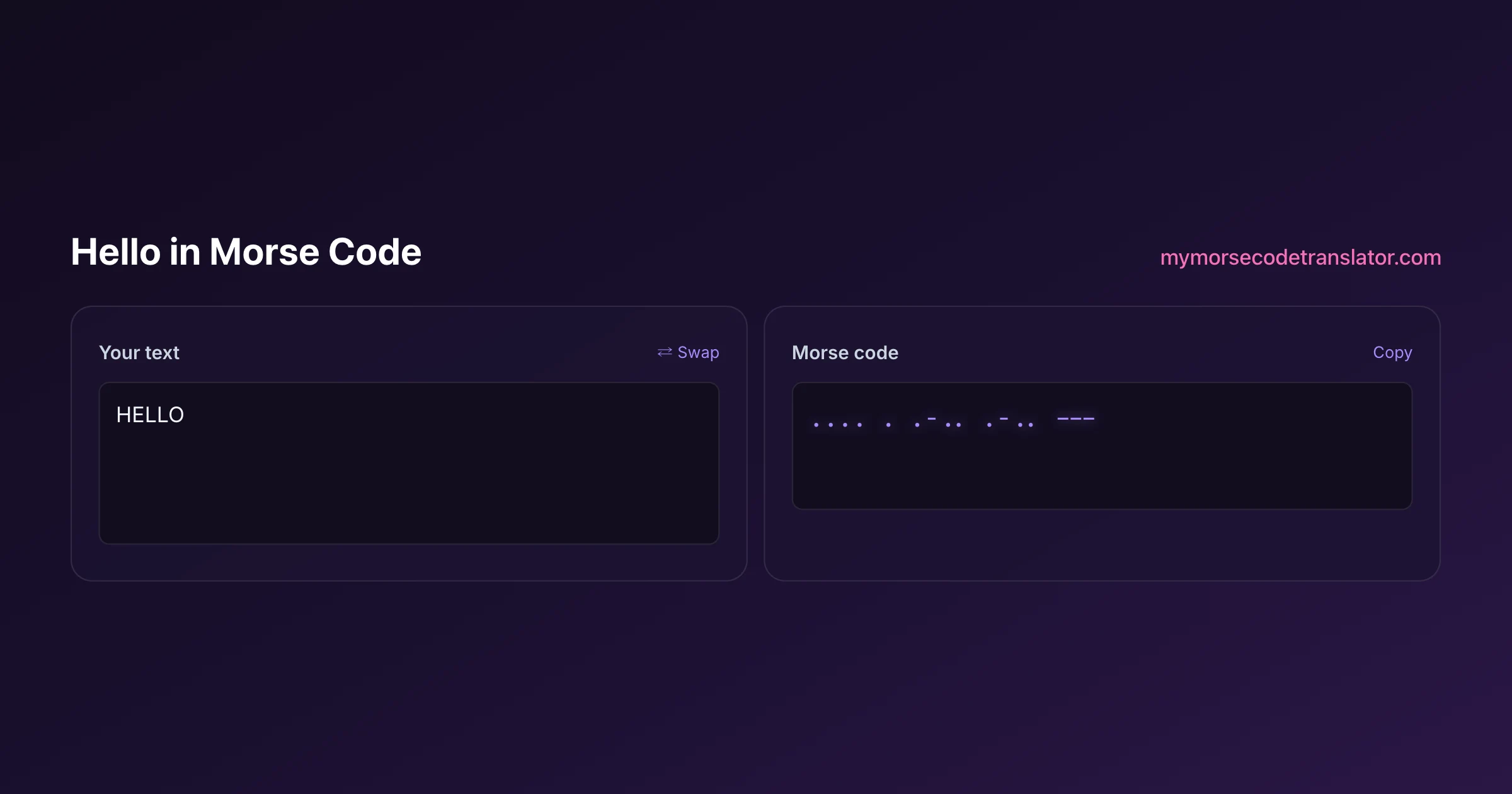
Hello in morse code is ···· · ·–·· ·–·· ––– — H, E, L, L, O — five letters, sixteen marks, and 49 timing units, which is just under four seconds at a relaxed 15 words per minute. The translator on this page opens with "Hello world" already typed in: press play to hear it, or change the text to hear any other greeting. Below you'll find what each letter sounds like, how to send it with a torch or a tap, the greetings that are faster than hello, and what radio operators send instead when they start a real conversation.
👀 Preview
Press ▶ Play — this shows what you'll see and hear.
Customize your message
Your picture appears in Play and downloaded videos. Note: it can't be included in a shared link — links carry the message only.
Share as a secret message
The message is hidden inside the link and decodes with sound & light when your friend opens it.
The five letters of HELLO, and how each one sounds
Morse has no special signal for hello. You spell it out, with a three-unit gap between letters. Written and spoken the way operators say them:
- H
····di-di-di-dit: four dots, the longest all-dot letter - E
·dit: one dot, the shortest character in the whole code - L
·–··di-dah-di-dit: dot, dash, then two dots - L
·–··di-dah-di-dit: the same again - O
–––dah-dah-dah: three dashes, the longest all-dash letter
Copy it in either form:
- With dots and dashes:
.... . .-.. .-.. --- - With the typographic marks used on this site:
···· · ·–·· ·–·· –––
The interesting thing about hello is its shape. It opens with five quick dots in a row (H then E), slows into the two identical L's, and ends on three long dashes. Played at speed, that sounds like a quick run-up and a long sign-off. Because H and E run together, beginners often hear the start as five dots, which would be the digit 5. The gap after H is what separates them, which is why the Morse code timing rules matter even for a single word.
How long hello takes to send
Under the International Morse rules (ITU-R M.1677), a dot is one unit, a dash three, the gap inside a letter one, between letters three and between words seven. Add those up for HELLO and you get 49 units. A unit lasts 1.2 ÷ WPM seconds, so:
| Word or phrase | Morse | Units | At 15 WPM | At 20 WPM |
|---|---|---|---|---|
| HI | ···· ·· | 13 | 1.0 s | 0.8 s |
| HEY | ···· · –·–– | 27 | 2.2 s | 1.6 s |
| HELLO | ···· · ·–·· ·–·· ––– | 49 | 3.9 s | 2.9 s |
| HELLO WORLD | ···· · ·–·· ·–·· ––– / ·–– ––– ·–· ·–·· –·· | 111 | 8.9 s | 6.7 s |
| HELLO FRIEND | ···· · ·–·· ·–·· ––– / ··–· ·–· ·· · –· –·· | 103 | 8.2 s | 6.2 s |
HI is nearly four times faster than hello, and it is all dots (H then I, six dots with one gap), so it is the easiest greeting to learn by ear and to flash with a light. If you are blinking a greeting across a room or tapping one on a desk, use HI.
These timings come from the same arithmetic as the translator's playback, so if you press play at 15 WPM on this page you'll hear HELLO finish in just under four seconds.
Sending hello with light, sound or taps
Sound. The translator above plays hello as a radio tone by default. Switch the sound to telegraph clicks to hear what a 19th-century sounder made of it, or download it as an MP3 to use as a ringtone or a message alert. The text to Morse code audio page covers the download options.
Light. Turn on the light option in the translator to flash HELLO on your screen, or with your phone's torch where your browser allows it. Keep it slow: at 5 WPM each dot lasts about a quarter of a second, which the eye follows easily, and the Morse code light translator page explains the safe flash rates.
Taps. Knocking hello on a table works only if your listener can tell a dash from a dot, and a knock has no length. People get around this by holding the contact (a drawn-out scrape or press) or by agreeing on two different sounds. On a screen, our tap Morse code key measures how long you hold, so you can practise sending HELLO and watch it decode as you go.
Writing it down. For a bracelet, card or tattoo, put a clear gap or a slash between letters. Otherwise ···· · reads as five dots, which is the digit 5. The Morse code bracelet maker draws the beads with the gaps already in place.
What radio operators send instead of hello
On the air, almost nobody spells out H-E-L-L-O. Morse operators built up a vocabulary of short abbreviations because every letter costs time. The ones that do the job of hello and goodbye:
- CQ
–·–· ––·–: "calling anyone", the opening of a conversation with whoever answers. A typical call is CQ CQ CQ DE followed by the station's callsign. DE means "from", so the call literally says "calling anyone, from…". - GA: good afternoon, often followed by OM, the friendly "old man" operators use for each other regardless of age.
- K: "go ahead", the invitation to reply at the end of a transmission.
- TU: thank you.
- 73: best regards, the standard friendly sign-off.
- 88: love and kisses, used between family or close friends.
- SK: end of contact.
These come from the amateur radio tradition documented in the Wikipedia article on Morse code abbreviations, and they are why a ham who wants to say "hello, nice to talk to you, goodbye" might send GA OM … TU 73 rather than a sentence. You don't need any of them to send hello to a friend. But if you hear a recording of real Morse and wonder why you never hear HELLO, this is why.
More everyday words, including hi, yes, no, ok and thank you, are on our common words in Morse code page. Messages to someone close are on I love you in Morse code.
When a hello you were sent won't decode
Most "my Morse message doesn't make sense" problems come from spacing, not from the dots and dashes themselves. Hello is a good example, because its first two letters are both made of dots. These are the four ways a hello gets mangled, and what each one turns into if you paste it into the Morse code decoder as written:
- The gap after H is missing:
..... .-.. .-.. ---decodes as 5LLO. Five dots in a row is the digit 5, so the H and the E have merged. Put a space after the fourth dot. - The E has joined the first L:
.... ..-.. .-.. ---decodes as H#LO...-..is not a letter in International Morse, which is why the decoder shows #. Split it into.and.-... - The two L's have run together:
.... . .-.-.. ---decodes as HE#O, for the same reason. Each L needs its own group. - No spaces at all:
......-...-..---can't be decoded reliably by anyone, person or program, because the letter boundaries are gone. If you see this, try the likely word first: count four dots for H, one for E, then look for the.-..pattern twice.
When a decode comes out almost right, as with 5LLO or H#LO, the fix is nearly always to move a single gap. That is also why spacing matters so much on a bracelet or a tattoo, where nobody can ask you what you meant. Leave a clear double space or a slash between letters, and a bigger gap or a slash between words.
If the message arrived as sound or as a flashing light rather than text, the same problem shows up as timing. A sender who leaves too short a pause after H produces the digit 5 just as surely as a missing space does. The hearing Morse code page has tips for copying by ear when the spacing is sloppy, and the audio translator can decode a recording for you.
One more trap: some keyboards and messaging apps "helpfully" turn three dots into a single ellipsis character (…) or two hyphens into a dash (–). Our decoder accepts the typographic dot · and the dash –, but an ellipsis stands for three dots in one character, which can throw the count off. Paste the original text if you can, or retype the pattern by hand.
Variations people ask about
"Hello world" in Morse code. ···· · ·–·· ·–·· ––– / ·–– ––– ·–· ·–·· –··. The slash (or a seven-unit pause when sent) marks the space between the two words. It is a favourite first test for programmers building a Morse project, and it is a good one, because between them the two words use seven different letters.
Hello in lowercase or capitals. Morse has no letter case. hello, Hello and HELLO are the same signal, so the translator shows them identically.
Hello with a name. Add a word space and spell the name: HELLO EMMA is hello, a slash, then · –– –– ·–. Our names in Morse code page shows how to keep the letters of a name apart when you write or engrave it.
Hello in other languages. International Morse covers the Latin alphabet, so hola, hallo and bonjour spell out the same way as English words. Accented letters and non-Latin alphabets have their own extensions, covered on the Morse code in other languages page.
Is there a single Morse symbol for hello? No. ITU-R M.1677 defines letters, figures, punctuation and a few service signals (such as the starting signal and the end of work), but no greeting. The closest thing to a "hello" signal is CQ, and that means "calling anyone", not hello to a particular person.
On 22 October 2026 I typed HELLO, HI, HEY and HELLO WORLD into the translator and checked each output against the code table, then added up the timing units by hand for the table on this page. What surprised me was HI: at 13 units it is almost four times shorter than HELLO's 49, so if you are blinking a greeting with a torch it is the obvious choice.
Frequently Asked Questions
Q. What is hello in Morse code?
Hello in Morse code is ···· · ·–·· ·–·· ––– (.... . .-.. .-.. ---): H is four dots, E one dot, each L is dot-dash-dot-dot, and O is three dashes.
Q. What is hi in Morse code?
Hi is ···· ·· (.... ..): four dots for H, a short gap, then two dots for I. It is all dots and takes about one second at 15 words per minute.
Q. How do you say goodbye in Morse code?
Spelled out, goodbye is ––· ––– ––– –·· –··· –·–– ·. Radio operators usually sign off with 73 (best regards) or SK (end of contact) instead.
Related guides
← Back to the My Morse Code Translator home page.

By Sukie
Sukie is the creator of My Morse Code Translator — a puzzle nerd and gadget tinkerer who fell down the Morse code rabbit hole and decided to build the most fun Morse translator on the web. When she's not adding new sound packs or reveal animations, she's decoding hidden messages in songs or designing Morse code bracelets for friends.
Last updated: 2026-10-25