Help in Morse Code: The Pattern, the Timing, and When to Use SOS Instead
Help in morse code is written ···· · ·–·· ·––· — H, E, L, P — and it takes 37 timing units to send, which is about three seconds at a relaxed 15 words per minute. That is the quick answer, and you can type the word into the translator on this page to hear it and copy it. The more useful answer is underneath: HELP is a word anyone can read, SOS is a signal anyone can recognise, and the two are not interchangeable when it actually matters. This page gives you both, plus "help me", "I need help" and "send help", with the real lengths of each so you can choose the right one.
👀 Preview
Press ▶ Play — this shows what you'll see and hear.
Customize your message
Your picture appears in Play and downloaded videos. Note: it can't be included in a shared link — links carry the message only.
Share as a secret message
The message is hidden inside the link and decodes with sound & light when your friend opens it.
HELP, letter by letter
Morse code has no special symbol for the word help — it is simply the four letters spelled out, each separated by a short pause. Here they are, with the way radio operators say them out loud:
- H —
····— four dots, said di-di-di-dit - E —
·— one dot, said dit. E is the shortest character in the whole code because it is the most common letter in English. - L —
·–··— dot, dash, dot, dot, said di-dah-di-dit - P —
·––·— dot, dash, dash, dot, said di-dah-dah-dit
Written in one line with a space between letters, help in Morse is ···· · ·–·· ·––·. Notice that HELP contains no letter made only of dashes and only three dashes in total; it is a fairly "dotty" word, which makes it quick to tap but easy to blur. The commonest mistake when people key it by hand is running the H and the E together, which turns ···· · into ····· — and five dots is not H-E at all, it is the number 5.
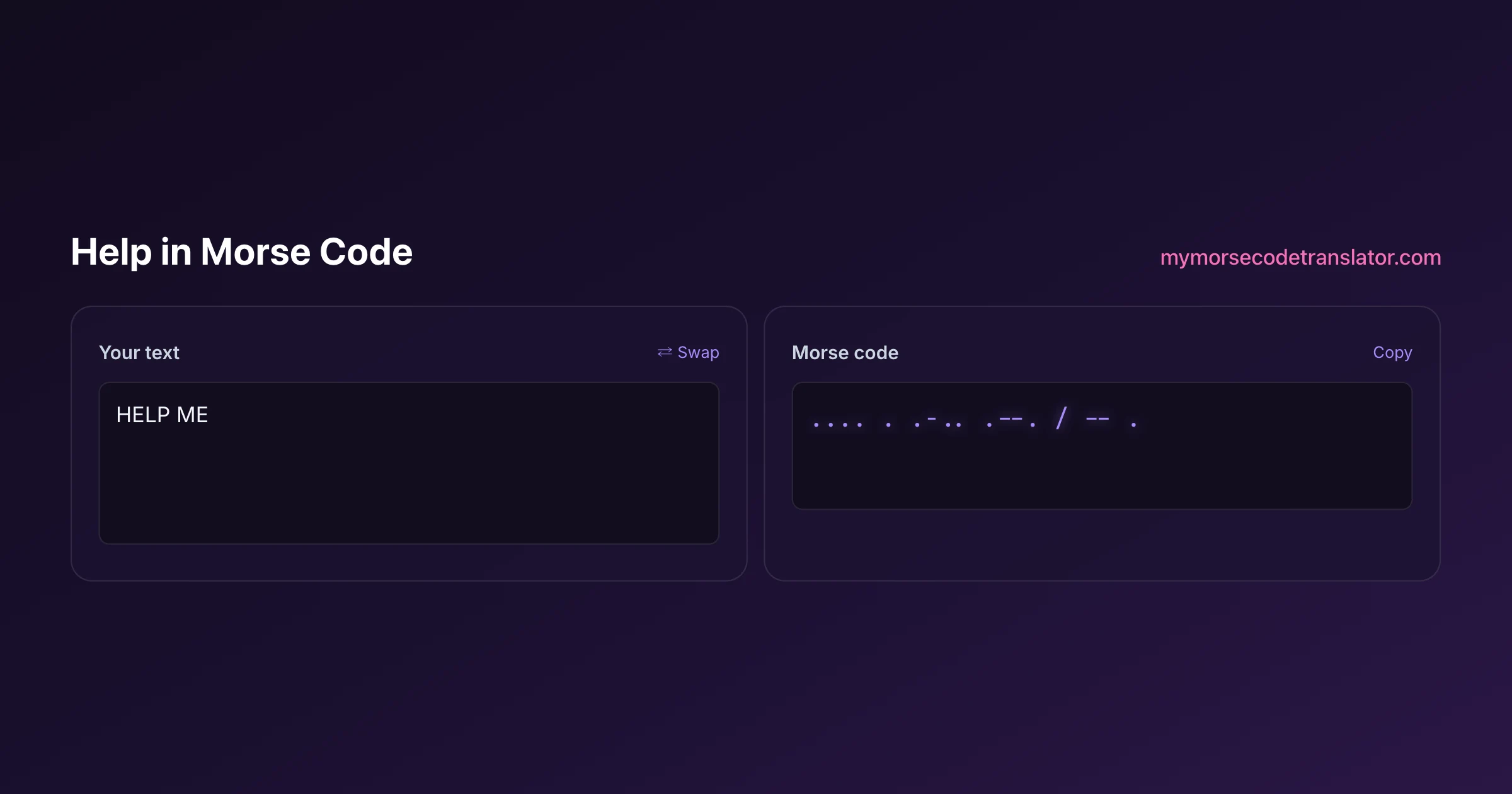
Help me adds a word gap and two more letters: M is –– and E is · again, so the full phrase is ···· · ·–·· ·––· / –– ·. The slash is the convention for a word space when Morse is written down; when it is sent as sound or light, the slash is just a longer silence.
Every pattern on this page is generated by the same table the translator uses, which follows the international standard, ITU-R M.1677. If you copy a pattern from the tool, it will match what you see here character for character.
How long it takes to send — the real numbers
Morse timing is built from one unit: a dot is 1 unit, a dash is 3, the gap inside a letter is 1, the gap between letters is 3 and the gap between words is 7. Those ratios come from ITU-R M.1677, and the speed in words per minute just sets how long one unit lasts (at 15 WPM, one unit is 80 milliseconds). Add up the units for a phrase and you know exactly how long it will take. I worked these out unit by unit from the code table, after checking the patterns against the live translator's output:
- HELP — 37 units — 8.9 s at 5 WPM, 4.4 s at 10 WPM, 3.0 s at 15 WPM, 2.2 s at 20 WPM
- SOS (as three letters) — 27 units — 6.5 s at 5 WPM, 3.2 s at 10, 2.2 s at 15, 1.6 s at 20
- SOS (as one run-together distress signal) — 23 units
- HELP ME — 55 units — 13.2 s at 5 WPM, 4.4 s at 15
- SEND HELP — 71 units — 17.0 s at 5 WPM, 5.7 s at 15
- I NEED HELP — 77 units — 18.5 s at 5 WPM, 6.2 s at 15
- MAYDAY — 65 units — 15.6 s at 5 WPM, 5.2 s at 15
The takeaway is blunt. If you are flashing a torch slowly enough for an untrained eye to follow — and 5 WPM is already fast for light — SOS takes about six and a half seconds while "I need help" takes over eighteen. Over a long night of repeating a signal, that difference is the difference between a rhythm someone notices and a jumble they ignore. The Morse code timing page explains the unit system in more depth if you want to work out your own phrases.
HELP or SOS? Choosing the right one
Use SOS when the goal is to be noticed by anyone. SOS (··· ––– ···) is recognised far beyond people who know Morse: three short, three long, three short is a rhythm that reads as "distress" even to someone who has never learned a single letter. It is short, symmetrical, and hard to mistake for anything else. It is also not an abbreviation — it doesn't stand for "save our souls" — it was picked precisely because the pattern is so distinctive. Our SOS in Morse code page covers its history and how to send it correctly as one unbroken signal.
Use HELP when the person on the other end can read Morse, or when you want the message to be readable in writing rather than recognised as a rhythm. A word on a bracelet, a note tapped on a wall to a friend who knows the code, a puzzle in an escape room, a scene in a story — in all of those, HELP says something more human than SOS does. It is also the better choice for anything playful, because SOS carries a weight that HELP does not; nobody is alarmed by a bracelet that reads ···· · ·–·· ·––·.
In a genuine emergency, reach for the phone first. Modern emergency numbers, mobile networks and satellite messaging on recent phones will get help faster than any signal you can flash. Morse is a fallback for when those fail — no signal, no battery to spare for a call, or no way to speak — and in that fallback, SOS is the one to send. If you can add information after it (your location, how many people, what is wrong), spell it out in plain words afterwards; that is where words like HELP, HURT or WATER earn their place.
Ways to send it when you can't speak
Morse works with anything you can switch on and off, which is why it survives as an emergency skill. The same ···· · ·–·· ·––· pattern can be:
- Flashed with light. A phone screen or torch at night is visible for a long way. Go slowly — the eye needs longer gaps than the ear — and repeat the message with a clear long pause between repetitions so the watcher can find the start. The Morse code light translator on this site flashes your screen (or the torch on Android phones) at a speed you choose. Before you flash at anyone, be aware that rapid flashing can trigger seizures in people with photosensitive epilepsy; WCAG accessibility guidance puts the threshold at three flashes per second, and slow Morse stays well under it.
- Tapped on a surface. Knocking on a wall, a pipe or a table carries surprisingly well through a building. Use a single knock for a dot and a scrape or two quick knocks for a dash if a long knock isn't possible.
- Blinked. Short and long blinks have been used by people who could not speak — the most famous case is the US Navy pilot Jeremiah Denton, who blinked T-O-R-T-U-R-E during a filmed interview as a prisoner of war in 1966. The same idea works at home between two people who both know the code.
- Whistled, beeped or hummed. Short and long notes carry further than speech in wind or noise.
- Written. Dots and dashes scratched into sand, chalked on a rock or worked into a bracelet with two bead colours.
Whichever method you use, the hard part is the gaps, not the dots and dashes. People almost always rush the pause between letters, and without it HELP becomes an unreadable string. Count it out: one beat inside a letter, three beats between letters, seven between words.
Practising it so it's there when you need it
You don't need to learn the whole alphabet to be useful in a pinch. Learn two things until they are automatic: the SOS rhythm, and the four letters of HELP. Both together are eight characters, and you can drill them in a few minutes a day.
A method that works: type HELP into the translator above, set the speed to around 10 WPM, press play and listen with your eyes closed. Then turn the sound off, watch the karaoke highlight instead, and tap along on the table. When you can tap HELP without looking, slow the speed down and switch to the light mode — reading Morse by eye is a different skill from hearing it, and most people find it harder. Finally, try receiving: have a friend send you either SOS or HELP at random using the secret message link, and say which one it was before the reveal.
If you want to go further, the how to learn Morse code guide lays out a full plan, and our list of common words in Morse code covers short replies like YES, NO and OK that pair naturally with HELP. And if you just came here to copy the pattern for a note, a craft or a caption, here it is one more time: help in Morse code is `···· · ·–·· ·––·`.
On 14 October 2026 I typed HELP and HELP ME into the live translator and checked its output (.... . .-.. .--. and .... . .-.. .--. / -- .) against the code table, then added up the timing units for every phrase on this page. The surprise was how much longer the polite versions are: "I need help" is 77 units against 37 for HELP — more than double — which is a real cost when you are flashing a light slowly by hand.
Frequently Asked Questions
Q. What is help in Morse code?
Help in Morse code is ···· · ·–·· ·––· — H (four dots), E (one dot), L (dot dash dot dot) and P (dot dash dash dot), with a short gap between each letter.
Q. How do you say help me in Morse code?
Help me is ···· · ·–·· ·––· / –– · . The slash marks the gap between the two words; when you send it as sound or light, it is simply a longer silence of seven units.
Q. Is it better to send HELP or SOS?
For getting attention in an emergency, send SOS: it is shorter (27 units against 37 for HELP) and recognisable even to people who don't know Morse. HELP is better when the receiver can read Morse, or for jewellery, notes and puzzles.
Q. How long does it take to send HELP in Morse code?
HELP is 37 timing units long. That is about 3 seconds at 15 words per minute, 4.4 seconds at 10 WPM, and close to 9 seconds at the slow 5 WPM that works best for flashing light.
Q. How do I tap help in Morse code on a wall?
Use a single sharp knock for a dot and a longer scrape (or two very quick knocks) for a dash. Leave a clear pause between letters — that pause is what makes ···· · ·–·· ·––· readable instead of a run of knocks.
Q. Why does help in Morse code look like the number 5 sometimes?
If the gap between H (····) and E (·) is missed, the five dots run together, and ····· is the Morse code for the number 5. Keeping a three-unit gap between letters prevents it.
Q. What is 'I need help' in Morse code?
I need help is ·· / –· · · –·· / ···· · ·–·· ·––· — 77 timing units, roughly 6 seconds at 15 WPM. In an emergency SOS gets the same point across in about a third of the time.
Related guides
← Back to the My Morse Code Translator home page.

By Sukie
Sukie is the creator of My Morse Code Translator — a puzzle nerd and gadget tinkerer who fell down the Morse code rabbit hole and decided to build the most fun Morse translator on the web. When she's not adding new sound packs or reveal animations, she's decoding hidden messages in songs or designing Morse code bracelets for friends.
Last updated: 2026-10-19