Morse Code Chart
A morse code chart is the fastest way to look something up when you do not want to learn the whole system — you find the character, read across, and you have your dots and dashes. This page gives you the complete table in one place: the twenty-six letters, the ten digits, and the punctuation that actually gets used. It also explains the part most charts leave out, which is how the spacing between the marks works, because a chart alone will let you write Morse that nobody can read back.
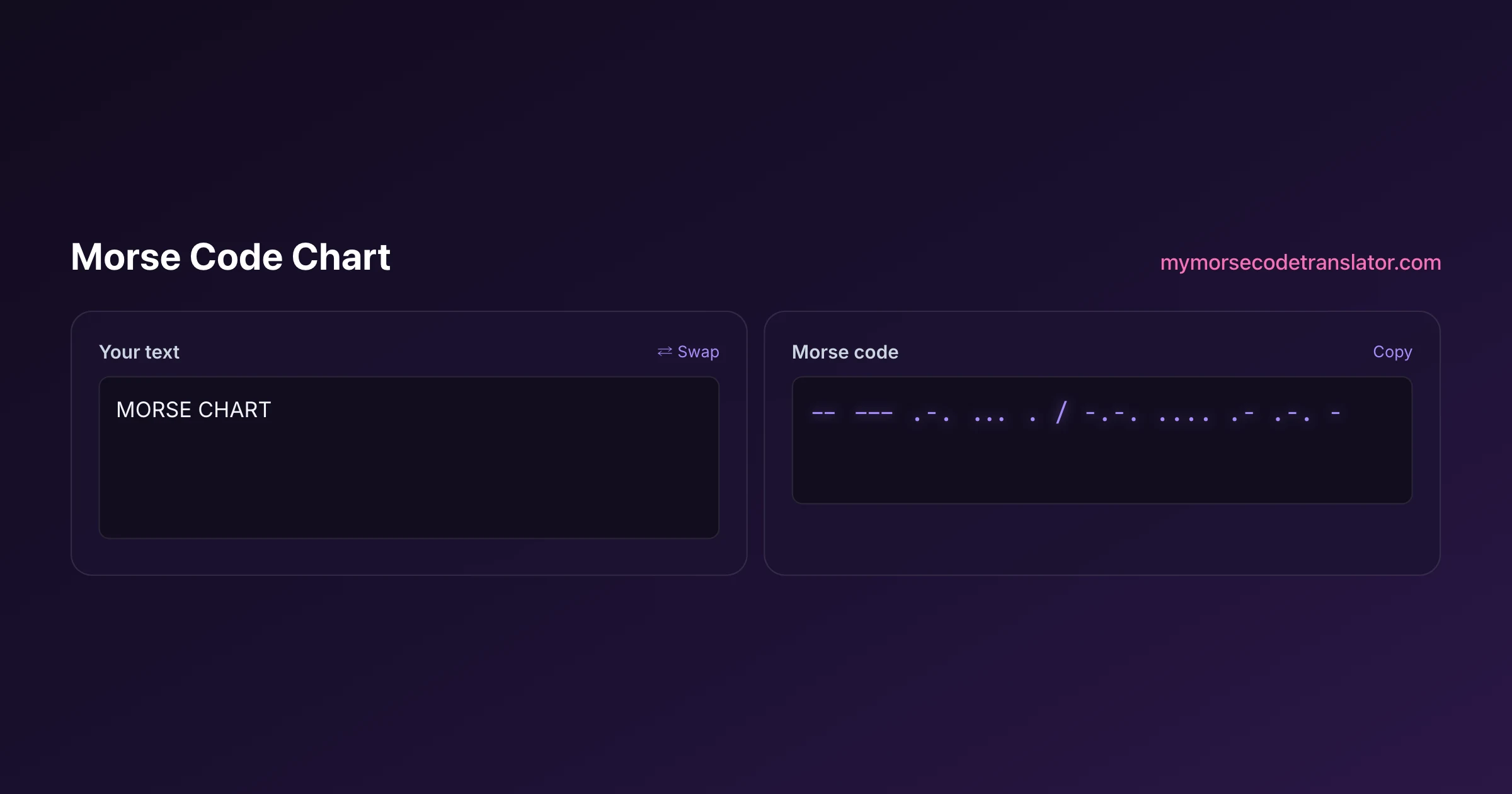
👀 Preview
Press ▶ Play — this shows what you'll see and hear.
Customize your message
Your picture appears in Play and downloaded videos. Note: it can't be included in a shared link — links carry the message only.
Share as a secret message
The message is hidden inside the link and decodes with sound & light when your friend opens it.
The complete chart
Letters
A .- · B -... · C -.-. · D -.. · E . · F ..-. · G --. · H .... · I .. · J .--- · K -.- · L .-.. · M -- · N -. · O --- · P .--. · Q --.- · R .-. · S ... · T - · U ..- · V ...- · W .-- · X -..- · Y -.-- · Z --..
Numbers
0 ----- · 1 .---- · 2 ..--- · 3 ...-- · 4 ....- · 5 ..... · 6 -.... · 7 --... · 8 ---.. · 9 ----.
Punctuation
Period .-.-.- · Comma --..-- · Question mark ..--.. · Apostrophe .----. · Exclamation -.-.-- · Slash -..-. · Open bracket -.--. · Close bracket -.--.- · Ampersand .-... · Colon ---... · Semicolon -.-.-. · Equals -...- · Plus .-.-. · Hyphen -....- · Underscore ..--.- · Quotation mark .-..-. · Dollar ...-..- · At sign .--.-.
That is the full International set as standardised by the ITU. A few things stand out once it is all in front of you. The numbers are perfectly regular — five marks each, sliding from all-dots at 5 to all-dashes at 0 — which makes them far quicker to learn than the letters. The punctuation is the opposite: irregular, long, and mostly unused outside formal traffic. And the at sign is the newest addition to the standard, added in 2004 so that email addresses could be sent, which is a rather charming detail for a code designed in the 1830s.
If you want this on paper rather than on screen, the printable morse code chart is the same information laid out to fit one page in black and white, with a print button that strips the site away and sends only the grid to the printer.
Reading the chart correctly: the part that is usually missing
A chart gives you the characters. It does not give you the silences, and in Morse the silences carry as much information as the marks. This is the single most common reason that Morse written from a chart turns out to be unreadable.
There are four durations, all measured against the length of one dot, which is the basic unit:
- A dot is 1 unit of sound.
- A dash is 3 units of sound.
- The gap between marks inside one character is 1 unit of silence.
- The gap between characters is 3 units of silence.
- The gap between words is 7 units of silence.
Why this matters: S is three dots and I is two dots, and E is one dot. If you write .... with even spacing, is that H, or two Is, or four Es? The chart cannot tell you. Only the gaps can. When Morse is written out as text, people mark this with a space between characters and a slash between words — .... . .-.. .-.. --- / .-- --- .-. .-.. -.. — but when you send it as sound or light, you have to actually hold those silences.
So the practical rule when working from a chart is: leave an obvious gap between characters and a very obvious gap between words. If in doubt, make the word gaps longer than feels natural. Nobody has ever misread a message because the pauses were too generous.
Why the chart looks the way it does
Read down the letters and something becomes obvious: the patterns are not the same length, and the short ones are not randomly distributed.
E is a single dot. T is a single dash. Those are the two most common letters in English. A, I, N and M are two marks each — also common. Meanwhile Q is `--.-`, Y is `-.--`, and J is `.---`, all four marks, all letters you need rarely.
That is the whole design principle, and it was deliberate. When Samuel Morse and Alfred Vail worked out the assignments in the 1830s, Vail reportedly went to a local newspaper office and counted the type in the printer's cases — the more of a letter the printer stocked, the more often it was used, and the shorter the signal it got. Frequency analysis by way of a type case.
The payoff is speed. Because common letters are short, ordinary English sends far faster than it would with fixed-length codes. It is the same instinct behind modern compression: give the frequent things the short representations.
There is a second structure hiding in the chart too. Every character can be reached by starting at the top of a branching tree and turning one way for a dot and the other for a dash — E and T at the first level, I, A, N and M at the second, and so on. Some people find the tree far easier to memorise than a flat alphabetical list, and it explains why the mirror pairs like A and N sit where they do.
None of this is necessary to use the chart. It is, however, the thing that makes the chart stop looking arbitrary.
What the chart leaves out: prosigns
Standard charts stop at letters, numbers and punctuation, but real Morse contains a fourth category that no character table shows: prosigns, short for procedural signals.
A prosign is two or more letters run together with no gap between them, forming a single unit that acts as a control instruction rather than text. Because the letter gap is removed, the combination becomes a distinct rhythm that cannot be confused with the letters sent separately.
The ones worth knowing:
- SOS (
...---...) — international distress. Sent as one continuous nine-mark signal, not as three separate letters, which is precisely what makes it unmistakable. - AR (
.-.-.) — end of message. - SK (
...-.-) — end of contact, the sign-off at the close of a conversation. - BT (
-...-) — a separator, used as a paragraph break or pause within a message. - AS (
.-...) — wait, stand by. - HH (
........) — eight dots, meaning "error, disregard that" — the Morse equivalent of crossing something out.
That last one is delightfully practical. Eight dots in a row cannot be any legitimate character, so it is unambiguous even in poor conditions, and it lets an operator retract a mistake mid-message.
Prosigns are usually written with an overbar in formal texts, or with the letters run together, to show they are one signal. They are the main reason a chart alone will not let you fully read a real transmission — the characters will be there, but the punctuation of the conversation will not.
When a chart is the wrong tool
Charts are excellent for looking up one character and terrible for three other jobs, and it is worth being honest about which is which.
For converting a whole message, a chart is slow and error-prone — every character is a fresh lookup and a fresh chance to slip a dot. The translator on this page does the same job instantly and, more importantly, will decode it back so you can verify it. For anything longer than a word, type it.
For learning to read Morse by ear, a chart is actively counterproductive. If you learn the characters as visual patterns of dots and dashes, you build a habit of hearing a sound, picturing the marks, and then reading off the letter — and that middle step becomes a hard ceiling on your speed later. People who teach this properly, including the ARRL and the instructors at the Long Island CW Club, will tell you to learn each character as a single sound with its own rhythm from the very beginning, and to avoid the chart entirely while training your ear.
For decoding something you found — a photo of a bracelet, a pattern in a game, a message a friend sent — a chart means working backwards through the table character by character. The decoder does it in one step.
Where a chart genuinely wins: checking a single character quickly, teaching the shape of the system to a group, and hanging on a wall. Those are real uses. Just do not try to run a whole message through it by hand and then commit that message to something permanent.
I printed a chart for a scout group and watched six kids produce six unreadable messages from it, because every one of them ran the letters together with no gaps. Adding a single line about the 1-3-3-7 timing to the bottom of the sheet fixed every message the following week.
Frequently Asked Questions
Q. What is the full morse code chart?
It covers 26 letters, 10 digits and around 18 punctuation marks. The letters run from E (a single dot) to characters like Q and Y that use four marks; numbers are all exactly five marks; punctuation is longer and less standardised in everyday use.
Q. Is there one official morse code chart?
Yes. The International standard is defined by the ITU in recommendation ITU-R M.1677, and it is what essentially every modern chart, tool and operator uses. Older American landline Morse used a different and now largely obsolete set.
Q. Why do the numbers look so much more regular than the letters?
Because they were designed as a block rather than weighted by frequency. Every digit is five marks, starting at 1 as one dot followed by four dashes and sliding across until 0 is five dashes. The letters were instead weighted so common ones are short.
Q. How do I show spaces between words on a chart?
By convention a forward slash marks a word gap when Morse is written as text. In the transmitted signal it is simply a longer silence — about seven units, compared to three between characters.
Q. Can I print this chart?
Yes, print the page directly. For classroom or workshop use it helps to group characters by how many marks they use rather than alphabetically, and to keep the reversed pairs such as A and N next to each other.
Q. Does the chart include accented letters?
The core table does not. Languages with accents add extra combinations for characters like é, ä, ñ and ü, which sit outside the basic 26-letter set and vary somewhat by country.
Q. Is a morse code chart enough to send a message?
Not on its own. The chart gives you the marks but not the silences, and Morse depends on the gaps between marks, characters and words to be readable. Add the timing rule — dot 1, dash 3, letter gap 3, word gap 7 — and it is.
Q. Should I memorise the chart to learn morse code?
Memorising the visual patterns is generally the slower path. Learning each character as a distinctive sound from the start avoids building a hear-then-picture-then-read habit that later limits your speed.
Q. What is the fastest way to convert a long message?
Use the translator rather than the chart. It converts both ways instantly, so you can also paste the result back in to verify it says what you intended before committing it to anything permanent.
Related guides
← Back to the My Morse Code Translator home page.

By Sukie
Sukie is the creator of My Morse Code Translator — a puzzle nerd and gadget tinkerer who fell down the Morse code rabbit hole and decided to build the most fun Morse translator on the web. When she's not adding new sound packs or reveal animations, she's decoding hidden messages in songs or designing Morse code bracelets for friends.
Last updated: 2026-09-02