Translate Morse Code Both Ways, Step by Step
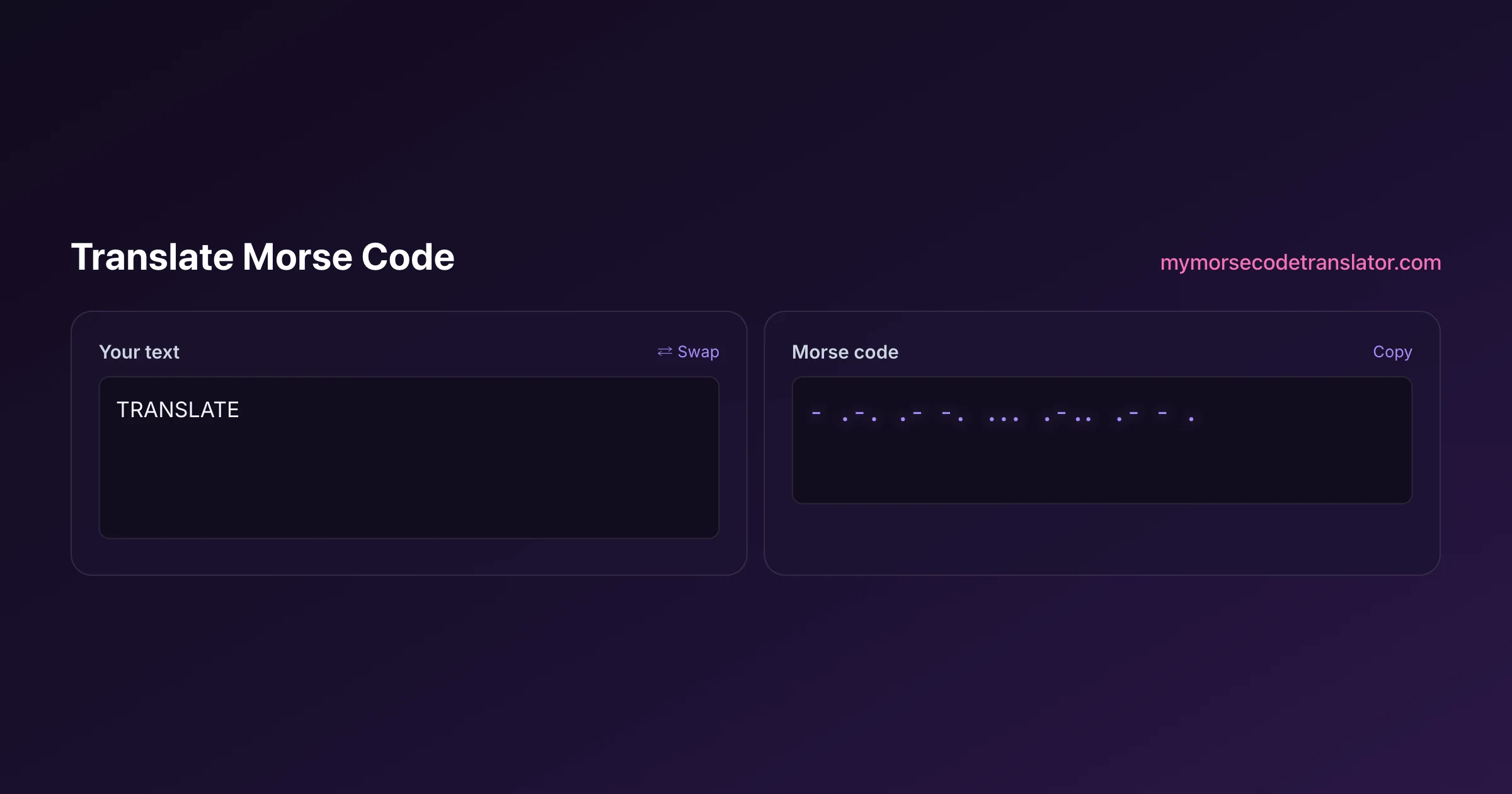
Translate morse code and you are really doing one of two jobs: turning English into dots and dashes, or turning dots and dashes back into English. This page walks through both directions slowly, with worked examples for SOS and HELLO you can follow letter by letter. The tool above does it instantly, but understanding what it is doing underneath is what lets you catch a mistake, rescue a garbled message, or send one by ear when no tool is handy.
👀 Preview
Press ▶ Play — this shows what you'll see and hear.
Customize your message
Your picture appears in Play and downloaded videos. Note: it can't be included in a shared link — links carry the message only.
Share as a secret message
The message is hidden inside the link and decodes with sound & light when your friend opens it.
The two directions, and why they feel different
Every time you translate Morse you are going one of two ways, and they are not equally easy. Encoding, going from English to dots and dashes, is the simple direction. Each letter has exactly one code, so you look it up and write it down. There is no ambiguity: E is always a single dot, no matter the context.
Decoding, going from dots and dashes back to English, is the trickier direction, and the reason is spacing. The dots and dashes tell you the shape of a letter, but the gaps tell you where one letter stops and the next begins. Get the gaps wrong and even perfect dots and dashes turn into nonsense. So while the tool handles both instantly, the mental model to hold is: encoding is a lookup, decoding is a lookup plus a puzzle about where the boundaries are.
Hold that distinction and everything else on this page makes sense. When you encode you focus on the codes. When you decode you focus first on the spaces, then the codes.
How to translate English into Morse code
Going from a word to dots and dashes is a four-step routine you can do in your head or on paper:
1. Write your message in plain capital letters, since Morse ignores upper and lower case anyway. 2. Replace each letter with its code, leaving a single space between letters. A is .- , B is -... , and so on. 3. Between whole words, leave a bigger gap, written as a forward slash (/) or a double space, so the reader knows a word ended. 4. Read it back and, ideally, play it as sound. A wrong dash almost always sounds wrong before it looks wrong.
That is the entire encoding process. The tool above does steps two and three for you the instant you type, but the routine is worth knowing because it is exactly what you would do with a pencil if your phone died. The only judgment call is spacing: keep letter gaps small and word gaps clearly larger, and your message will read the way you meant it.
How to translate Morse code back into English
Decoding runs the routine in reverse, but with the spacing puzzle up front:
1. Split the message into words first, wherever you see a slash or an obviously bigger gap. 2. Inside each word, split into letters wherever you see a single space. 3. Look up each group of dots and dashes: .... is H, . is E, and so on. 4. Read the letters in order, then read the words in order, and you have your sentence.
Notice that steps one and two happen before you decode a single letter. That is the secret that separates people who can decode from people who get stuck: they sort out the boundaries first. If a message arrives with no gaps at all, like ...---..., you genuinely cannot decode it reliably, because Morse is not self-punctuating and that string has many valid readings. The fix is not a cleverer tool; it is to ask the sender to put spaces between letters. Once the gaps are there, the dots and dashes almost translate themselves.
Worked example: translating SOS
SOS is the perfect first example because it is short, famous, and built from just two letter shapes. Let us encode it from scratch. Write the word in capitals: S O S. Now look up each letter. S is three dots: ... . O is three dashes: --- . S again is three dots: ... . Put a single space between the letters and you get ... --- ... , which is SOS.
Now decode it back to prove it works. Take ... --- ... and split on the single spaces into three groups: ... then --- then ... . Look each up: ... is S, --- is O, ... is S. Read them in order and you are back to SOS.
One myth worth clearing up: SOS does not stand for 'Save Our Souls' or anything else. It was chosen in 1906 precisely because ... --- ... is an unmistakable, evenly spaced rhythm that is hard to confuse with anything else, even in bad conditions. When it is sent as a true distress call it is run together as one nine-symbol signal with no letter gaps, which is the rare case where the missing spaces are the point rather than a mistake.
Worked example: translating HELLO
HELLO is a better second example because it has five different letters and a repeated one, so it shows the spacing rules doing real work. Encode it letter by letter: H is .... , E is . , L is .-.. , L is .-.. again, O is --- . Drop a single space between each and you get .... . .-.. .-.. --- . That is HELLO in Morse.
Now watch how much the spaces matter. Those same symbols with the letter gaps removed would be an unreadable blob, because your eye and the decoder both rely on the single spaces to know that .... ends and . begins. Add a second word to see the word gap in action: HELLO WORLD becomes .... . .-.. .-.. --- / .-- --- .-. .-.. -.. , where the slash marks the jump from HELLO to WORLD. Remove that slash and you would read HELLOWORLD as one run-on word.
To decode it, do the reverse: split on the slash to get two words, split each on single spaces to get the letters, and look them up. The dots and dashes were never the hard part; the two levels of spacing are what carry the meaning. Translate your own name this way once, boundaries first, and the whole process stops feeling mysterious.
The timing that makes a translation technically correct
When you translate Morse only on paper, the spaces are just visual. When you translate it into sound or light, those spaces become real durations, and getting them right is what makes a signal readable to an experienced ear. Standard Morse is built on one unit of time. A dot is one unit. A dash is three units. The gap between symbols inside a letter is one unit. The gap between letters is three units. The gap between words is seven units.
Those ratios are why a played-back message has a rhythm rather than being a flat stream of beeps. They are also why the same dots and dashes with different pauses can mean different things. When you slow a message down, every part stretches in proportion, which keeps it correct at any speed. There is one popular exception for learners called Farnsworth timing: you keep the letters themselves at full speed but pad the gaps between them, so your ear learns each letter's real sound while still having time to think. Many operators trained by the American Radio Relay League (ARRL) learn this way, because it avoids the bad habit of counting individual dots that plateaus so many beginners.
Translating by ear, by light, and from a picture
Text in a box is only one way Morse arrives. Often you need to translate a signal you can hear, see flashing, or find in an image, and each has its own trick.
Translating by ear is a real skill: the reliable beginner method is to write the dots and dashes as you hear them rather than trying to name letters in real time, then decode the written version afterward. People who try to translate in their head fall behind and panic; people who just scribble dots and dashes stay calm and catch the whole message.
Translating a flashing light works the same way, a short flash is a dot, a long flash a dash, so you jot the pattern and decode it after. And when the Morse comes to you as a photo, of a puzzle card, a signal lamp, or a beaded bracelet, you can hand the image to the tool and let it read the dots and dashes out for you. In every case the pattern is the same: get the message into written dots and dashes first, then run it through the decoding routine from earlier. The channel changes; the translation logic does not.
Which Morse are you translating?
One thing that quietly breaks translations is assuming there is only one Morse code. The version this tool uses, and the one you almost certainly want, is International Morse Code, defined formally in ITU-R Recommendation M.1677. It is the standard behind amateur radio, maritime signalling, and scouting worldwide, which is why a message you translate here will be understood by an operator anywhere.
The catch is history. The original American Morse, used on landline telegraphs in the 1800s, assigned different patterns to several letters and even used internal spaces inside some characters. So if you try to translate a genuine 1860s telegram with an international-Morse tool, letters like C, L, O, R, and several numbers come out wrong, not because the tool failed but because it is reading the wrong code book. For anything modern, ham radio, a puzzle, a tattoo, a scout badge, international Morse is correct. Only reach for a specialist American Morse reference if you know you are handling a historical artifact. Knowing which code you are translating is the last piece that turns guesswork into a clean, reliable translation every time.
The first time I tried to translate a message by ear off a shortwave recording, I kept trying to name each letter as it played and lost the thread within four characters. The moment I switched to just scribbling dots and dashes and decoding afterward, I caught a full sentence, MEET AT NOON, on the very next pass. I have translated by ear that way ever since.
Frequently Asked Questions
Q. What is the easiest way to translate Morse code for a beginner?
Sort out the spacing first, then look up the letters. To decode, split the message into words at the slashes, split those into letters at the single spaces, then look each group up. To encode, replace each letter with its code and keep letter gaps small and word gaps larger. The tool above does both instantly, but that routine is what it is doing underneath.
Q. Why can't I translate dots and dashes with no spaces?
Because Morse is not self-punctuating. A string like ...---... with no gaps could be SOS or several other letter combinations, since nothing inside the dots and dashes marks where one letter ends. The gaps carry that information, so a message without them cannot be translated reliably by anyone. Ask the sender to space the letters.
Q. How do I translate SOS into Morse code?
S is three dots and O is three dashes, so SOS is ... --- ... with single spaces between the letters. Sent as a true distress call it is run together as one nine-symbol signal, ...---..., because that even rhythm is deliberately hard to mistake for anything else.
Q. Does capitalisation change the translation?
No. Morse code carries no case information, so HELLO, Hello, and hello all translate to the identical dots and dashes. When you decode, the result is shown in uppercase by convention, and you are free to retype it in whatever case you need.
Q. Can I translate Morse code by sound instead of text?
Yes. Play any message as audio to hear it, and to translate a signal you are listening to, write down the dots and dashes as you hear them, then decode the written version. Writing first and decoding after is the method most learners, including those trained through the ARRL, rely on early on.
Q. How are words separated when I translate a sentence?
Words are separated by a forward slash (/) or a wider gap, while single spaces separate letters within a word. That distinction is what keeps HELLO WORLD from collapsing into HELLOWORLD, so getting the word gaps right is as important as getting the letters right.
Q. Will a message I translate here be understood by a ham operator?
Yes. This tool uses International Morse Code as defined in ITU-R Recommendation M.1677, the same standard amateur radio operators, maritime services, and scouts use worldwide. The only thing it does not translate is the older American landline Morse, which used different patterns for several letters.
Related guides
← Back to the My Morse Code Translator home page.

By Sukie
Sukie is the creator of My Morse Code Translator — a puzzle nerd and gadget tinkerer who fell down the Morse code rabbit hole and decided to build the most fun Morse translator on the web. When she's not adding new sound packs or reveal animations, she's decoding hidden messages in songs or designing Morse code bracelets for friends.
Last updated: 2026-07-20