Common Words in Morse Code
Common words in morse code are what most people actually want when they land here — not the whole alphabet, just how to say yes, or no, or hello to somebody. Below are the words that get asked for most, written out in full so you can copy them straight off the page, along with the handful that behave unexpectedly once you try to send them. If your word is not here, the translator on this page will handle it in a second; but for the everyday ones, a list you can read at a glance is faster than typing.
👀 Preview
Press ▶ Play — this shows what you'll see and hear.
Customize your message
Your picture appears in Play and downloaded videos. Note: it can't be included in a shared link — links carry the message only.
Share as a secret message
The message is hidden inside the link and decodes with sound & light when your friend opens it.
The short answers: yes, no, and ok
These three come up more than anything else, and two of them have a wrinkle worth knowing.
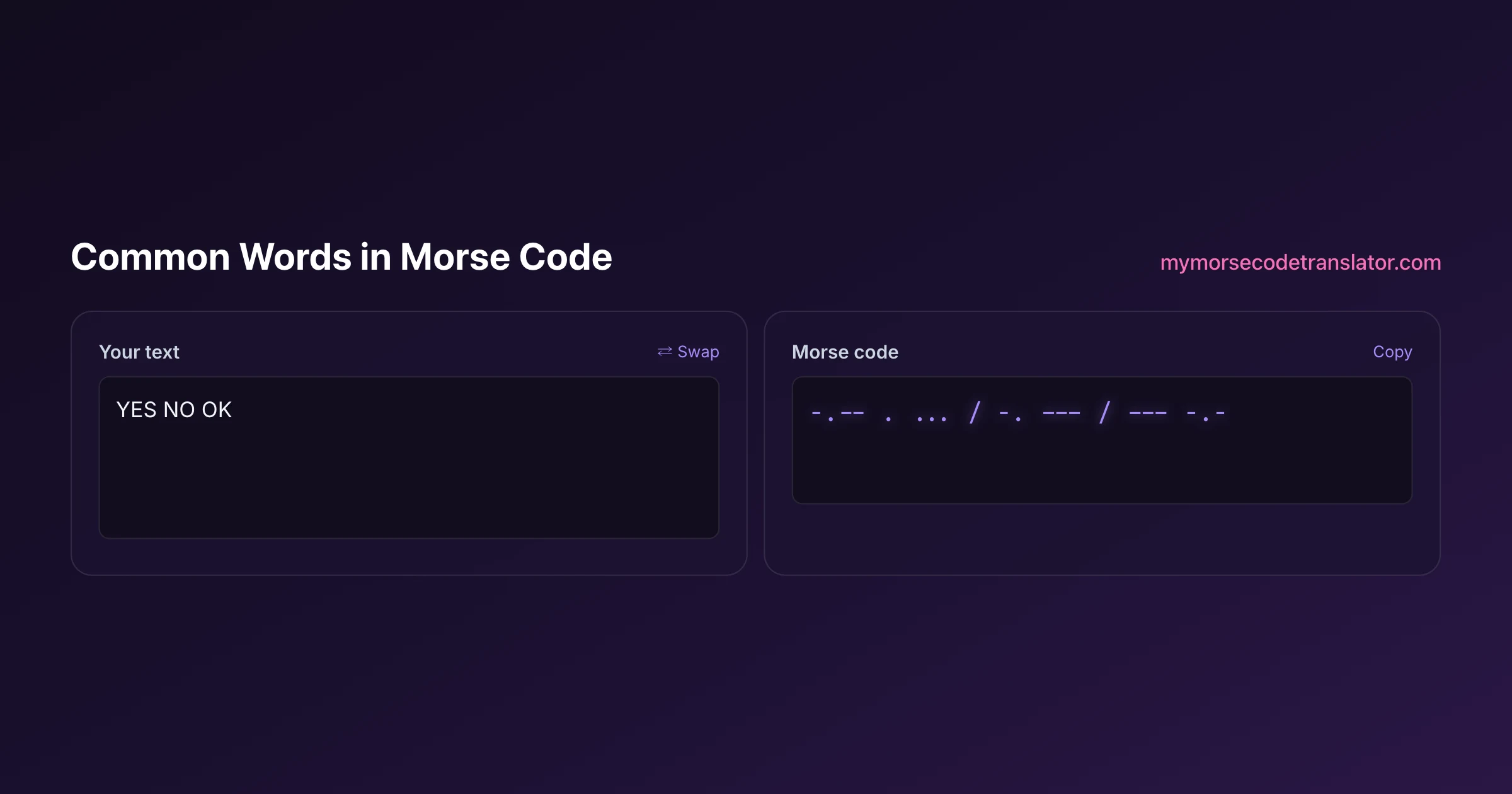
YES — -.-- . ...
NO — -. ---
OK — --- -.-
The wrinkle is that experienced operators frequently do not send any of these. On the air, yes is usually sent as R (.-.), short for "roger" or "received", and agreement is often just C (-.-.). Meanwhile OK is so common in casual use that it is often shortened further.
There is also a genuine ambiguity in "no": in operating shorthand, N (-.) on its own can mean "no" or "negative", which is why a bare N in the middle of a conversation is not always the letter N. For anything you are sending to a friend rather than over a radio, spell the words out. Clarity beats tradition when the person on the other end is holding a phone.
Greetings and pleasantries
HELLO — .... . .-.. .-.. ---
HI — .... ..
HEY — .... . -.--
BYE — -... -.-- .
GOOD MORNING — --. --- --- -.. / -- --- .-. -. .. -. --.
GOOD NIGHT — --. --- --- -.. / -. .. --. .... -
THANKS — - .... .- -. -.- ...
THANK YOU — - .... .- -. -.- / -.-- --- ..-
PLEASE — .--. .-.. . .- ... .
SORRY — ... --- .-. .-. -.--
Note the / in the multi-word entries. That is the conventional way to write a word gap in text form — a longer silence, seven units instead of three. When you actually send it, nothing is transmitted during that gap at all; the slash is a notation for humans reading it on a page, not a signal.
Ham operators compress most of these ruthlessly. Hello becomes a simple call, thanks becomes TU or just TNX, and good morning rarely survives contact with a busy band. Again: if you are sending to somebody who is not a radio operator, spell it out.
Words people send to each other
This is the group that actually gets typed into translators late at night.
LOVE — .-.. --- ...- .
I LOVE YOU — .. / .-.. --- ...- . / -.-- --- ..-
I MISS YOU — .. / -- .. ... ... / -.-- --- ..-
MISS YOU — -- .. ... ... / -.-- --- ..-
MY LOVE — -- -.-- / .-.. --- ...- .
FOREVER — ..-. --- .-. . ...- . .-.
ALWAYS — .- .-.. .-- .- -.-- ...
FRIEND — ..-. .-. .. . -. -..
HOME — .... --- -- .
FAMILY — ..-. .- -- .. .-.. -.--
I LOVE YOU is far and away the single most-requested phrase, and it is the one most often engraved, beaded, or tattooed. It is also the one where a mistake is most expensive, because a misplaced dot changes a letter and the error is permanent. If you are putting it on something physical, decode it backwards as a check — take the dots and dashes you are about to commit to and run them through the decoder to confirm they say what you think.
Urgent and practical words
HELP — .... . .-.. .--.
SOS — ... --- ...
STOP — ... - --- .--.
WAIT — .-- .- .. -
COME — -.-. --- -- .
NOW — -. --- .--
WATER — .-- .- - . .-.
FIRE — ..-. .. .-. .
SOS is the one everybody knows, and it is worth being precise about what it is. It is not an abbreviation — it does not stand for "save our souls" or anything else, despite the folklore. It was chosen in 1906 precisely because the run of three dots, three dashes, three dots is unmistakable and hard to garble, and it is properly sent as one continuous nine-mark signal with no letter gaps at all. Written as a prosign it is ...---... rather than ... --- ....
And the obvious but necessary note: SOS is a real distress signal. Flashing it from a beach or a hillside where somebody might see it and call for help is not a prank, it is a call-out. Use HELP, or anything else, when you are playing.
The abbreviations real operators use instead
If you listen to actual Morse traffic, you will hear very few complete words. Over a century of practice produced a dense shorthand, and it is worth knowing because it explains why a real transmission looks nothing like the lists above.
Common abbreviations:
- TU or TNX — thanks
- R — received, understood
- K — go ahead, over to you
- KN — go ahead, specific station only
- AR — end of message
- SK — end of contact
- CQ — calling any station
- DE — from (before a callsign)
- ES — and
- HI HI — laughter
- OM — old man, a friendly term for another operator
- 73 — best regards
- 88 — love and kisses
The numbers are the part people find most charming. 73 and 88 are survivors of a numbered code used by 19th-century commercial telegraphers, where whole phrases were compressed into two digits to save time on a paid-by-the-word wire. Almost all of that system is gone; 73 and 88 stayed because operators liked them, and they are still sent daily on the amateur bands.
There is also a set of three-letter Q-codes, each standing for a question or a statement depending on context — QTH for location, QRM for interference, QRT for stopping transmission, QSL for acknowledgement. They were designed so that operators without a shared language could still exchange essential information, which is a genuinely elegant piece of design. The ARRL publishes the full working list if you want to go deeper, and the Wikipedia entry on Morse code abbreviations covers the historical numbered codes.
For sending a message to a friend, ignore all of this and spell the words out. But if you are decoding something you picked up off the air and it is full of two-letter fragments, this is why.
Sending these words rather than reading them
Copying the dots and dashes off this page works, but it is the slowest way to use them. Two faster paths:
Paste any of the patterns above into the decoder box on this page and it will read straight back as text, which is a quick way to check that a pattern you have found elsewhere is correct before you rely on it. Or type the word itself and let the tool produce the code — then press Play to hear it, switch on the light to flash it, or send it as a link that decodes itself when the other person opens it.
That last one is worth a mention here specifically because it changes what these words are for. A list of dots and dashes is a reference. A message that beeps and flashes on somebody else's phone and slowly reveals itself is a small gift. The words on this page are the ones people most want to send to somebody, and sending them as a live thing lands rather better than sending a string of punctuation over text.
A friend asked me to check a bracelet before she gave it to her sister. It was supposed to read SISTER; one bead too few in the fourth letter and it actually read SISTED. She had already paid for it. Decoding backwards before you commit is a thirty-second habit that would have saved that.
Frequently Asked Questions
Q. What is yes in morse code?
YES is -.-- . ... — Y, E, S. On the air, operators frequently send a single R (.-.) for "received" or agreement instead, but spelling out YES is unambiguous and better for casual messages.
Q. What is no in morse code?
NO is -. --- — N followed by O. Be aware that a lone N (-.) is also used as operating shorthand for "no" or "negative", so context matters when you are decoding somebody else's transmission.
Q. What is ok in morse code?
OK is --- -.- — O followed by K. K on its own (-.-) is a standard invitation meaning "go ahead, over to you", which is one of the most-used single letters in real Morse conversation.
Q. What is hello in morse code?
HELLO is .... . .-.. .-.. ---. The two Ls in the middle are identical patterns back to back, so the gap between them has to be clear or it reads as one long run of marks.
Q. What is hi in morse code?
HI is .... .. — four dots then two dots. It is also, by happy accident, the traditional Morse way of laughing: operators send HI HI to mean something like "ha ha".
Q. What is help in morse code?
HELP is .... . .-.. .--.. If you are signalling for genuine assistance, SOS (...---...) is the recognised international distress call and will be understood by far more people.
Q. What is I love you in morse code?
I LOVE YOU is .. / .-.. --- ...- . / -.-- --- ..-, with the slashes marking the gaps between words. It is the most requested phrase on this site by a wide margin.
Q. What is thank you in morse code?
THANK YOU is - .... .- -. -.- / -.-- --- ..-. Radio operators almost always shorten this to TU or TNX, but the full spelling is clearer for anyone who is not an operator.
Q. What is sorry in morse code?
SORRY is ... --- .-. .-. -.--. Note that the first two letters, S then O, are the opening of SOS — the difference is entirely in what follows, which is a good reminder that letter spacing carries real meaning.
Q. What is my name in morse code?
Type it into the translator on this page and you will have it instantly, including any punctuation. Names are the single most common thing people convert, usually for bracelets, engravings or tattoos.
Q. Why do the words have slashes in them?
A forward slash is the written convention for a word gap. In the actual signal nothing is sent during that gap — it is simply a longer silence, about seven units rather than the three that separate letters. The slash exists so the pattern is readable on a page.
Q. Do operators really spell out common words?
Often not. Real Morse conversation is dense with abbreviations and Q-codes — TU for thanks, R for received, K for over, 73 for best wishes. Spelling words out in full is normal for beginners and for messages sent to non-operators.
Q. Is it safe to flash SOS for fun?
No. SOS is an active international distress signal, and flashing it where it might be seen can trigger a real emergency response. Use HELP or any other word if you just want something dramatic to flash.
Q. How do I check a word before I get it engraved?
Decode it backwards. Take the dots and dashes you are about to commit to, paste them into the decoder, and confirm the text that comes back is what you intended. It takes five seconds and catches the single-dot errors that are invisible by eye.
Related guides
← Back to the My Morse Code Translator home page.

By Sukie
Sukie is the creator of My Morse Code Translator — a puzzle nerd and gadget tinkerer who fell down the Morse code rabbit hole and decided to build the most fun Morse translator on the web. When she's not adding new sound packs or reveal animations, she's decoding hidden messages in songs or designing Morse code bracelets for friends.
Last updated: 2026-08-29