Morse Code Converter
A morse code converter earns its name when the thing you are starting from is not ordinary text. Binary, emoji, digits, another encoding entirely — each one converts to Morse perfectly well, but not always directly, and understanding why some need an intermediate step through plain text saves a lot of confusion. This page collects the conversions available on this site and explains what is actually happening in each.
👀 Preview
Press ▶ Play — this shows what you'll see and hear.
Customize your message
Your picture appears in Play and downloaded videos. Note: it can't be included in a shared link — links carry the message only.
Share as a secret message
The message is hidden inside the link and decodes with sound & light when your friend opens it.
The conversions available here
- Binary to morse code — turning 0s and 1s into dots and dashes, and why they are not the same idea despite looking like it.
- Emoji morse code — hiding a Morse message inside a sequence of emoji, and pulling one back out.
- Morse code number translator — digits specifically, which follow a far more regular pattern than the letters do.
- Text to morse code — the baseline conversion everything else routes through.
- Morse code decoder — going the other way, from dots and dashes back to readable text.
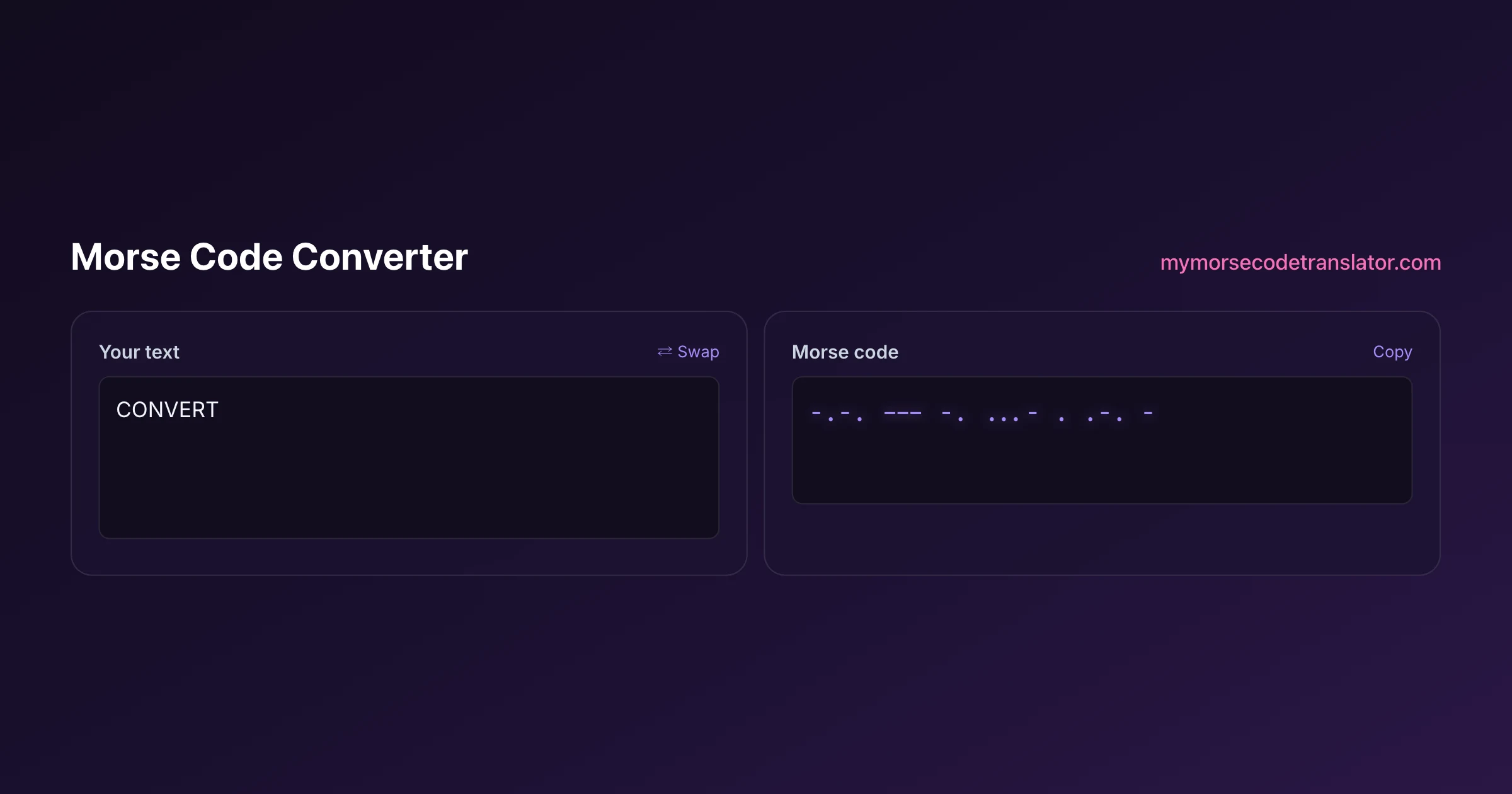
The tool on this page handles text in both directions directly. For binary and emoji, the dedicated pages explain the extra step involved and do the work for you.
Why binary does not map straight onto Morse
This is the single most common misconception in the whole category, and it is worth understanding because the reason explains something fundamental about how Morse works.
Both systems use two symbols, so the intuition is obvious: a dot is a 0, a dash is a 1, done. It does not work.
Binary is fixed-width. Every ASCII character is exactly eight bits. A receiver can chop the stream into eight-bit blocks mechanically, with no separators and no ambiguity.
Morse is variable-width. E is one mark. Q is four. There is no block size to chop on, so the code depends entirely on the gaps to show where one character ends and the next begins.
So if you translate dots and dashes into 0s and 1s and drop the timing, you destroy exactly the information that made the message decodable. You would need a third symbol for the gaps — at which point it is not binary any more.
The correct route is therefore two steps: binary → text → Morse. Decode the binary to characters using ASCII, then encode those characters as Morse. That is what the binary page does, and it is a real conversion rather than a workaround.
Emoji, and why it works better than it should
Emoji Morse is a genuine novelty rather than a standard, but it is a surprisingly robust one.
The idea is straightforward: pick one emoji to stand for a dot, another for a dash, and a third to mark the gaps. A message becomes a string of emoji that looks like decoration and reads as text to anyone who knows the scheme.
Why it survives where other hidden-message tricks fail: emoji are ordinary Unicode characters, maintained by the Unicode Consortium, so they copy and paste cleanly across almost every app, survive being quoted and forwarded, and do not get stripped as formatting. A message hidden this way makes it through chat apps, comments and captions intact, which is more than can be said for most encoding tricks.
The limitation is that it is a convention between you and your reader rather than anything standard. There is no universal emoji-Morse table, so the recipient needs to know which emoji you chose for dots and dashes — or be curious enough to work it out, which for a short message is not difficult.
Numbers, and the pattern nobody points out
Digits are the easiest part of Morse to learn and the part most people skip, which is a shame because the structure is genuinely elegant.
Every digit is exactly five marks, and they slide across in order:
- 1 is one dot then four dashes
- 2 is two dots then three dashes
- 3 is three dots then two dashes
- 4 is four dots then one dash
- 5 is five dots
- 6 is one dash then four dots
- 7 is two dashes then three dots
- 8 is three dashes then two dots
- 9 is four dashes then one dot
- 0 is five dashes
Once you see it, you do not need to memorise ten separate patterns — you need one rule. Count the dots at the front for 1 through 5; count the dashes at the front for 6 through 0.
This regularity exists because the digits were designed as a block, whereas the letters were weighted by how often they appear in English. It is the clearest example in the whole system of design intent showing through.
Converting in the other direction
Every conversion here runs backwards too, and decoding is where people hit trouble more often than encoding.
The reason is always the same: the gaps. When you encode, the tool inserts correct spacing automatically. When you decode something you found — copied from a game, transcribed from a recording, read off a piece of jewellery — the spacing is whatever the source had, and if letters were run together the result is genuinely ambiguous rather than merely wrong.
A run of four dots is H with short gaps, two Is with medium gaps, and four Es with long ones. The marks are identical; only the silences differ. No decoder can resolve that without the spacing information, which is why a pattern that looks perfectly clean can still return nonsense.
If a decode fails, try regrouping before assuming the source is corrupt. And if you are producing something for somebody else to decode later, be generous with the gaps — nobody has ever misread a message because the pauses were too long.
Why Morse is not really an encoding at all
It is worth naming the category error that sits underneath most conversion questions, because once you see it the rest becomes obvious.
Binary, hexadecimal, base64 and ASCII are encodings: fixed, mechanical mappings between symbols. They are lossless, reversible, and require no timing. You can write them down, transmit them at any speed, and reconstruct them perfectly.
Morse is closer to a transmission protocol. It was designed for a physical channel that can only be on or off, and its unit of meaning is duration, not symbol. A dot is not a character; it is a mark of a certain length, distinguished from a dash only by lasting a third as long. The gaps are not separators added for readability; they are part of the signal.
This is why converting to Morse always works and converting from something that lost the timing sometimes cannot. Encode text as Morse and the tool supplies correct durations. Take a photograph of a bracelet where the maker squeezed the letter gaps, and the timing information is simply gone — no algorithm can recover what was never recorded.
It also explains the design of the code itself: the variable widths, the frequency weighting that gave E one mark and Q four, the rigid 1-3-3-7 ratios. Those are choices made for a noisy physical channel, not for a lookup table.
Other encodings people ask about
A few conversions come up regularly that are not on this site, and it is more useful to say where they stand than to stay silent.
Hexadecimal to Morse works exactly like binary: convert the hex to text first, then encode. Hex is just a compact way of writing the same bytes.
Base64 to Morse is possible but rarely useful. Base64 expands data by about a third and produces long strings of mixed-case letters, digits, + and / — mixed case is meaningless in Morse, so the result is both enormous and lossy.
Braille to Morse has no direct relationship at all. Both were designed around the 1820s–1830s for people who could not use ordinary print or wire, but they share no structure. Route through text.
Semaphore to Morse likewise: flag positions map to letters, so convert to text and encode from there.
The pattern across all of these is the same one from the binary section — when in doubt, go through plain text. Text is the common currency, every system on this list converts to and from it, and the two-step route is a real conversion rather than a compromise.
Where to go next
If your conversion is here, the pages above cover it in full and the translator on this page handles text both ways.
For conversions from a photo, a recording, or an older variant of the code, the morse code translators hub has the full set. To understand the code rather than convert it, start at learn morse code. And for turning a converted message into something physical or shareable — a bracelet, a video, a secret link — see morse code tools.
The main translator is on the homepage.
I spent an embarrassing amount of time trying to build a direct dot-equals-zero converter before realising the gaps were the whole problem. The moment you try to write it down as pure binary, you discover you need a third symbol — and that is the point where the two systems visibly stop being the same idea.
Frequently Asked Questions
Q. Can I convert binary directly to morse code?
Not directly. Binary is fixed-width and Morse is variable-width and depends on gaps, so a symbol-for-symbol mapping loses the information that makes Morse decodable. The correct route is binary to text to Morse, which is what the binary page does for you.
Q. Why isn't a dot just a 0 and a dash a 1?
Because that mapping throws away the gaps, and in Morse the gaps carry meaning. Without them, four marks could be one letter, two letters or four — you would need a third symbol for silence, at which point it is no longer binary.
Q. How does emoji morse code work?
One emoji stands for a dot, another for a dash, and a third marks the gaps. Because emoji are ordinary Unicode characters they copy, paste and forward cleanly through almost any app, which makes the hidden message unusually durable.
Q. Are morse code numbers hard to learn?
No — they are the easy part. Every digit is exactly five marks, sliding from one dot and four dashes at 1, through five dots at 5, to five dashes at 0. It is one rule rather than ten patterns.
Q. Why does my decode come out as gibberish?
Almost always spacing. If the source ran letters together, a run of marks is genuinely ambiguous — four dots is H, or two Is, or four Es depending only on the gaps. Try regrouping the marks before concluding the source is wrong.
Q. Is there a standard for emoji morse code?
No. It is a convention between you and whoever reads it, so they need to know which emoji you picked for dots and dashes. For short messages most people work it out from the pattern anyway.
Q. Can I convert morse code back to binary?
Yes, by the same two-step route in reverse — decode the Morse to text, then encode that text as binary. The intermediate text step is what makes both directions work.
Related guides
← Back to the My Morse Code Translator home page.

By Sukie
Sukie is the creator of My Morse Code Translator — a puzzle nerd and gadget tinkerer who fell down the Morse code rabbit hole and decided to build the most fun Morse translator on the web. When she's not adding new sound packs or reveal animations, she's decoding hidden messages in songs or designing Morse code bracelets for friends.
Last updated: 2026-08-14