Love in Morse Code
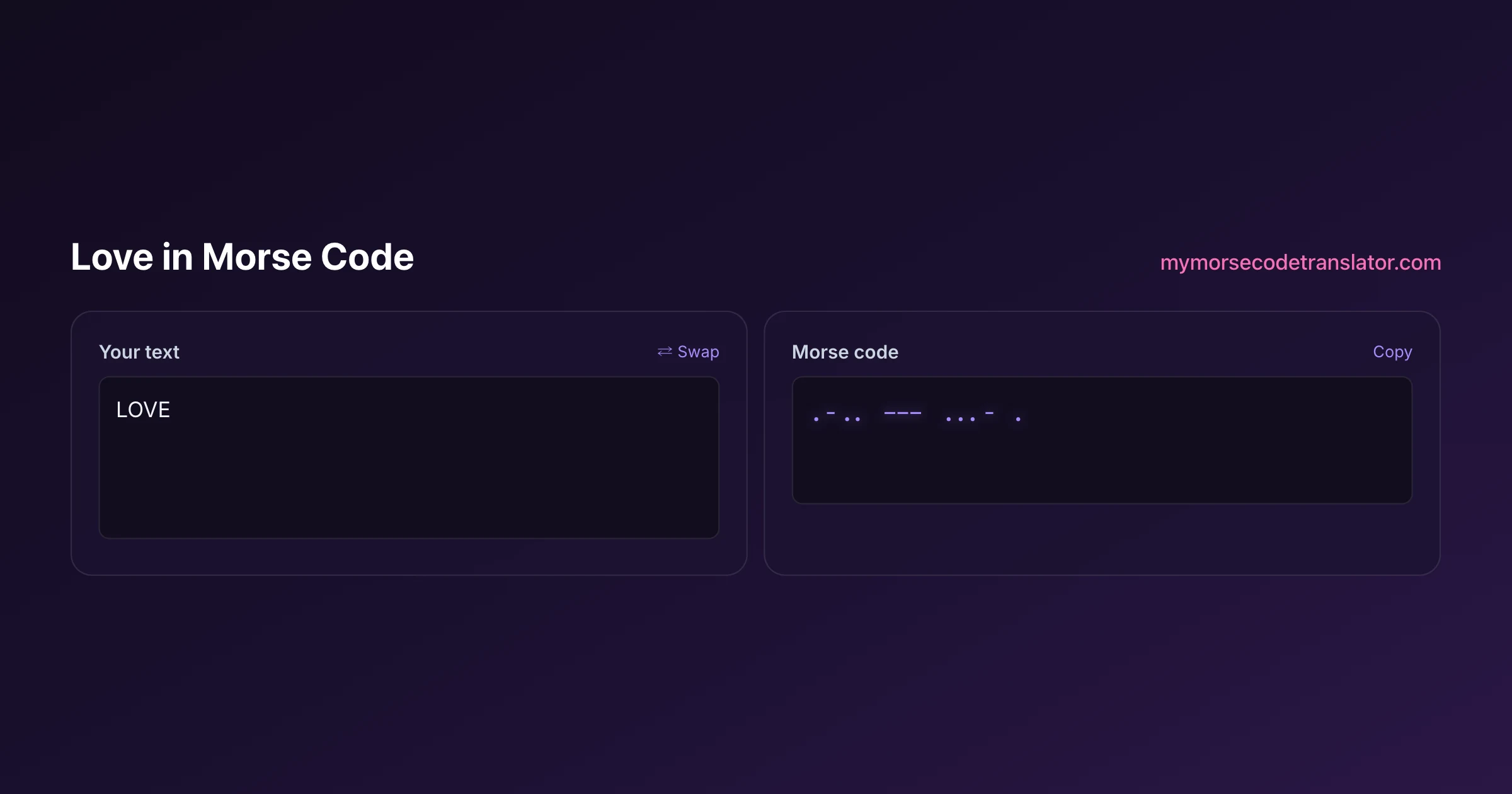
Love in morse code is .-.. --- ...- . — four letters, eleven marks, and by a wide margin the most-requested word on this site. What people usually want next is everything around it: the longer phrases, the variants that fit on a bracelet, and the reassurance that what they are about to have engraved actually says what they think. This page gives you the patterns, the ones that go wrong most often, and the check that takes thirty seconds and prevents a permanent mistake.
👀 Preview
Press ▶ Play — this shows what you'll see and hear.
Customize your message
Your picture appears in Play and downloaded videos. Note: it can't be included in a shared link — links carry the message only.
Share as a secret message
The message is hidden inside the link and decodes with sound & light when your friend opens it.
The word itself, letter by letter
LOVE — .-.. --- ...- .
Broken apart so you can check it against anything you have been given:
- L —
.-..(dot dash dot dot) - O —
---(three dashes) - V —
...-(three dots, dash) - E —
.(a single dot)
Four letters, eleven marks, three letter-gaps. It is a pleasingly balanced pattern: it opens with a mixed letter, runs through the longest common letter in the alphabet, and finishes on the shortest possible one. That single closing dot is the reason so many bracelets end with one small bead — E is the most frequent letter in English, so Samuel Morse and Alfred Vail gave it the shortest signal in the system.
A warning that matters if you are working by hand: V is `...-` and it is not the same as S followed by T. The difference is entirely in the gaps. Run them together and the pattern reads as something else, which is the single most common way a hand-assembled LOVE goes wrong.
The phrases people actually want
Ready to copy. The / marks a word gap — a longer silence, seven units rather than three — and it is notation for humans reading the page, not something you transmit.
I LOVE YOU — .. / .-.. --- ...- . / -.-- --- ..-
I LOVE YOU TOO — .. / .-.. --- ...- . / -.-- --- ..- / - --- ---
MY LOVE — -- -.-- / .-.. --- ...- .
MY LOVE FOREVER — -- -.-- / .-.. --- ...- . / ..-. --- .-. . ...- . .-.
I MISS YOU — .. / -- .. ... ... / -.-- --- ..-
ALWAYS — .- .-.. .-- .- -.-- ...
FOREVER — ..-. --- .-. . ...- . .-.
I LIKE YOU — .. / .-.. .. -.- . / -.-- --- ..-
I ADORE YOU — .. / .- -.. --- .-. . / -.-- --- ..-
MY HEART — -- -.-- / .... . .- .-. -
SOULMATE — ... --- ..- .-.. -- .- - .
I AM YOURS — .. / .- -- / -.-- --- ..- .-. ...
If the phrase you want is not here, type it into the translator above rather than assembling it from a chart. Hand-assembly is exactly where single-mark errors creep in, and the tool will also decode your result back so you can confirm it.
Why the short versions are usually the better choice
Morse is long. That is the practical constraint nobody mentions until they are halfway through threading a bracelet.
Count the marks: LOVE is 11. I LOVE YOU is 25. MY LOVE FOREVER is 42. On a beaded bracelet each mark is a bead and each letter gap needs a spacer, so I LOVE YOU is already most of an adult wrist. MY LOVE FOREVER is a necklace, not a bracelet.
This is why the pieces that actually get worn tend to be short. A single word. A pair of initials. Sometimes just the four letters on this page. The long phrase looks better in a design mockup and worse on an actual arm, because the spacing has to be squeezed until the letters stop being separable — and at that point the piece no longer says anything to anyone who does not already know.
If you want length, the answer is usually a different medium rather than tighter spacing: an engraving on the inside of a band, a line of ink where you control the scale, or a card where the pattern can run across two lines. Keep the wearable versions short and let them stay readable.
The check that prevents a permanent mistake
Every piece of advice on this page reduces to one habit, and it is worth stating on its own because it is the only thing standing between a thoughtful gift and a permanent error.
Decode it backwards before you commit.
Not read it forwards against a chart — that only shows you what you already expect to see. Take the exact dots and dashes from your final layout, paste them into the decoder, and confirm the text that comes back is what you intended.
Do this specifically when: the pattern came from a seller rather than from you, you assembled it by hand from a chart, someone else laid it out, or it is about to become permanent. Those are the four situations where errors actually appear.
I have checked a lot of these for people now, and the failures are boringly consistent. A missing dot inside V. A letter gap that is the same width as a mark gap, so two letters merge into one. A repeated bead where someone lost count halfway. Every one of them takes half a minute to catch beforehand and is either expensive or impossible to fix afterwards.
The tool on this page decodes in both directions, so the check costs you nothing but the thirty seconds.
Wearing it: bracelets, ink and engraving
Each medium has one thing it gets wrong more than the others.
Bracelets. The gaps are distances rather than silences, and the piece is unreadable unless the space between letters is visibly wider than the space between marks inside a letter. Well-made pieces use a distinct spacer bead or knot between letters rather than simply a slightly bigger gap. If you are buying rather than making, this is the single thing to look at in the photograph — a bracelet with evenly-spaced identical beads is decoration, not a message. There is a full walkthrough on morse code bracelet maker, and morse code bracelet translator covers reading one you already own.
Tattoos. Ink spreads over years. If a dot and a dash are only just distinguishable on day one, they will not be at year ten, so ask for a dash that is generously long relative to the dot. Hand the artist the pattern rather than the word, and specify the spacing visually at final size. Morse code tattoo generator has the pre-needle checklist.
Engraving. The easiest of the three, because the spacing is under your control and the marks do not move. The usual failure is scale: a pattern that reads cleanly on screen closes up at 6 mm on the inside of a ring. Print it at true size and look at it before approving.
Marketplaces like Etsy are full of all three, and the same rule applies to every one of them — ask the seller for the exact dots and dashes and decode them yourself before buying.
Sending it rather than wearing it
Not everything has to be an object. The tool on this page will play the phrase as a tone, flash it as light, export it as a still image or a short vertical video, or encode it into a link.
That last one is the interesting option. Send a secret morse message packs the message and your playback settings into the URL itself — nothing is stored on a server — so the person you send it to opens a single play button and the message reveals itself with the sound and light you chose. It arrives as a small event rather than as a string of punctuation in a text message, which for this particular set of phrases is rather the point.
And if the recipient wants to read it themselves rather than watch it play, four letters is a genuinely achievable thing to learn in an afternoon — common words in morse code has the rest of the everyday vocabulary.
A friend sent me a photo of a bracelet before buying it, described by the seller as her daughter's name. It was one bead short in the fourth letter and actually spelled something else. The seller remade it without argument — but only because we could point at exactly which bead was wrong, which took about thirty seconds with the decoder.
Frequently Asked Questions
Q. What is love in morse code?
.-.. --- ...- . — L is dot dash dot dot, O is three dashes, V is three dots and a dash, and E is a single dot. Eleven marks in total across four letters.
Q. What is I love you in morse code?
.. / .-.. --- ...- . / -.-- --- ..- — twenty-five marks across three words. The slashes mark the word gaps, which are seven units of silence rather than the three units between letters.
Q. Why does my bracelet not look like the pattern?
Almost always the spacing. On an object the gaps are distances, and if the space between letters is not clearly wider than the space between marks inside a letter, the letters merge and the piece cannot be decoded by anyone who does not already know what it says.
Q. How do I check a design before it is permanent?
Decode it backwards. Paste the exact dots and dashes from your final layout into the decoder and confirm the text that returns is what you intended. Reading forwards against a chart only shows you what you already expect to see.
Q. What is my love in morse code?
-- -.-- / .-.. --- ...- . — MY is dash dash, dot dash dot dot; then the word gap; then LOVE.
Q. What is I miss you in morse code?
.. / -- .. ... ... / -.-- --- ..-. Note the double S in MISS — two runs of three dots with a letter gap between them, which is the easiest place in the phrase to drop a mark.
Q. What is forever in morse code?
..-. --- .-. . ...- . .-. — seven letters and twenty-two marks, which is long for anything worn on a wrist but fine for an engraving or a card.
Q. Which phrase fits best on a bracelet?
A single word or a pair of initials. LOVE is eleven marks and sits comfortably; I LOVE YOU at twenty-five is already most of an adult wrist once you add the spacer beads between letters.
Q. Is there a different morse code for love in other languages?
The letters are identical worldwide — the international standard fixed by the ITU covers A to Z the same way everywhere. Only accented characters differ, so a French or Spanish word with an accent needs an extra pattern.
Q. Can I send this as a sound or a video?
Yes. The translator will play it as a tone, flash it as light, export a still image with a transparent background, or render a short vertical video sized for social platforms — all free and all rendered in your browser.
Q. What goes wrong most often with the word LOVE?
The V. It is three dots and a dash, and if the gaps around it are uneven it stops reading as a single letter. A missing dot inside V is the single most common hand-assembly error on this word.
Q. Should I include the spaces between words?
Yes, and make them obviously longer than the letter gaps — seven units against three. On a physical piece that usually means a distinctly larger spacer or a visible break, otherwise a multi-word phrase reads as one long unbroken run.
Q. How do I know a seller's pattern is correct?
Ask for the exact dots and dashes rather than trusting the photograph, then decode that string yourself. Sellers make counting errors like everyone else, and it is far easier to resolve before the piece is made than after.
Related guides
← Back to the My Morse Code Translator home page.

By Sukie
Sukie is the creator of My Morse Code Translator — a puzzle nerd and gadget tinkerer who fell down the Morse code rabbit hole and decided to build the most fun Morse translator on the web. When she's not adding new sound packs or reveal animations, she's decoding hidden messages in songs or designing Morse code bracelets for friends.
Last updated: 2026-10-11