Morse Code Tattoo Ideas
Most morse code tattoo ideas fall apart at the same point: the design looks perfect as a drawing and becomes an unreadable row of marks on skin. The code itself is not the hard part — you can convert a word in seconds. What decides whether the tattoo still says something in five years is length, spacing, and where on the body it sits. This page is organised by what you are trying to spell, because that is what actually constrains the design. A three-letter word and a seven-word phrase are not the same project. One fits on a finger; the other is a back piece whether you intended that or not. Every example below is written out in full so you can see the real length before you commit to it. Convert your own text in the tool on this page and count the marks — that number, not the sketch, is what your artist has to work with.
👀 Preview
Press ▶ Play — this shows what you'll see and hear.
Customize your message
Your picture appears in Play and downloaded videos. Note: it can't be included in a shared link — links carry the message only.
Share as a secret message
The message is hidden inside the link and decodes with sound & light when your friend opens it.
Why length is the first decision, not the last
In Morse, one letter is one to four marks. The average across the English alphabet is about three. So a five-letter word is roughly fifteen marks plus four letter gaps — call it twenty units of horizontal space before you have drawn anything decorative.
That is the number people skip. They pick a phrase they love, convert it, and discover it is 90 marks long. At a legible size — marks thick enough not to blur — 90 marks is most of a forearm.
A rough guide that holds up in practice:
- 1–4 letters — finger, wrist, behind the ear, ankle, collarbone.
- 5–8 letters — inner forearm, outer forearm, ribs, spine.
- 9–15 letters — full forearm, spine, along a ribcage.
- More than 15 — a back or thigh piece, or reconsider.
Decide the length first, then choose the words that fit it. That order round is much less painful than the reverse.
Short words: the ones that always work
Short words are the reason this style exists. They are legible, they fit almost anywhere, and the code stays visually balanced.
- LOVE —
.-.. --- ...- .— 11 marks. - HOPE —
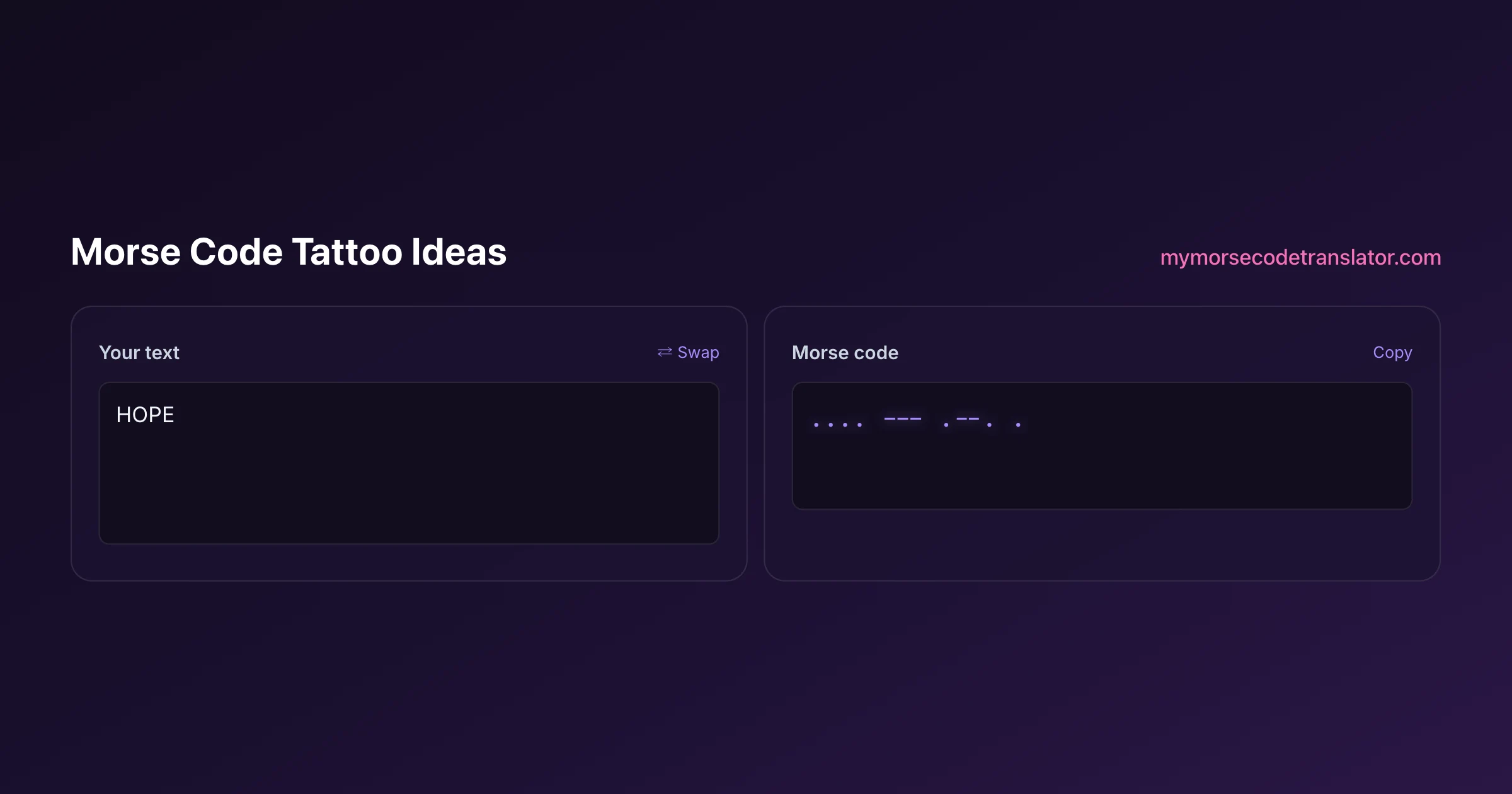
.... --- .--. .— 11 marks. - MOM —
-- --- --— 7 marks. - DAD —
-.. .- -..— 7 marks. - STAY —
... - .- -.--— 10 marks. - HOME —
.... --- -- .— 10 marks.
Notice how different these look despite similar letter counts. MOM is all dashes — a heavy, even row. HOPE opens with four quick dots. That texture is part of the design, and it is worth converting three or four candidate words just to see which one has a shape you like.
Names, and the problem with long ones
Names are the most common request and the most commonly underestimated. A name is not chosen for its brevity, so it is often the worst fit.
- ANNA —
.- -. -. .-— 9 marks. Comfortable. - EMMA —
. -- -- .-— 9 marks. - JAMES —
.--- .- -- . ...— 14 marks. - ELIZABETH —
. .-.. .. --.. .- -... . - ....— 26 marks.
ELIZABETH is not a wrist tattoo. It is a forearm, a spine, or a shortened form. Plenty of people go with initials instead — two letters, unmistakable to them, invisible to everyone else. That is often the better tattoo.
Dates, which are longer than they look
Numerals are uniformly five marks each in International Morse. There are no short digits, which makes dates deceptively heavy.
- 2026 —
..--- ----- ..--- -....— 20 marks for four characters. - A full 08 09 2026 is 40 marks.
Compare that with HOPE at 11 marks. A four-digit year is nearly twice the length of a four-letter word. If you want a date, consider just the year, or the day and month, and be prepared for a wide design.
Phrases: where most ideas quietly die
A phrase is where the arithmetic becomes brutal.
- I LOVE YOU —
.. / .-.. --- ...- . / -.-- --- ..-— 21 marks across three words, plus two word gaps. - BREATHE —
-... .-. . .- - .... .— 16 marks, one word. - THIS TOO SHALL PASS — over 60 marks.
The single-word phrases are usually the stronger tattoo anyway. BREATHE carries the same meaning as a sentence and fits an inner forearm cleanly. If you are set on a multi-word phrase, map it at full size on paper and hold it against the placement before you book.
Placement, by what the shape demands
Morse is a long horizontal strip. That single fact rules most placements in or out.
- Inner forearm — the default, and for good reason: long, flat, and it reads naturally left to right.
- Spine — a vertical run. Beautiful for longer text, but the code is then read top to bottom, which is unconventional; agree the orientation with your artist.
- Collarbone — elegant for 4–8 letters, follows the bone line.
- Ribs — takes length well, hurts considerably more.
- Finger — 1–3 letters at most, and finger ink fades and blurs faster than anywhere else.
- Behind the ear / nape — very short words only.
- Ankle / wrist — 3–5 letters comfortably.
Wrapping a long code around a limb is tempting and usually a mistake: the curve hides part of the sequence at any viewing angle, so the tattoo is never fully readable at once.
The spacing problem that ruins most of them
This is the single biggest cause of Morse tattoos that do not work, and it is almost always the artist's unfamiliarity rather than bad intent.
International Morse, standardised in ITU-R M.1677, defines the proportions precisely. A dash is three times the length of a dot. The gap between marks inside one letter is one unit. The gap between letters is three units. The gap between words is seven.
That three-to-one letter gap is what gets lost. An artist spacing marks evenly — because evenly spaced looks tidier — produces a design that cannot be decoded at all. Every letter boundary disappears and the whole row becomes one long ambiguous string.
Give your artist the spacing explicitly, marked on the stencil. Do not assume it will be inferred from the reference image.
Mark shapes beyond the plain bar
Dots and dashes do not have to be circles and rectangles, and this is where a design becomes personal rather than generic.
- Solid bar and dot — the classic. Cleanest, ages best.
- Outlined marks — lighter on the skin, but fine lines blur over years.
- Beads — reads as jewellery; pairs naturally with a matching morse code bracelet.
- Birds, leaves, stars — small motifs standing in for dots, longer ones for dashes. Charming, and the most likely to become illegible.
- Mountain ridges or a heartbeat line — the marks hidden inside a continuous line.
The more decorative the substitution, the more the proportions matter. If a dash is not visibly three times a dot, a motif-based design stops being code and becomes decoration that resembles code.
Combining Morse with other elements
A bare strip of marks is a strong minimal tattoo, but it does read as abstract to anyone who does not know. Common ways people anchor it:
- Running the code along a stem, branch or arrow.
- Placing it under a small illustration — a wave, a moon, a compass.
- Using the code as a border around a larger piece.
- Pairing the code with the word itself in small text, so the meaning is not lost to time.
That last one is worth considering seriously. Part of the appeal here is privacy, but a tattoo nobody can read — including you, in twenty years — is a different proposition from a private one.
What to check before you book
Run these five checks. They take ten minutes and prevent the failure modes that cannot be fixed afterwards.
1. Convert it twice, independently. Use the tool on this page, then check it against a printed chart such as the morse code alphabet. A transposed letter is permanent. 2. Count the marks. Write the number down. Show that number to your artist, not just the picture. 3. Print it at actual size. Tape it where it will go. Live with it for a day. 4. Confirm the letter gaps are on the stencil. Ask directly: are the between-letter gaps three times the within-letter gaps? 5. Decode it backwards. Have someone who did not create it read the marks back to you using a chart. If they cannot, neither will anyone else.
Step five catches nearly everything. If the design fails it, the spacing is wrong, and that is a drawing problem — free to fix now, impossible later.
Getting the code right before anything else
Everything above assumes the underlying code is correct, which is worth its own minute of attention.
Use International Morse, not American Morse. American Morse is a different, older code with internal spaces inside some letters, and it is not what any modern chart or tool means by Morse. If you are curious about the difference, the american morse code translator page covers it.
Watch punctuation. An apostrophe in a name, an ampersand, an accented character — these either have long codes or none at all. Most designs are cleaner without them.
And decide about capitals early: Morse does not distinguish case, so anna and ANNA are the same marks. That is one fewer thing to agonise over.
Convert your text in the translator above, count the marks, and take that number to your consultation. If you want to see the layout rendered rather than counted, the morse code tattoo generator draws it out at proportion.
I mapped out every example on this page in our own translator and counted the marks by hand rather than trusting the drawing. ELIZABETH came out at 26 marks — nearly two and a half times HOPE at 11 — which is exactly the gap between a wrist tattoo and a forearm one. The date 2026 surprised me most: 20 marks for four characters, because every numeral in Morse is five marks with no short ones.
Frequently Asked Questions
Q. What are the best morse code tattoo ideas for a first tattoo?
A three-to-five letter word on the inner forearm or wrist. LOVE, HOPE, STAY and HOME are all around 10–11 marks, which is short enough to stay legible at a small size and simple enough that spacing errors are obvious before you commit.
Q. How long will my word be as a tattoo?
Count roughly three marks per letter, plus a gap between each letter. A five-letter word is about 15 marks and 4 gaps. Convert it in the tool on this page and count exactly — that number is what determines placement more than anything else.
Q. Can a morse code tattoo actually be read by other people?
Only if the spacing is right. With correct three-to-one letter gaps, anyone with a chart can decode it. With even spacing — the most common mistake — it cannot be decoded by anyone, including you.
Q. Where do morse code tattoos fade or blur fastest?
Fingers, then hands and feet. Morse depends on the gap between marks staying visible, so blur is more damaging here than in most styles — two dots merging into a dash changes the letter entirely. For fingers, keep to one or two letters with generous spacing.
Q. Should I get the word written underneath the code?
It is a real trade-off. The appeal of Morse is that it is private, and adding the text removes that. But it also guarantees the meaning survives if the marks blur. Many people add it in very small text on the inside edge, where only they see it.
Q. Are numbers and dates a good idea?
They work, but every digit is five marks with no exceptions, so a four-digit year is 20 marks — longer than most four-letter words. A full date runs to 40 marks. Consider just the year if space is tight.
Q. What should I tell my tattoo artist?
Three things: the exact sequence of dots and dashes, the total mark count, and that the gaps between letters must be three times the gaps within a letter. The third point is the one most likely to be missed, and the only one that cannot be corrected later.
Q. Is International Morse the right code to use?
Yes. International Morse, defined in ITU-R M.1677, is what every modern chart and translator uses. American Morse is an older, different code with internal spaces in some letters and should not be used unless you specifically want it for historical reasons.
Q. Can I match a tattoo to a bracelet?
Yes, and the proportions carry across directly — a small round bead is a dot, a long tube bead is a dash, and a spacer is the letter gap. If you want both, design the bracelet first: beads force you to be honest about length in a way a drawing does not.
Related guides
← Back to the My Morse Code Translator home page.

By Sukie
Sukie is the creator of My Morse Code Translator — a puzzle nerd and gadget tinkerer who fell down the Morse code rabbit hole and decided to build the most fun Morse translator on the web. When she's not adding new sound packs or reveal animations, she's decoding hidden messages in songs or designing Morse code bracelets for friends.
Last updated: 2026-11-04