Morse Code Symbols: Punctuation, Signs and Prosigns
Which Morse code symbols exist beyond the 26 letters and 10 digits? The international standard, ITU-R M.1677-1, defines 13 punctuation marks and signs, from the full stop .-.-.- to the @ sign .--.-., plus a handful of operating signals such as "wait" and "error". A few more, like ! and &, are informal conventions. Every one of them is built from just two marks and three lengths of silence.
The tables below separate the official signs from the unofficial ones, show which characters secretly share a pattern with a procedural signal, and match exactly what the translator on this page outputs, so you can type a symbol, see its code and hear it.
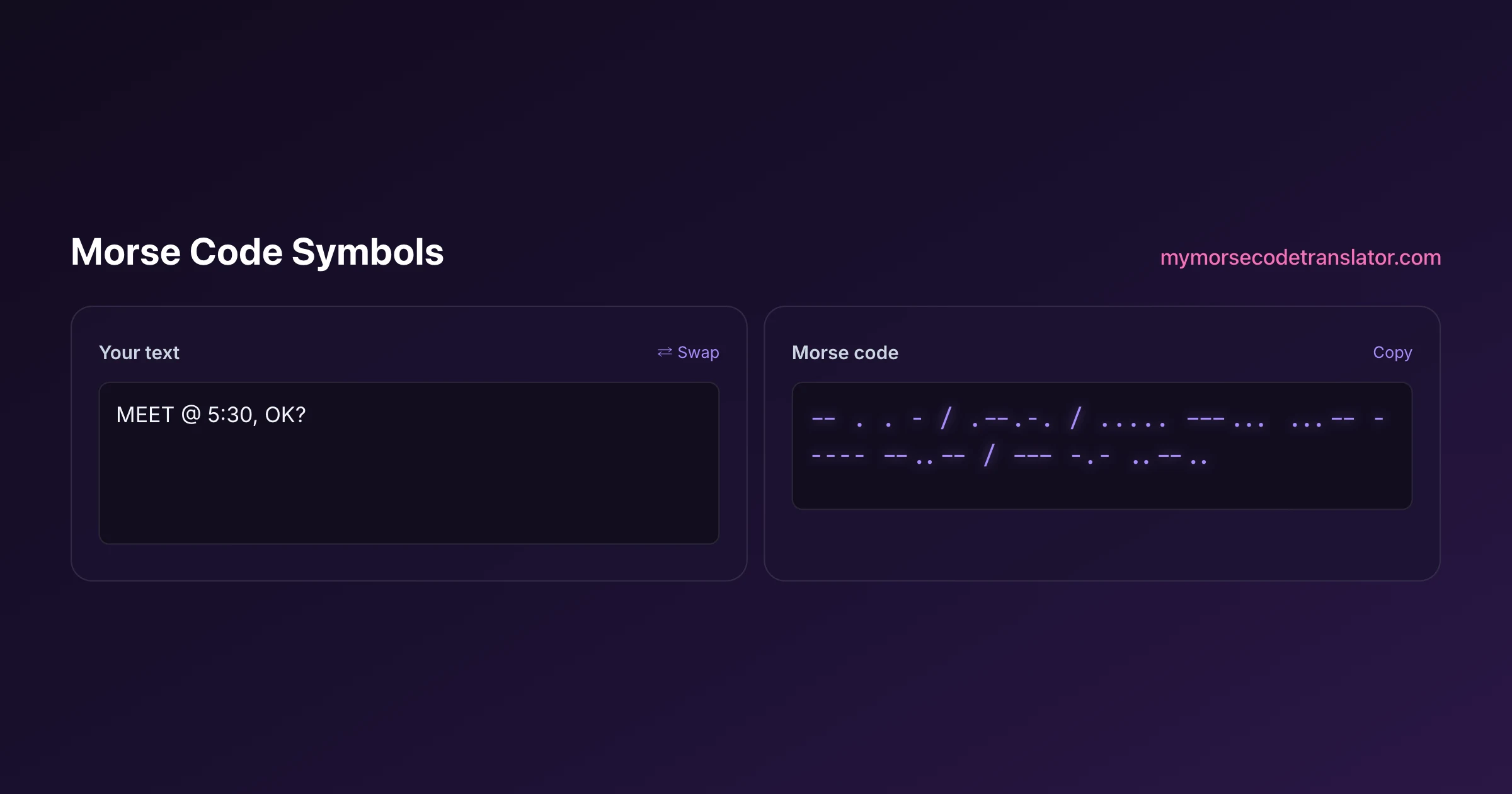
👀 Preview
Press ▶ Play — this shows what you'll see and hear.
Customize your message
Your picture appears in Play and downloaded videos. Note: it can't be included in a shared link — links carry the message only.
Share as a secret message
The message is hidden inside the link and decodes with sound & light when your friend opens it.
Two marks and three silences: what every sign is made of
Strip Morse down and there are only two sounds: the short dot (spoken dit) and the long dash (dah). What turns those into a readable message is silence, and the standard is precise about how much. Section 2 of ITU-R M.1677-1, the Recommendation published by the International Telecommunication Union, sets every length in multiples of one dot:
- a dash lasts as long as three dots;
- the gap between the marks inside one character lasts one dot;
- the gap between two characters lasts three dots;
- the gap between two words lasts seven dots.
That 1:3:7 ratio is why a pattern written on paper needs separators. The translator shows a three-dot gap as a single space between characters and a seven-dot gap as / between words, so .... .. is HI and .... / .. is H, then a new word starting with I. The timing guide turns those units into milliseconds at any speed.
Punctuation follows the same grammar as letters, only longer: letters use one to four marks and digits five, while most Morse code symbols for punctuation run to six, and the dollar convention to seven.
The gaps also carry meaning. A and R with a normal pause are two letters; run together as .-.-. they become one sign meaning either "+" or "end of message". Most confusion about symbols comes from that one fact.
The 13 signs in the ITU standard
These are the punctuation marks and signs in section 1.1.3 of ITU-R M.1677-1 (October 2009 edition), under the names the standard uses. The translator outputs every pattern exactly.
| Sign | ITU name | Morse |
|---|---|---|
. | Full stop (period) | .-.-.- |
, | Comma | --..-- |
: | Colon or division sign | ---... |
? | Question mark (also a request to repeat) | ..--.. |
' | Apostrophe | .----. |
- | Hyphen or dash or subtraction sign | -....- |
/ | Fraction bar or division sign | -..-. |
( | Left-hand bracket (parenthesis) | -.--. |
) | Right-hand bracket (parenthesis) | -.--.- |
" | Inverted commas (quotation marks) | .-..-. |
= | Double hyphen | -...- |
+ | Cross or addition sign | .-.-. |
@ | Commercial at | .--.-. |
Details worth knowing before you send them:
- The @ sign is the newest. Wikipedia records that the ITU added it on 24 May 2004 so e-mail addresses could be sent. It is A and C run together.
- Quotation marks go on both sides. The same signal
.-..-.is sent before and after the quoted words. - The apostrophe doubles as minutes and seconds. For 1′15″, send the apostrophe once or twice; the standard forbids the quotation signal for seconds.
- Some signs have no code at all. A multiplication sign is sent as the letter X (
-..-). A percentage is sent as zero, fraction bar, zero, joined to its number by a hyphen: the standard's own example is 2% sent as2-0/0, not20/0. - One accented letter made the list. The standard also defines an accented e (é) as
..-... The translator does not include it, so typing é gives#, the tool's marker for "no code for this character".
Note the near-twins: the brackets differ only by a final dash, and the full stop is A three times with no gaps.
Five extras the translator supports that the ITU never defined
Wikipedia's Morse code article is explicit that the symbols !, $ and & are not defined in the official ITU-R Recommendation, and it lists ; and _ with them under nonstandard punctuation. The translator includes all five because people type them, but a receiver may not read them as you intend.
| Sign | Morse | Written as | Where it comes from |
|---|---|---|---|
! | -.-.-- | KW run together | Proposed by the Heathkit Company in the 1980s; some North American operators still send the older ---. (MN) instead |
& | .-... | AS run together | The same pattern as the official "wait" signal; hams nearly always write ES for "and" |
; | -.-.-. | KR run together | Nonstandard; not in the ITU list |
_ | ..--.- | UK run together | Unofficial; sent before and after a word to show it is underlined |
$ | ...-..- | SX run together | From the Phillips Code abbreviation SX, later merged into one sign |
Two of these deserve a warning label.
The exclamation mark has two versions in use. Translation software, this site included, uses the Heathkit -.-.--, but on-air use is not universal. A ---. from a radio contact is probably an exclamation mark too; the translator shows it as #.
The ampersand clashes with an official signal. .-... is the ITU's "Wait" signal, so an operator who hears it pauses rather than writing "&". For "and", hams send the letters E and S.
For money, skip the dollar sign: the ITU has never codified a currency symbol, and ISO 4217 codes such as USD (..- ... -..) are preferred.
The semicolon has a trap of its own. It is one dot longer than the ITU starting signal -.-.-, so a sender who clips the final dot has changed a punctuation mark into "a transmission begins here".
Prosigns: symbols you send but never write
A procedural signal, or prosign, is a sign about the conversation rather than part of the text. Prosigns are written as two letters with a bar over the top (AR, SK, BT) to mean "send these as one character, with no gap". The Prosigns for Morse code article on Wikipedia puts it simply: the only difference between the prosign and the two separate letters is whether the inter-letter space is there.
Several prosigns share their dots and dashes with a punctuation mark. A receiver tells them apart by context; a translator cannot.
| Prosign | Morse | Meaning | Same pattern as | The translator decodes it as |
|---|---|---|---|---|
| K | -.- | Invitation to transmit ("over") | the letter K | K |
| AR | .-.-. | End of message / end of telegram | + cross sign | + |
| AS | .-... | Wait | & (unofficial) | & |
| BT | -...- | Break; start a new section | = double hyphen | = |
| KN | -.--. | Go ahead, named station only | ( left bracket | ( |
| CT (KA) | -.-.- | Starting signal; a transmission begins | nothing | # |
| SN (VE) | ...-. | Understood / verified | nothing | # |
| SK (VA) | ...-.- | End of work; the contact is over | nothing | # |
| HH | ........ | Error: the preceding text was wrong | nothing | # |
The ITU Recommendation does not use the two-letter names; it lists these signals by meaning ("Understood", "Error (eight dots)", "Invitation to transmit", "Wait", "End of work", "Starting signal (to precede every transmission)"). The letter names come from operator practice. KN is not in M.1677-1 at all as a prosign; Wikipedia cites the ARRL's operating manual for it and notes that decoder software may show it as (.
Part II of the standard shows how the signs work together. A call is the other station's call sign, the word DE, your own call sign, then K. The double hyphen -...- separates the preamble, the address, the text and the signature. Every telegram ends with the cross signal .-.-., the end of a transmission is that cross followed by K, and the station that sent the last telegram closes with the end-of-work signal ...-.-.
The most famous prosign of all is the distress signal, sent as one unbroken nine-mark sign ...---... rather than three letters. It has a page of its own. The everyday operator shorthand that is sent as ordinary letters, such as CQ, DE and 73, is a different thing again; those are abbreviations, and they are covered in common words in Morse code.
When a decoded message suddenly shows +, &, ( or #
A code table holds one meaning per pattern, so some decodes look odd. Here is how to read them.
A stray + at the end of a message is almost certainly AR, "end of message", not addition. A trailing = in the middle of a radio text is BT, a paragraph break. A ( after a call sign is KN. Read them as procedure and drop them from the text.
A # means the pattern is not in the table. The translator never guesses. In copied radio traffic it usually means a prosign with no printable character (SK, SN, the starting signal, the eight-dot error) or the older ---. exclamation mark.
Phone keyboards cause the most # results when encoding. Many keyboards silently replace a straight apostrophe with a curly one and straight quotes with curly quotes. Typed into the translator, DON’T comes out as -.. --- -. # -, because ’ is not the ITU apostrophe. Retype it with the plain ' and you get -.. --- -. .----. -. The same goes for the en dash –: only the plain hyphen - encodes as -....-.
Characters with no Morse at all (%, ×, #, emoji, currency signs other than $) need the ITU workarounds: X for times, 0/0 for percent, letters for currencies. For decorative uses like emoji in Morse, there is no official code, so any mapping is a private agreement.
If you are learning, take Morse code symbols after the alphabet, letters and numbers, starting with the full stop, comma and question mark. The Morse code chart puts everything on one sheet, and the translator above, also on the home page, plays any line so you can hear the punctuation at speed.
On 14 November 2026 every pattern in the tables on this page was exported from the site's code table (54 characters) and compared with the ITU-R M.1677-1 PDF and Wikipedia's Morse code and Prosigns articles. All 18 punctuation patterns the tool outputs match those sources. The differences found are gaps, not conflicts: the tool has no code for é or ×, and it decodes SK, SN, the starting signal and the eight-dot error as #.
Frequently Asked Questions
Q. What are the basic symbols of Morse code?
Two marks and three gaps. A dot, a dash three dots long, a one-dot gap inside a character, a three-dot gap between characters and a seven-dot gap between words. ITU-R M.1677-1 defines all five lengths in section 2.
Q. What is the Morse code for a question mark?
..--.. (di-di-dah-dah-di-dit). Sent on its own it also means "please repeat, I did not understand", which is how the ITU standard describes it.
Q. What is the Morse code for a full stop and a comma?
Full stop is .-.-.- and comma is --..--. Both are six marks long and both are in the ITU standard.
Q. Is there an exclamation mark in Morse code?
Not officially. The common convention is -.-.-- (KW run together), proposed by Heathkit in the 1980s, and it is what this translator outputs. Some North American operators still send ---. instead.
Q. How do you send the @ sign in Morse code?
.--.-., which is A and C run together. The ITU added it in 2004 so e-mail addresses could be sent, and it is part of ITU-R M.1677-1.
Q. Is & (ampersand) in Morse code?
Only informally. Its usual pattern .-... is the ITU's official "wait" signal, so radio operators send ES for "and" instead. The translator encodes & as .-... and decodes that pattern back to &.
Q. What is the Morse code error signal?
Eight dots in a row, ........, often written HH. It tells the receiver that the last word was wrong and the correction follows. The translator shows it as # because it has no printable character.
Q. What does SK mean in Morse code?
SK, sent as ...-.-, is the end-of-work signal: the contact is finished. ITU-R M.1677-1 lists it as "End of work".
Q. Why does my translator turn some signals into + or =?
Because several prosigns share a pattern with a punctuation mark. AR (end of message) is identical to +, BT (new section) to =, KN to ( and AS (wait) to &. A decoder can only show the character; context tells you which was meant.
Q. How do you send a percent sign or a multiplication sign?
Neither has its own code. The ITU says to send × as the letter X, and to send a percentage as 0/0 joined to the number by a hyphen, so 2% becomes 2-0/0.
Related guides
← Back to the My Morse Code Translator home page.

By Sukie
Sukie is the creator of My Morse Code Translator — a puzzle nerd and gadget tinkerer who fell down the Morse code rabbit hole and decided to build the most fun Morse translator on the web. When she's not adding new sound packs or reveal animations, she's decoding hidden messages in songs or designing Morse code bracelets for friends.
Last updated: 2026-11-24