Morse Code Machine: How the Telegraph Key, Relay and Sounder Sent a Message
A Morse code machine is not one box but a circuit: a telegraph key that opens and closes the current, a battery that supplies it, a single wire between offices, and a receiver at the far end that turns each pulse back into a mark or a click. The first receivers embossed the marks on paper tape; later ones simply clicked. Today the same job is done by keys, paddles and electronic keyers. Below: every part in one table, the trip a single dot makes down the line, and dot and dash lengths in milliseconds. The translator on this page plays any message with the operators' 1:3:7 timing.
👀 Preview
Press ▶ Play — this shows what you'll see and hear.
Customize your message
Your picture appears in Play and downloaded videos. Note: it can't be included in a shared link — links carry the message only.
Share as a secret message
The message is hidden inside the link and decodes with sound & light when your friend opens it.
Six parts on one wire
Every Morse telegraph, from the first experimental line to a railway office decades later, was built from the same handful of parts. According to Wikipedia's Electrical telegraph article, the Morse system used a single wire between offices, usually strung overhead on poles, with the earth itself serving as the return path for the current.
| Part | What it does | How it works |
|---|---|---|
| Telegraph key | Sends | A spring-loaded bar with a knob on top and an electrical contact underneath. Pressing it closes the circuit; releasing it opens it. The first key was made by Alfred Vail, Samuel Morse's associate. |
| Battery | Powers the line | Supplies the current the key switches on and off. On North American railway lines the batteries sat only in the offices at one or both ends; in Europe each station often had its own bank. |
| Line wire and earth return | Carries the pulse | One wire between offices, with the ground completing the circuit. Carl August Steinheil put the first earth-return telegraph into service in 1838, on the Nuremberg–Fürth railway. |
| Relay | Repeats a weak signal | A small electromagnet that, when a faint current arrives, closes a second contact connected to a fresh battery, so a clean copy of the signal travels on. |
| Register | Records (1840s) | Vail's recording instrument. A clockwork mechanism pulled a paper tape along while an electromagnet pressed a stylus into it for as long as current flowed. |
| Sounder | Receives by ear | An electromagnet pulls down a pivoted iron armature with a click when current starts; a counterweight lifts it back with a clack when current stops. |
Two details matter. American railway keys had a shorting bar that kept the circuit closed when the operator was not sending; with batteries only at the ends of the line, an open key would have cut off every station beyond it.
And the relay is why the telegraph could cross a continent. Wikipedia's Relay article notes that relays were first used on long-distance telegraph lines as signal repeaters, transmitting a refreshed copy of the incoming signal onto another circuit. It calls the mechanism in Morse's 1840 patent a kind of digital amplifier that let signals travel as far as desired.
One dot's journey through the circuit
Here is what happens, part by part, when an operator in one office sends a single dot, the letter E (.), to an office down the line.
1. The key closes. The bar's contact touches the one beneath it and completes the circuit from the battery into the line wire. 2. Current flows down the wire. The pulse travels along the single overhead wire and returns through the ground. The pulse carries no letter; its meaning is in how long it lasts. 3. A relay refreshes it, if the line is long. By the time the current reaches a distant station it may be too weak to work a receiver. A relay's sensitive electromagnet closes a local contact on a fresh battery, which drives the receiver or the next stretch of line. 4. The receiver's electromagnet pulls. In the 1840s that receiver was the register: the magnet pushed a stylus onto the moving paper tape. From around mid-century it was more often a sounder, whose armature snapped down onto its stop with a sharp click. 5. The key opens. The current stops everywhere on the circuit at once. 6. The receiver lets go. On a register, a spring pulls the stylus back and the tape runs on unmarked, leaving a short indentation behind: a dot. On a sounder, the counterweight lifts the armature against its upper stop with a second, different sound, the clack. 7. Someone reads it. A short gap between click and clack is a dot, a long one a dash, and the operator writes the letter down.
Step 6 is the subtle one. Wikipedia's Telegraph sounder article stresses that a sounder had to make a sound both when the circuit closed and when it opened, because the listener had no other way to measure how long the current had been on. A sounder that only clicked at the start would make every dot and dash sound the same. The machine sends durations, and the code is a language of durations. A dash makes the same journey with the key held three times as long.
How long the machine holds a dot: timing in milliseconds
International Morse fixes every duration as a multiple of one unit, the length of a dot. ITU-R M.1677-1, the standard that defines the code, sets the ratios: a dot is 1 unit, a dash is 3, the gap between marks inside a letter is 1, the gap between letters is 3 and the gap between words is 7. Speed is measured in words per minute using PARIS, the standard word named in Wikipedia's Morse code article, which by those ratios takes exactly 50 units including its closing word gap. So one unit lasts 1,200 ÷ WPM milliseconds, which is the same formula the translator on this page uses.
The ARRL notes that experienced operators converse at 20 to 30 WPM. At 20 WPM that gives:
- Dot: 60 ms
- Dash: 180 ms
- Gap inside a letter: 60 ms
- Gap between letters: 180 ms
- Gap between words: 420 ms
Wikipedia's Telegraph key article gives the human range on a straight key as about 5 WPM for novices up to about 30 WPM for skilled operators. At 5 WPM a dot is a leisurely 240 ms and a dash 720 ms. At 30 WPM a dot shrinks to 40 ms and a dash to 120 ms, and the gaps between letters are just 120 ms. A clockwork "bug" key lets a skilled operator pass 40 WPM, where a dot is under 30 ms.
Those numbers explain why listening won. In a run of dots at 20 WPM the sounder's armature falls and rises about eight times a second, and the ear judges 60 ms against 180 ms with ease.
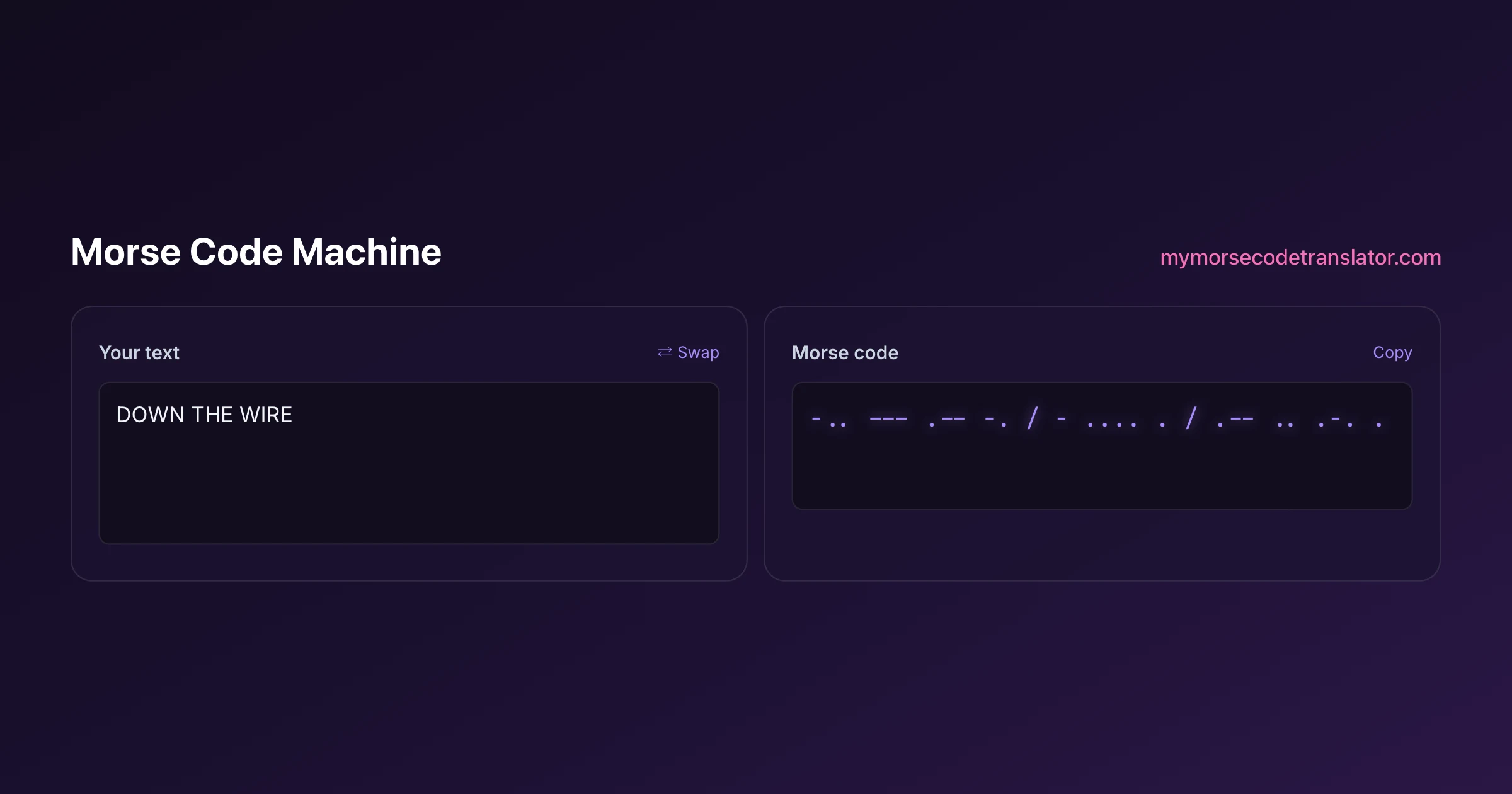
To put a whole message on the clock, take our demo phrase, DOWN THE WIRE: -.. --- .-- -. / - .... . / .-- .. .-. . It adds up to 101 units of marks and gaps. At 20 WPM the key would be busy for 6.06 seconds; at a beginner's 5 WPM, 24.24 seconds; at 30 WPM, 4.04 seconds. More arithmetic, including Farnsworth spacing, is in our Morse code timing guide.
From paper tape to listening by ear
The first Morse machines were built to write, not to be heard. Morse's original design was a recording telegraph that left a strip of marks to be read later. The very words "dot" and "dash" come from those marks on the tape, as Wikipedia's Telegraph sounder article points out. (The story of who designed the code and the famous first message of 1844 is on our page about who invented Morse code.)
The register had a side effect nobody planned. Its armature clicked as it moved in and out, and operators found they could read the clicks directly and write the message out by hand, skipping the tape altogether. According to the Electrical telegraph article, some networks began employing these "sound operators" from 1848, starting with the New York–Boston line. The register gave way to the sounder, just an electromagnet, an iron lever and a stop. The sounder article credits Alfred Vail with it, after 1850, and says the tape mechanism lost because it was more complicated and failed more often than listening.
Inventors still chased automatic machines, because the human operator was the speed limit:
- Alexander Bain's chemical telegraph (patented 1846) marked chemically treated paper tape with an iron pen, producing blue Morse marks at 16½ words per minute.
- Charles Wheatstone's automatic system punched the message in Morse onto perforated tape in advance, then ran the tape through a transmitter at 70 words per minute.
Meanwhile the code split: American lines kept American Morse, while Europe adopted Friedrich Gerke's 1848 revision, standardised as International Morse in Paris in 1865. You can compare the two in our American Morse code translator.
Morse code machines that are still made today
Search for a Morse code machine today and you mostly find keys. The wire and sounder are gone, but radio amateurs still make and use each of these:
- Straight key. The classic up-and-down bar and knob, essentially the telegraph office key. You make every dot and dash yourself. Hard pounding gave many telegraphers a strain injury called "glass arm".
- Sideswiper (cootie key). A lever that moves side to side, making contact in either direction. It was introduced for speed and to spare operators' arms.
- Semi-automatic key, or "bug". Often called a Vibroplex after an early maker. One direction sets a pendulum tapping out evenly timed dots; the other gives a contact for dashes, timed by hand. The ARRL's Learning Morse Code page dates bug keys to 1902.
- Paddle and electronic keyer. Since the mid-20th century, electronic keyers generate both dots and dashes automatically at a speed set with a knob. A dual or "iambic" paddle lets you squeeze both levers for alternating dot-dash: the letter C (
-.-.) becomes one squeeze instead of four separate movements. Most keyers offer iambic modes A and B (B is the usual default) and dot and dash memories, so your hand can run slightly ahead of the output. - Code practice oscillator. A small circuit that beeps when you close a key, so you can practise sending without a transmitter. The ARRL suggests building one as a first project.
One thing changed when keyers arrived: the operator's fist. On a straight key or bug every telegrapher had a recognisable rhythm; Wikipedia's Telegraph key article reports that in 1897 an operator could be identified after a few words. A keyer's code is uniform, so only the gaps between letters and words give a sender away.
Want to try keying before you buy anything? The tap Morse code key on this site works like a straight key on your screen, decoding your rhythm as you send.
Hear your message the way the line carried it
The translator at the top of this page shows any message as dots and dashes and plays it at 5 to 40 WPM with the 1:3:7 timing above. A few settings bring it closer to the old machines:
- Speed. 20 WPM is a working operator's pace; 5 WPM is a beginner on a straight key.
- Telegraph Clicks. This sound option is a rough electronic stand-in for a sounder. It buzzes through each mark, whereas a real sounder clicked at the start, clacked at the end and was silent between.
- Farnsworth timing. Stretches the gaps between letters while keeping each letter at full speed, a common way to learn.
A good first experiment: type DOWN THE WIRE, set 20 WPM and time the playback. It should run just over six seconds, the same 101 units a telegrapher's key would have spent. For the basics of the code itself, see what is Morse code, or open the main Morse code translator.
Every timing on this page was computed on 14 November 2026 from the 1:3:7 ratios in ITU-R M.1677-1 and the 1,200 ÷ WPM formula in the site's own code, and every Morse pattern was checked against the site's code table. The parts and circuit description follow Wikipedia's Electrical telegraph, Telegraph key, Telegraph sounder, Relay and Morse code articles and the ARRL's Learning Morse Code page, all read the same day.
Frequently Asked Questions
Q. What was the machine that sent Morse code called?
It was the electrical telegraph. The operator sent with a telegraph key, a spring-loaded switch, and the message was received on a register (which marked paper tape) or, later, a sounder (which clicked).
Q. What is the paper tape Morse machine called?
The register. Alfred Vail developed it for Morse's system: clockwork pulled a paper tape past a stylus, and an electromagnet pressed the stylus into the tape whenever current flowed, embossing dots and dashes. Sounders later replaced it.
Q. How did the telegraph send a message over long distances?
Over a single wire with the earth as the return path. On long lines, relays at intermediate stations detected the weakened current and switched a fresh local battery onto the next section, passing on a clean copy of the signal.
Q. How fast could a telegraph operator send?
On a straight key, about 5 words per minute for a novice up to about 30 for a skilled operator, according to Wikipedia's Telegraph key article. With a semi-automatic bug key, a skilled operator could exceed 40. At 30 WPM a dot lasts 40 milliseconds.
Q. Are Morse code telegraph machines still used?
The old landline telegraph is gone. Morse was the international maritime distress standard until 1999, and the last US commercial Morse transmission went out on 12 July 1999. Radio amateurs still send it with straight keys, bugs and keyers.
Related guides
← Back to the My Morse Code Translator home page.

By Sukie
Sukie is the creator of My Morse Code Translator — a puzzle nerd and gadget tinkerer who fell down the Morse code rabbit hole and decided to build the most fun Morse translator on the web. When she's not adding new sound packs or reveal animations, she's decoding hidden messages in songs or designing Morse code bracelets for friends.
Last updated: 2026-11-15