How to Memorize Morse Code: Pairs, Groups and a 7-Day Plan
There are 36 characters to learn, 26 letters and 10 digits, built from only 132 dots and dashes, and how to memorize Morse code quickly comes down to using the structure hiding in those numbers. Learn the letters in four length groups (2, 4, 8 and 12 letters), pair each one with its dot-for-dash opposite, walk them as a left/right tree, and learn the digits as a single rule. Do all of it by sound, not by staring at a chart.
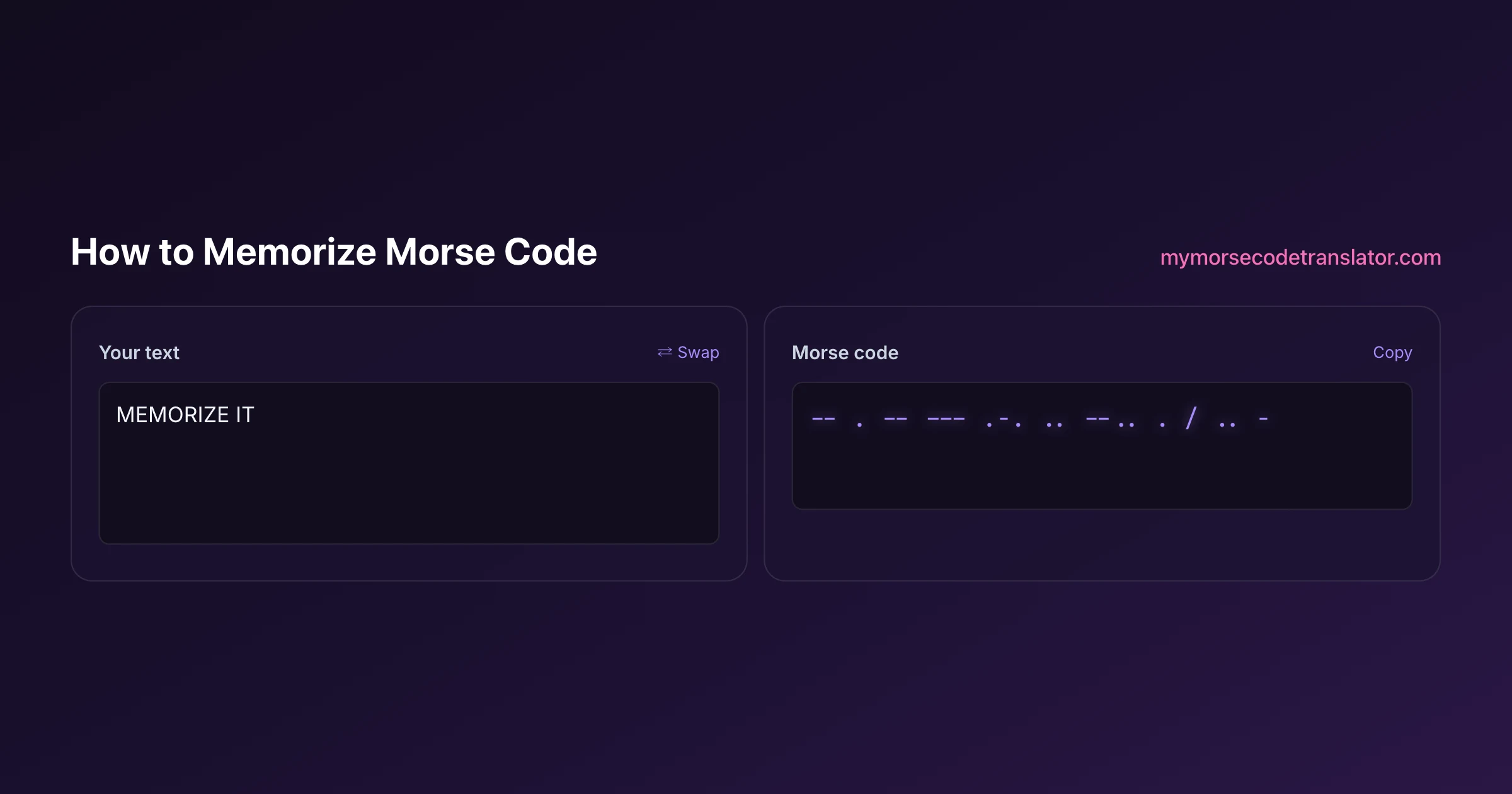
👀 Preview
Press ▶ Play — this shows what you'll see and hear.
Customize your message
Your picture appears in Play and downloaded videos. Note: it can't be included in a shared link — links carry the message only.
Share as a secret message
The message is hidden inside the link and decodes with sound & light when your friend opens it.
Charts and mnemonics: great for a quiz, a ceiling for listening
Search for this topic and you get pictures: letters drawn as objects, rhyming phrases. They are not new. Wikipedia's Morse code article notes that Baden-Powell put a visual mnemonic chart in the Girl Guides handbook in 1918, and that in the United Kingdom many people learned Q (dah-dah-di-dah) as "God Save the Queen" and F (di-di-dah-dit) as "Did she like it?".
- Charts and picture mnemonics work if your goal is to pass a test, solve a puzzle, or decode Morse written on paper at your own pace. You have time to look things up.
- They cost you when Morse is coming at you as sound or light. To use a picture, you hear the beeps, count them, convert them to a dot-dash string, then search your memory for the picture. That extra lookup step takes time, and live Morse doesn't wait.
- The numbers show how little time there is. Morse timing is fixed by ITU-R M.1677-1: a dot is 1 unit, a dash 3, the gap inside a letter 1, the gap between letters 3. Our translator uses the standard 1,200 ÷ WPM milliseconds per unit. At 20 WPM that is 60 ms per unit, so all of Q lasts 0.78 seconds and the next letter starts 0.18 seconds after it ends.
Ludwig Koch's 1936 study, as summarised by the Long Island CW Club, called the chart approach the "analytical method": counting the elements and rebuilding the symbol works at a low tempo but cannot be done at faster speeds. The club discourages any chart showing the CW symbols.
So use the structures on this page as memory hooks, not as a lookup table. The goal is to hear "dah-di-dah" and simply know K.
Memorize the shape as a sound, even on day one
The fix is to learn Morse by ear from the start: Koch's method plays each character at full speed and adds one new character at a time, and Farnsworth timing keeps the characters fast but stretches the gaps between them. Our how to learn Morse code guide explains both in depth, and the Morse code trainer runs a Koch-style course in your browser.
The groups below give you an order and a reason to remember each letter. To keep them tied to sound:
- Say it, don't spell it. Read
.-as "di-dah", never "dot dash". - Play every group in the translator above. Set 12 WPM or faster and press Play. Koch's summary names 12 WPM as the best first-learning speed and says that below 10 WPM a letter stops sounding like one shape.
- Turn on Farnsworth if the gaps feel too short. Letters keep their speed; only the gaps grow.
- Look away while it plays. Name the letter first, then check.
The 11 opposite pairs: swap every dot for a dash
Take any letter, turn every dot into a dash and every dash into a dot, and you often get another letter. We ran every letter in the site's code table through that swap. 22 of the 26 letters fall into 11 opposite pairs:
- E
.and T- - I
..and M-- - A
.-and N-. - S
...and O--- - K
-.-and R.-. - D
-..and W.-- - G
--.and U..- - B
-...and J.--- - F
..-.and Q--.- - L
.-..and Y-.-- - P
.--.and X-..-
Only four letters have no opposite, because the swapped pattern isn't a letter: C -.-. (.-.- unused), H .... (----), V ...- (---.) and Z --.. (..--). Remember them as one group: C, H, V, Z.
Learn one letter of a pair by sound, then its partner as "same rhythm, opposite marks". K and R make a good first pair: dah-di-dah against di-dah-di.
A second kind of pair is the mirror (the same marks read backwards, like D -.. and U ..-); the Morse code letters page lists all six. Koch found that letters whose written symbols are mirror images are rarely confused by ear. The ones that really sound alike are S and H, U and V, and D and B, which he said a beginner should not meet together. Give those extra listening time.
Count the symbols: 2, 4, 8 and 12 letters
Group the 26 letters by how many dots and dashes they contain and a neat pattern appears:
- 1 symbol, 2 letters: E, T
- 2 symbols, 4 letters: A, I, M, N
- 3 symbols, 8 letters: D, G, K, O, R, S, U, W
- 4 symbols, 12 letters: B, C, F, H, J, L, P, Q, V, X, Y, Z
The first three groups are complete. There are only 2 possible one-symbol patterns, 4 two-symbol and 8 three-symbol ones, and every one is a letter. Know 14 letters and you know every short pattern there is.
The four-symbol group is the only one with gaps: 12 of 16 possible patterns are letters. The four unused ones, ..--, .-.-, ---. and ----, are exactly the missing opposites of Z, C, V and H, so the two facts check each other.
More counts that make good hooks:
- Two ladders. E, I, S, H are one to four dots; T, M, O are one to three dashes (four dashes is unused).
- 13 and 13. Exactly half the letters start with a dot (A, E, F, H, I, J, L, P, R, S, U, V, W) and half start with a dash.
- 82 symbols in the alphabet: 44 dots and 38 dashes, about 3.2 per letter on average.
The groups also give a natural order: 6 short letters, then 8, then 12.
The tree: every letter is a run of left/right choices
Wikipedia notes that some teaching methods use a dichotomic search table. That's a tree: start at the top, go left for a dot and right for a dash, and wherever you stop is the letter. Read from our code table, the levels are:
| Level (symbols) | Letters, left (dot side) to right (dash side) |
|---|---|
| 1 | E · T |
| 2 | I A · N M |
| 3 | S U R W · D K G O |
| 4 | H V F – L – P J · B X C Y Z Q – – |
Each – marks an unused pattern (four, all on level 4). Every letter in the left half of a row starts with a dot, and every letter in the right half starts with a dash.
Why the tree helps:
- It shows the families. Walk dot, dot, dot and you pass E, I, then S; H is S plus one more dot.
- It's one picture instead of 26 separate ones.
- Every opposite pair sits in mirrored positions. E and T are the ends of level 1, I and M of level 2, S and O of level 3, and K and R are each third from their end.
The tree is for organising letters in your head, not for walking while you listen. If you catch yourself counting "left, left, right" while the next letter plays, practise that letter by sound until it comes at once.
The digits follow one rule
All ten digits have exactly five symbols, and the pattern is completely regular:
- 1 to 5: the digit's number of dots, then dashes to fill five. 1 is
.----, 2..---, 3...--, 4....-, 5...... - 6 to 9: (digit minus 5) dashes, then dots to fill five. 6 is
-...., 7--..., 8---.., 9----.. - 0: five dashes,
-----. It works as "10" in the second rule.
So 1–5 start with a dot and 6–9 and 0 with a dash; the rule holds for all ten digits in our code table. Two more ways to see it:
- The digits are opposite pairs too. Swap dots and dashes and 1 becomes 6, 2 becomes 7, 3 becomes 8, 4 becomes 9, and 5 becomes 0.
- Count the dots. From 1 up to 5 the dots go 1, 2, 3, 4, 5; from 6 up to 0 they fall back 4, 3, 2, 1, 0.
Easy to memorize, slow to send: ten digits use 50 symbols, and 0 lasts 19 units (1.14 seconds at 20 WPM). Our Morse code numbers page covers the digits one by one, including the unofficial shortened "cut numbers" some operators use.
A 7-day memorization plan
Each day gets one job. Keep sessions short (Koch's summary found half an hour the most effective length, with a morning and an afternoon session best of all), and hear each day's letters in the translator or trainer before you look at any written pattern.
- Day 1: the six short letters. E T, I M, A N. That's three opposite pairs and the top two levels of the tree. Play them at 12 WPM or faster until you name each one as soon as it ends.
- Day 2: the eight three-symbol letters. All four three-symbol opposite pairs live here: S O, K R, D W, G U. Learn one letter of each pair by sound, then its partner. End the day by hearing all 14 letters mixed.
- Day 3: the dot-side long letters. H V F L P J. H and V have no opposite; F, L, P and J are the halves of four pairs you finish tomorrow.
- Day 4: the dash-side long letters. B X C Y Z Q. Meet each as a partner: J and B, P and X, L and Y, F and Q. C and Z are the last two of the four letters with no opposite.
- Day 5: the digits. Learn the rule, then play 1 to 0 in order, then shuffled. Five symbols each, so listen for where the switch from dots to dashes happens.
- Day 6: the look-alike sounds. S and H, U and V, D and B, played back to back. Then a mixed review of all 26 letters.
- Day 7: the full test. All 36 characters in random order by ear, then the paper checks in the next section. Note the misses and start next week's sessions with them.
A week gets every character into memory; speed comes from regular listening afterwards.
Checking yourself without opening a chart
You can test yourself without the chart you are trying to stop needing:
- Redraw the tree. Write the four levels from memory: 26 letters and four gaps, 30 slots.
- Write the 36 patterns and count. The letters must add up to 82 symbols and the digits to 50, 132 in all. A wrong total tells you a pattern is off before you even compare.
- Quiz the pairs both ways. Ask "what is the opposite of K?" and "which four letters have no opposite?" If you answer C, H, V, Z at once, the structure is in place.
- Decode by ear. Ask someone to type a short word in the translator and play it while you look away.
- Run the trainer. The Morse code trainer shows accuracy by character, so it points to the letters that are still slow.
If you want a paper reference for checking answers, use the printable Morse code chart, and put it away for the listening tests.
After memorizing: making the letters automatic
Once all 36 characters are in memory, the work changes from remembering to recognising. Some places to go next:
- Daily listening. Wikipedia's Morse code article notes that many people in North America have built their recognition speed, after first memorizing the characters, by listening to the code practice transmissions of W1AW, the station at the ARRL's headquarters, or its archived recordings.
- A class. The Long Island CW Club teaches Morse by sound, and its summary of Koch's study is the source for the chart warnings here.
- Punctuation later. ITU-R M.1677-1 also defines punctuation and procedural signals; the Morse code alphabet page covers the common marks.
- Words, not letters. Once letters come quickly, play short words in the translator and hear each as one shape.
Every pair, group, count and tree position on this page was computed on 14 November 2026 from the site's own code table (the same one the translator uses), and each pattern was checked against ITU-R M.1677-1. The timings use the translator's own 1,200 ÷ WPM formula, and the chart warnings are taken from the Long Island CW Club's summary of Koch's 1936 study, read the same day.
Frequently Asked Questions
Q. What is the fastest way to memorize Morse code?
Learn it in groups by sound: the 6 short letters (E T I M A N), then the 8 three-symbol letters, then the 12 four-symbol letters, then the digits as one rule. Pair each letter with its dot-for-dash opposite and hear everything at 12 WPM or faster instead of reading a chart.
Q. Are visual Morse code mnemonics bad?
They are fine for quizzes and decoding written Morse slowly. When Morse is heard, you must turn the sound into a picture before you know the letter, and at 20 WPM a letter can be over in under a second. Koch's 1936 study found this chart method fails at faster speeds.
Q. Can I memorize Morse code in a week?
Getting all 36 characters into memory in a week is a realistic plan; the schedule above does one group a day. Reading Morse at speed takes much longer and depends on regular listening afterwards.
Q. What does Morse code sound like when you say it?
A dot is said "dit" (or "di" when more follows inside the letter) and a dash "dah". So A is "di-dah", K is "dah-di-dah" and S is "di-di-dit". Saying letters this way ties your memory to the rhythm you will hear.
Related guides
← Back to the My Morse Code Translator home page.

By Sukie
Sukie is the creator of My Morse Code Translator — a puzzle nerd and gadget tinkerer who fell down the Morse code rabbit hole and decided to build the most fun Morse translator on the web. When she's not adding new sound packs or reveal animations, she's decoding hidden messages in songs or designing Morse code bracelets for friends.
Last updated: 2026-11-24